Golf instruction is ever-evolving, but the best advice stands the test of time. In GOLF.com’s new series, Timeless Tips, we’re highlighting some of the greatest advice teachers and players have dispensed in the pages of GOLF Magazine. Today we look at an article breaking down Fred Couples’ smooth — and powerful — swing from our October 1991 issue.
Fred Couples is quintessential cool — and he has the swing to match it. His languid back-and-through action has long been the standard for aspirational tempo. But don’t mistake his smooth tempo for a lack of power. Back in his heyday, Boom Boom was one of the longest hitters in the game.
Perhaps that’s why his swing has captivated so many golfers over the years. With the perfect mix of languidity and explosiveness, there are few moves that can match up with those of Couples.
Back in a 1991 issue of GOLF Magazine, teaching editor Dick Harmon broke down the secrets to Couples’ move — and explained how such a smooth swing could generate so much power. Check it out below.
The secrets to Couples’ swing
Everybody knows that Fred Couples hits the ball a mile. They’re just not sure exactly how. How can someone who looks like he’s swinging easy hit the ball so far? Television announcers, desperate for an explanation, have even been heard to say he must be double-jointed.
Trust me when I tell you it’s not true. I have worked with Couples since he joined the Tour in 1981. He gets his awesome distance from a huge shoulder turn, perfect leg action and a syrupy tempo that makes it all appear effortless.
It’s a package that has most amateurs scratching their heads. They try to swing slowly like Couples, but are so anxious to hit the ball hard that they fail to complete their shoulder turn and jerk the club down with their hands. That’s no way to generate clubhead speed. You have to have patience to hit the ball far. “Boom Boom” never tries to kill the ball the way that the average amateur does. He simply makes a big, easy turn, rotating as much as he can, then lets his body unwind powerfully into the ball. It looks like he’s swinging easy because his arms and hands are relaxed, but this coiling action unleashes clubhead speeds of more than 120 mph with a driver.
Be warned, though: Don’t try to “copy” Fred’s clubhead speed. He’s not double-jointed, but he is gifted, and the chances of an amateur reproducing his enormous shoulder turn are slim to none.
You can add yards to your drives, however, by emulating Couples’ power-packed fundamentals.
Start with address. From a balanced and comfortable stance, reach for the ball slightly so your arms swing freely. Stabilize yourself with your legs, then concentrate on turning away from the ball. No matter how flexible or inflexible you are, your turn is the power producer. So make it as big as you can. Then stay balanced and unwind. Don’t try to “hit” the ball. You have to trust your turn to produce distance and let your arms and club follow along instead of forcing it. That’s how Boom Boom does it, and so should you.
Check out below for a detailed look at all the key positions in Couples’ swing.
GOLF Magazine
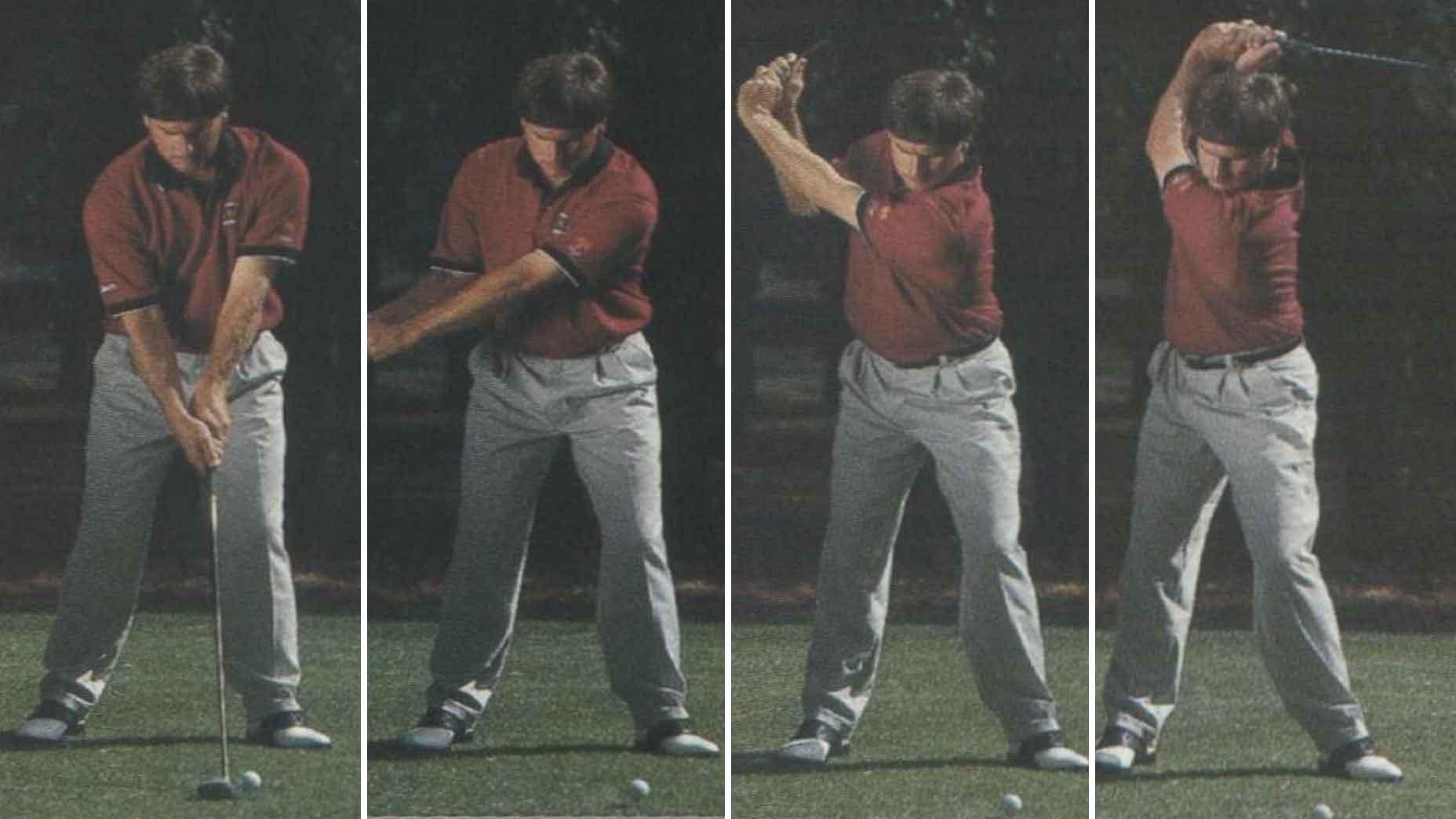
1. Address
Fred’s athletic setup prepares him to hit the ball long. His feet are slightly wider than shoulder width for stability and his knees are flexed. He stands about an inch farther away from the ball than normal, so he can extend his arms and make a huge turn.
2. Takeaway
Although he’s a long hitter, Boom Boom’s natural ball flight is a fade, so his first move away from the ball is noticeably outside the target line. At this point, he hasn’t turned his shoulders much, although he has begun his weight shift to the right side.
3. Three-quarters
Most amateurs would have finished the backswing at this point, but not Freddy. His wrists are fully cocked and his shoulders have turned 90 degrees — an ideal position for his iron shots — but for the driver, he strives for even more turn.
4. Top
Most amateurs would have finished the backswing at this point, but not Freddy. His wrists are fully cocked and his shoulders have turned 90 degrees — an ideal position for his iron shots — but for the driver, he strives for even more turn.
GOLF Magazine
5. Start of downswing
As he starts the downswing, Couples pushes off with the right foot to shift his weight back to the left side and clear the hips while his back is facing the target in a “torqued” position. The right elbow has dropped toward the right hip, an ideal move for any swing.
6. Downswing
Look at this power move! Couples’ left leg remains flexed and rock solid as it supports his weight shift. His upper body is unwinding as his hands and arms stay loose, dropping the club to the inside and producing an extreme cock of the wrists.
7. Impact
The moment of truth. Couples’ powerful leg drive doesn’t carry him ahead of the ball. His weight has moved smoothly to the left side, and the hips are clearing beautifully. His head is behind the ball, and his arms are extended in a powerful position at impact.
8. Follow-through
Couples’ spine angle remains constant throughout the swing, one reason he looks smooth, and a must for consistently square contact. As he extends into the follow-through, the club points slightly to the left of the target, consistent with his desire to play the fade.
Disclaimer : This story is auto aggregated by a computer programme and has not been created or edited by DOWNTHENEWS. Publisher: golf.com