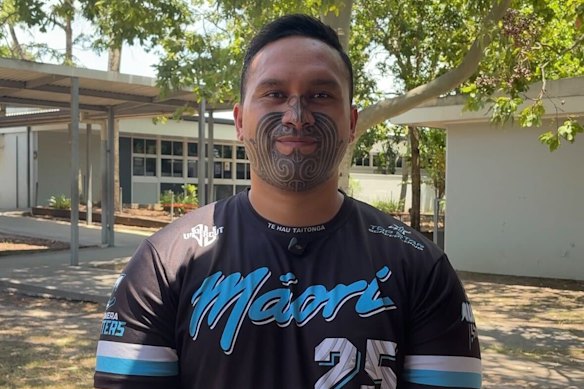

Tangaroa Hau-Hadfield has a simple rule for his three kids: when they’re in the car, they can only speak Te Reo Maori.
“Whether it’s a five-minute trip, a 20-minute trip, a two-hour trip, sometimes it makes the trip nice and quiet,” he says, laughing.
It’s just one way he’s working to keep the language and te ao Maori (Maori culture) alive in his Brisbane household.
“[We’re] grateful to be able to practise our culture here in another country because it’s a lost culture, a lost language, and so it’s our responsibility to get that back for us and for our kids.”
Like many of the almost 10,000 Kiwis who moved to Queensland in the last financial year, Hau-Hadfield came across the Tasman Sea in search of a better lifestyle.
He left Hokianga in Aotearoa/New Zealand’s far north over a decade ago to work in Australia’s mining industry. He then met his wife, and they welcomed three tamariki (children).
However, it took him five years to find his Brisbane whanau (family). That emerged as the competitive kapa haka group Te Kapa Haka o Te Kahu Ariki, based in Eagleby.
“We always say we’re more than a kapa haka group, it’s more so a family – we know what makes each other tick, what makes each other happy,” he says.
“This time last year, my partner and I were talking about moving back to New Zealand, and the only real thing that kept us here was our kapa haka group. That’s the commitment and the ties that we have to these people, and I’m happy that we chose to stay.”
The group formed in Brisbane three years ago to “keep our culture alive”, said leader Andre Ahipene.
“When one practises who they truly are through tradition and through culture, you become closer to the land in which you live on,” he said. “It’s a lifestyle.
“We’re very fortunate and privileged that our mana whenua – the people of this land, our Indigenous peoples – really support our consistency and being able to practise who we are.”
Co-leader Gaylene Ahipene added: “To have someone [who] understands you, to speak the same language, to think the same thoughts … it helps us really stay connected, not only to ourselves but to one another, and in this world that we live in, it helps us be very grounded.”
The couple moved to Brisbane almost two decades ago to “have a break” from their world. But just days after they arrived, they found themselves doing haka.
“It was inevitable that haka was never going to let us get away from who we truly are. This is truly … a lifestyle. We would not be as healthy, as well, and as vibrant as we are – fit and able – if we didn’t have haka in our life. I think we would seize up,” Andre said.
“Haka has been our oranga, our fountain of youth, and the spring in our step in life.”
The group is in the thick of rehearsals for the upcoming 10th Australian Maori Kapa Haka Festival, taking place on the Gold Coast at the end of March.
They will be one of nine groups vying for the chance to compete in the largest traditional Maori performing arts celebration in the world, Te Matatini 2027 in Waikato.
“That would be life-changing, especially for our members as well, they’ve worked so hard here, but to actually go home and stand on your own whenua [land], to perform with your own people, it just takes it that whole other step higher,” Gaylene said during a Sunday rehearsal.
“That would be our kapa, our members, our ropu [group] retracing their ancestral steps home,” Andre added.
Large-scale opportunities like this for Maori living in Brisbane to connect are rare. Andre hopes developmental conferences and language retreats will become more frequent, as many Maori come to Queensland for better employment opportunities and to “get ahead in life”.
“What I believe would mobilise us extremely would be opportunities to come together and unite, so our people can consistently find us,” he said.
But for Hau-Hadfield and the Ahipenes, the continuation of te ao Maori in Brisbane is for their children.
“They just come in the space and they’re sponges, they pick things up just as fast as we do – or probably even faster,” Hau-Hadfield explained.
“[We’ve] had our four children here, it’s evolution – we’re evolving with the time, and we’re just bringing our babies along,” Gaylene said.
Start the day with a summary of the day’s most important and interesting stories, analysis and insights. Sign up for our Morning Edition newsletter.
From our partners
Disclaimer : This story is auto aggregated by a computer programme and has not been created or edited by DOWNTHENEWS. Publisher: www.smh.com.au