On a warm afternoon in Gunawad village in Madhya Pradesh’s Jhabua district, a group of women sit in a circle beneath the shade of a neem tree, discussing issues affecting their community.
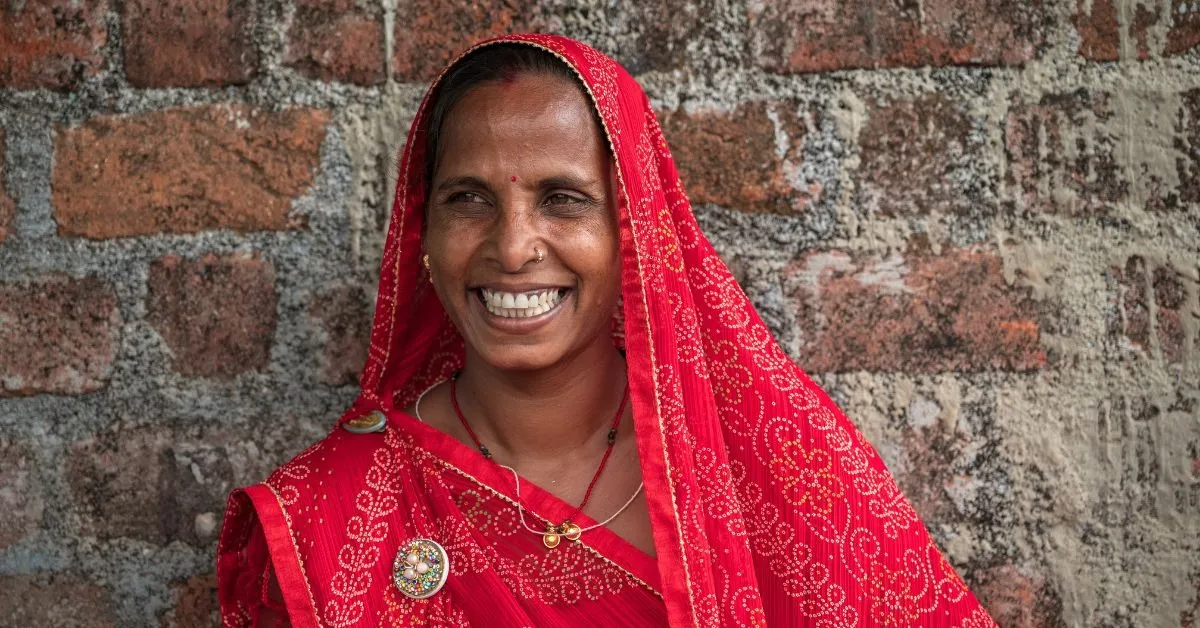
At the centre of the conversation is Chanda Bhabhar(32), listening closely and occasionally stepping in to guide the discussion.
For many in the village, she has become the person people turn to when something needs fixing, whether it’s accessing a government scheme, resolving pension paperwork, or raising concerns in the Gram Sabha.
But Chanda doesn’t see herself as a leader.
“I only try to help people with whatever problems they bring,” she tells The Better India.
“Sometimes it is about medical paperwork or pensions, sometimes about explaining what schemes are available. If someone comes to me with a problem, I try to find a way.”
Today, Chanda is known as a Panchayat Badlav Didi — a grassroots governance changemaker trained through Transform Rural India (TRI).
The initiative equips rural women with the knowledge and confidence to engage with local governance systems and ensure communities receive the services they are entitled to.
But Chanda’s journey to this role was far from obvious.
Finding her voice beyond the home
Born and raised in a rural household, Chanda grew up with limited opportunities for education. She studied until the eighth grade but could not continue after failing her exams.
She was married in 2007, before turning 18, and moved to Gunawad. Like many young brides, her life centred on household responsibilities. But quietly, she carried a desire to do something more.
“I always felt that I should step outside and do some work of my own,” Chanda says. “I wanted to contribute in some way, but I didn’t know how.”
That opportunity arrived in 2018 when she participated in a visioning exercise organised by TRI, where women were encouraged to think about the future of their community and their own role in shaping it.
For Chanda, the experience was eye-opening.
While many spoke about livelihoods or infrastructure, she began asking a different question: why were government schemes failing to reach people even when they existed?
She soon realised the problem wasn’t always resources, it was information, participation, and accountability.
Determined to change this, Chanda joined TRI’s Panchayat Badlav Didi training programme, which ran through a series of workshops between 2018 and 2019.
“At first, people even questioned why I was going for the training,” she remembers. “Some said, ‘What change will you bring?’ But I stayed focused and continued.”
Gradually, the training changed how she saw both her village and herself.
“I learned how planning happens in a village, how decisions are taken, and how we can raise issues; all of this gave me a lot of confidence,” she says.
With that confidence came a realisation: if someone didn’t step forward to ask questions and push for solutions, the system would remain unchanged.
Chanda decided she would be that person.
Learning governance and the power to question it
For Chanda, the training was not just about attending sessions; it was about understanding how the system around her worked.
The programme brought together rural women to learn governance from the ground up.
/filters:format(webp)/english-betterindia/media/media_files/2026/04/01/chanda-bhabhar-tri-2026-04-01-18-41-00.jpg)
“It was about understanding the basics of governance,” explains Rohit Yadav, Associate Practitioner at Transform Rural India. “From understanding the role of sarpanch to the workings of Gram Sabha, eligibility of schemes, women learnt everything and could guide their communities better,” he says.
The training also focuses on building perspective and confidence among women stepping into leadership roles for the first time.
“There is a module called the Perspective Building Module,” Rohit says. “It helps women realise why they want to become Panchayat Badlav Didis and how they can take responsibility for their villages.”
At the heart of the programme is a “visioning exercise”, where women collectively imagine the future of their communities.
“The objective is to understand the aspirations of women,” explains Mansi Dalal, Associate Practitioner with Transform Rural India.
“Most communities have never had the chance to create a roadmap for the future. Through this exercise, they prepare a five-year vision for their village — identifying the issues they want to solve and the changes they want to see.”
These discussions often surface problems that go beyond infrastructure, issues like alcohol abuse, domestic violence, and lack of participation in governance.
“When women speak openly during these discussions, many social challenges come forward,” Rohit says. “And sometimes two or three women from the group step forward and say they want to work on these issues for the village.”
Chanda was one of those women.
“What stood out about her was her willpower,” Mansi adds.
“Many people attend training, but only a few truly take ownership. In Chanda’s case, it was very clear that she genuinely wanted to bring change in her village.”
The training gave Chanda something she had never had before: the confidence to ask questions.
“At the sessions, we learned how planning happens in the village and how issues can be raised,” Chanda says. “Once I understood that, I realised we could actually solve many problems if we worked together.”
Soon, an opportunity to put those lessons into action arrived.
Fixing a broken health system
In Gunawad, healthcare services were inconsistent and unreliable.
The village’s Auxiliary Nurse Midwife (ANM), responsible for vaccinations and maternal health services, was posted from another block and visited only occasionally. As a result, many children missed critical vaccinations and pregnant women did not receive regular care.
/filters:format(webp)/english-betterindia/media/media_files/2026/04/01/chanda-bhabhar-tri-2026-04-01-18-41-46.jpg)
For years, villagers had raised concerns, but nothing changed.
Chanda decided to approach the issue differently.
“We gathered the women from our Self-Help Groups and discussed the problem,” she recalls. “Everyone shared what they were facing.”
Together, the women documented their concerns and drafted a formal application outlining the risks the village was facing. Copies were submitted to the Village Organisation, the panchayat, and the Janpad office.
It was a simple but strategic step, one Chanda had learnt during her training.
Soon after, authorities acknowledged the issue, and a new ANM was appointed for the village. Regular vaccination sessions resumed, ensuring children and pregnant women could access the healthcare they needed.
“That was when people realised that if we raise our voices properly, change can happen,” Chanda says.
Stories like Chanda’s are reflected in the lives of many villagers who have directly benefited from her efforts. For elderly residents, like Somla and Ganga from Gunawad village access to basic entitlements like pensions — once a frustrating process — has become simpler and more reliable.
“For a long time, we faced repeated challenges in accessing our old-age pension. Despite having all the required documents, we had to visit the Panchayat multiple times without receiving the right information or support,” says Somla.
During that time, she met Chanda Didi, who listened to the concerns patiently and guided us through the correct process.
“With her support, we reapplied and ensured that everything was completed properly. As a result, our pension was finally approved, and we now receive Rs 600 every month that helps us manage our daily expenses,” she adds.
Leading through fear during the pandemic
Just as Chanda was gaining confidence in her role, the COVID-19 pandemic brought a new challenge.
In 2021, fear and misinformation about vaccines spread quickly through rural communities. Many families in Gunawad were hesitant to get vaccinated.
/filters:format(webp)/english-betterindia/media/media_files/2026/04/01/chanda-bhabhar-tri-2026-04-01-18-45-10.jpg)
“People were very scared,” Chanda recalls. “Everyone was worried about what might happen if they took the vaccine.”
With support from TRI team members who explained the science behind the vaccine, Chanda began speaking to villagers about its importance.
But she knew words alone might not be enough.
So she took the first step herself.
“I decided I would get vaccinated first so that people could see there was nothing to fear,” she says.
The gesture made a powerful impact.
As villagers saw her confidence, many began reconsidering their fears. Gradually, families came forward for vaccination, and Gunawad eventually achieved 100 percent COVID vaccination.
“It showed real leadership,” Mansi says. “When she got vaccinated first, people trusted her and followed.”
Shutting down the liquor shop
As Chanda continued working with women in the village, another issue repeatedly surfaced in conversations, alcoholism.
The presence of a local liquor shop was fuelling domestic violence and disrupting families.
“I saw many homes breaking because of alcohol,” Chanda says. “Men would drink and then beat their wives and children. It created a lot of chaos in the village.”
Determined to address the issue, Chanda once again turned to collective action.
/filters:format(webp)/english-betterindia/media/media_files/2026/04/01/chanda-bhabhar-tri-2026-04-01-18-42-32.jpg)
Women from Self-Help Groups discussed the problem and decided to raise it formally in the Gram Sabha. With their support, Chanda drafted a proposal requesting the closure of the liquor shop.
Before submitting it, the women approached the sarpanch.
“We asked him if he would support us, and he agreed,” she says. With signatures from villagers and the backing of local leaders, the proposal was submitted to authorities in 2024.
The process took nearly two months and faced resistance from shopkeepers. Eventually, however, the shop was shut down.
The impact was visible almost immediately.
“There are fewer fights now,” Chanda says. “Earlier there was a lot of chaos. After the shop closed, things became calmer.”
Through her work, Chanda has helped mobilise around 500 women across 43 Self-Help Groups, along with representatives from 29 Village Organisations under the Krishna Bhagwan Cluster Level Federation.
But for Chanda, the recognition she now receives from her village feels most meaningful.
“I feel very blessed, earlier people doubted me. Now even elders come to me for advice,” she adds.
Becoming the change she once dreamed of
Today, in Gunawad, Chanda Bhabhar is no longer the quiet young bride who once wondered whether her voice would matter. She is a trusted community leader.
Her husband, Dasrath Bhabhar (38), remembers the early days when Chanda first began attending meetings and training sessions.
/filters:format(webp)/english-betterindia/media/media_files/2026/04/01/chanda-bhahar-tri-2026-04-01-18-44-00.jpg)
“I used to take her to the meetings and send her for the trainings,” he recalls. “In the beginning, people didn’t support her. They would talk and question what she was doing. But gradually they started understanding.”
At home too, her growing confidence reshaped everyday dynamics.
“Now she takes many decisions herself,” Dasrath says. “We discuss things together, but she makes many decisions.”
Watching her efforts transform the village has been a source of pride for him.
One of the most visible changes, he adds, came after the closure of the liquor shop.
“Earlier many people used to drink,” he says. “After the shop closed, alcohol consumption reduced and some people even stopped drinking completely. Families are more peaceful now.”
For Dasrath, Chanda’s journey also carries an important message.
“Husbands should support their wives,” he says simply. “If we encourage them and allow them to step forward, they can do a lot for the village.”
Chanda’s story is part of a larger grassroots movement led by Transform Rural India. Through initiatives like the Panchayat Badlav Didi programme, the organisation has empowered more than 3,000 women leaders across blocks such as Bijadandi, Budni, Khategaon, Petlawad, Thandla, Sondwa, Manawar, and Rajpur to engage with governance and strengthen community institutions.
In Gunawad, the ripple effects are already visible. Women participate more actively in Gram Sabha meetings, villagers are better informed about government schemes, and communities increasingly work together to solve local problems.
If there is one message she hopes other women take from her journey, it is simple:
“If I can do it, others can too. All we need is the courage to step forward and work for our village.”
All images courtesy TRI team
Disclaimer : This story is auto aggregated by a computer programme and has not been created or edited by DOWNTHENEWS. Publisher: thebetterindia.com