The Islamic holy festival of Ramadan begins on the evening of February 18th. From a light display in Frankfurt to an interfaith dinner in Nuremberg, and gatherings in Cologne, here’s how people in Germany are celebrating.
Ramadan is one of the holiest times of the year for the some 1.9 billion Muslims around the world, representing a time of deep reflection, community, prayer and fasting.
This year it starts on the evening of Wednesday, February 18th, with the month of fasting beginning the following day. The religious festival concludes on the evening of March 20th with the beginning of Eid al-Fitr.
Germany is home to around 5.5 million people belonging to the Muslim faith, with about half of them (nearly three million) holding German citizenship, according to the Deutsche Islam Konferenz.
In total, people of Muslim faith comprise about 6.6 percent of Germany’s total population. After the roughly 45 million members of Christian churches (50 percent of the total population), Muslims constitute the second-largest religious group in Germany by a considerable margin.
How are Muslims in Germany celebrating this year?
Ramadan commemorates the period when the Quran is believed to have first been revealed to the Prophet Muhammad by the angel Jibreel. For Muslims, this revelation marked a turning point of spiritual guidance and hope for humanity. Fasting is seen as a way to deepen faith and reflection.
During the month, Muslims across the world who observe the fast refrain from eating and drinking from dawn to dusk, typically for a period of 12 to 15 hours, depending on their location.
Their day is usually structured around two meals: suhur, eaten before dawn, and iftar, the evening meal that breaks the fast. Iftar is often a communal occasion shared with family and friends, and traditionally begins with dates.
In German cities, bakeries and restaurants prepare special foods and sweets for the month.
Families may also buy Ramadan calendars for children for the countdown to Eid, which are available in shops including DM and major supermarkets.
Across Germany, Muslim groups organise large open iftar events during Ramadan, with many welcoming people of all backgrounds and faiths.
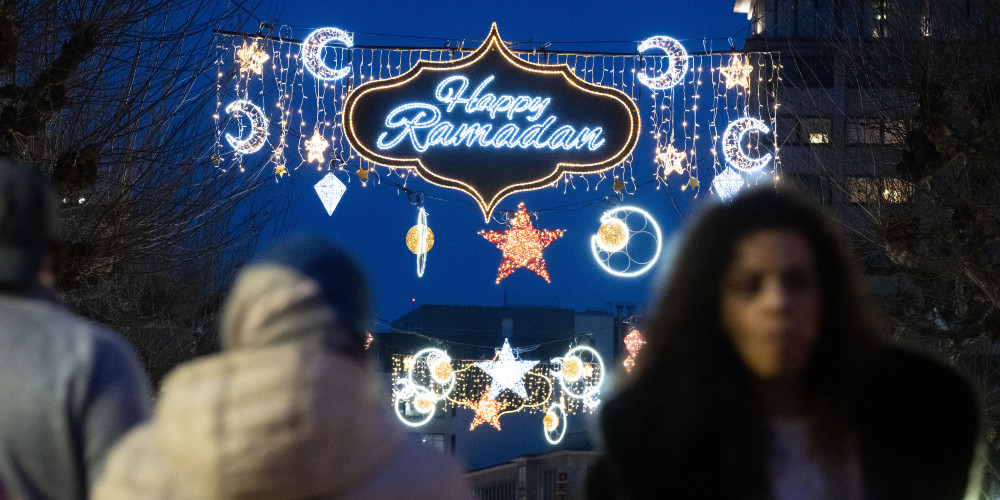
For the third year in a row, Frankfurt has a special light display for the religious festival in the city centre. Crescent moons, stars and lanterns hang above the city’s pedestrian area known as Freßgass, along with the words ‘Happy Ramadan’.
City politicians see the light installation as a symbol of Germany welcoming diversity. The banking city is thought to be home to around 130,000 Muslims.
READ ALSO: Where do the majority of foreigners live in Frankfurt?
Ramadan lights on display in Frankfurt. Photo: picture alliance/dpa | Boris Roessler
Under the motto ‘Ramadan Mosque Life’, the Mosque Forum in Cologne is bringing cheer and community to the University of Cologne this year. From February 19th to March 19th, the mosque will distribute freshly prepared iftar meal packages every day from 5pm to 6.30pm in the Philosophikum of the university. The meals are free and the service is aimed at students and lecturers.
In Berlin, a Halal Food Festival is scheduled on March 6th and March 7th. Under the motto ‘Ramadan meets cyberpunk’, guests can break their fast at one of the food stalls stationed on the Gesundbrunnen-Center rooftop. Expect games, entertainment, mocktails and time to relax with members of the community.
A networking event also takes place in the capital on February 21st. The Muzz Ramadan Iftar Event encourages young Muslim professionals to get together at the Taftan Restaurant in Berlin.
In Nuremberg, the ESG (Evangelical Student Community), in cooperation with Brücke-Köprü and the Ahmadiyya Muslim Community of Nuremberg are hosting an interfaith dinner. The event begins at 5.30pm on March 12th at the Brücke-Köprü.
After the meal, participants are encouraged to talk about what this time of year means to them whether they’re fasting as a Muslim, taking part in Lent as a Christian or are not religious. Those attending should register by March 9th.
Then comes Zuckerfest...
After Ramadan ends, Muslims mark Eid al-Fitr, also known as the Festival of Breaking the Fast. It lasts from March 20th to March 22nd.
The three-day event is also called Zuckerfest (sugar festival), as families often rush out to purchase a large selection of tasty food and sweets to enjoy following the fasting month.
Events are held across the world, including in Germany. In Berlin’s Neukölln district, for instance, a Zuckerfest will take over Hermannplatz on March 21st with music, dance and delicious snacks.
In some German states, practising Muslims can get a paid day off work for Eid celebrations.
READ ALSO: INTERVIEW – ‘People in Germany only know about Muslims from the media’
How do you greet Muslims during this time?
To wish someone a happy Ramadan, you can say: “Ramadan Mubarak” (Blessed Ramadan) or “Ramadan Kareem” (generous Ramadan).
In the evening during the fast, you may also want to say: Frohes Iftar or Guten Appetit (Happy Iftar / Enjoy your meal) to Muslim friends or colleagues.
At the end of Ramadan, you can say: Eid Mubarak!
Do you know of any other Ramadan events happening in Germany? Please share in the comments.
Disclaimer : This story is auto aggregated by a computer programme and has not been created or edited by DOWNTHENEWS. Publisher: thelocal.de