
India depends heavily on imported energy. A significant portion of the crude oil and natural gas it buys from abroad travels through the Strait of Hormuz — one of the world’s most strategically sensitive waterways.
That exposure does not mean India is entirely reliant on the route. But it is large enough to raise a practical question for everyday consumers: what happens to petrol and LPG prices if tensions rise there?
To answer that, we need to look beyond headlines and trace how a cooking gas cylinder and a litre of petrol actually reach your home.
The fuel in your vehicle and the LPG cylinder in your kitchen may feel entirely local. But their journey often begins thousands of kilometres away — and sometimes passes through a narrow stretch of water just 33 kilometres wide.
How one LPG Cylinder and a litre of petrol connect India to the Strait of Hormuz
When you book an LPG cylinder or refill your bike with petrol, the transaction feels local. A delivery agent arrives. A fuel pump clicks. You pay and move on.
But part of what you’re paying for may have travelled through one of the most strategically important stretches of water in the world: the Strait of Hormuz.
This narrow sea passage, located between Iran and Oman, connects the Persian Gulf to the Arabian Sea. It is just about 33 km wide at its narrowest point — yet it carries nearly 20 million barrels of oil per day, roughly one-fifth of global petroleum liquids consumption, according to the U.S. Energy Information Administration (EIA).
So what does that mean for India? How dependent are we on oil passing through this route — and should everyday consumers worry?
Let’s trace one LPG cylinder and one litre of petrol backwards to understand the answer.
Your LPG cylinder’s long journey
but when traders believe something might happen. Photograph: (Shutterstock)
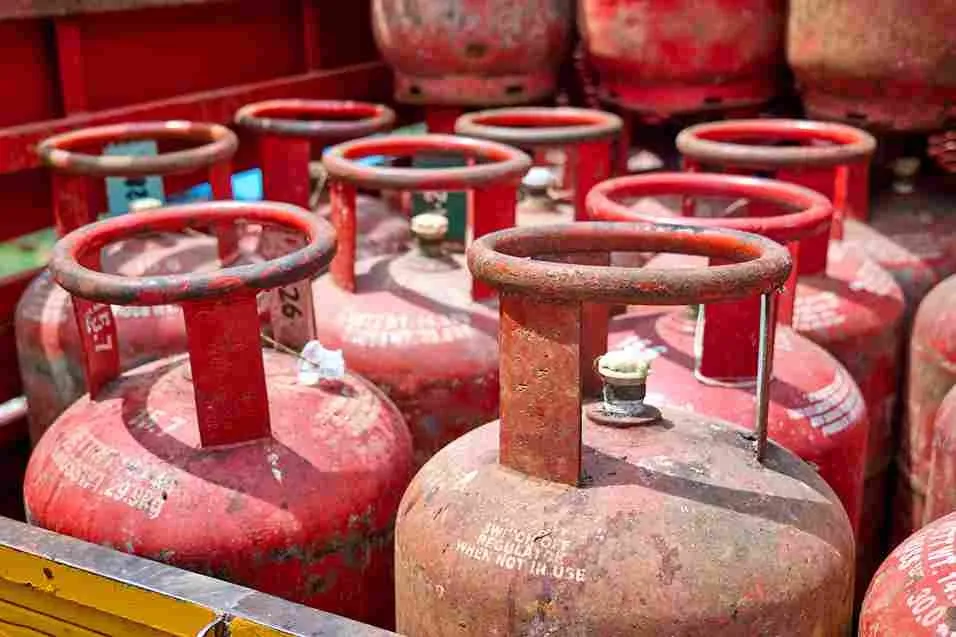
LPG — liquefied petroleum gas — is primarily a mix of propane and butane. While India produces some LPG domestically through refineries and gas processing plants, a significant share is imported.
India is among the world’s largest LPG markets, and domestic demand has grown steadily over the past decade due to expanded household access.
A large portion of India’s LPG imports has historically come from Gulf countries such as the UAE, Qatar, Saudi Arabia and Kuwait. Cargoes from these producers must exit the Persian Gulf via the Strait of Hormuz before reaching India.
These cargoes travel on specialised gas carriers designed to transport liquefied petroleum gas under pressure. After exiting the Strait of Hormuz, the vessels cross the Arabian Sea and dock at Indian ports, where the LPG is unloaded into storage terminals. From there, it is sent to bottling plants, filled into cylinders and distributed to households.
This journey — from Gulf export terminal to Indian kitchen — can take days or even weeks, depending on shipping schedules and port logistics.
While India has begun diversifying its LPG sourcing — including long-term supply agreements with the United States that account for roughly 10% of annual imports — a majority of India’s imported LPG still originates from Gulf suppliers whose shipments transit the Strait of Hormuz.
That means a substantial share of the LPG used in Indian households remains linked to the stability of this route, even as diversification efforts gradually reduce that dependence.
Petrol starts as Crude Oil
/filters:format(webp)/english-betterindia/media/media_files/2026/03/02/shutterstock_2449541539_11zon-2026-03-02-15-22-26.jpg)
Now let’s look at petrol.
Petrol does not arrive in India ready to pump. It begins as crude oil, which is processed in Indian refineries.
India imported 232.5 million tonnes of crude oil in FY2023–24, and crude import dependence rose to nearly 87.7%, according to data from the Petroleum Planning and Analysis Cell (PPAC) reported by Business Standard and Mint.
Put differently, nearly nine out of every ten barrels of crude used in India come from overseas.
That crude oil is then refined into petrol, diesel, aviation fuel, LPG and other products.
You can think of it like a bakery that makes bread locally — but if almost all the flour is imported, the price of bread still depends on global wheat markets. Refining happens in India, but the raw material that determines cost begins its journey elsewhere.
India’s total petroleum product consumption in FY2023–24 stood at roughly 223 million tonnes, with diesel and petrol being major contributors to demand growth.
So when we talk about Hormuz and petrol prices, we are really talking about how much of India’s crude oil — the raw material — travels through that chokepoint.
So, how much of India’s oil passes through Hormuz?
/filters:format(webp)/english-betterindia/media/media_files/2026/03/02/shutterstock_2644702975_11zon-2026-03-02-15-22-26.jpg)
in Indian refineries. Photograph: (Shutterstock)
Estimates vary depending on the period and import mix, but here is a consistent range.
-
Around 35% to 50% of India’s crude oil imports may be linked to shipments passing through the Strait of Hormuz.
-
India sources about 42% of its LNG from Qatar, whose exports transit the Strait of Hormuz, according to reporting in the Economic Times citing government data. LNG is primarily used for city gas distribution, power and industry — not for petrol or household LPG cylinders.
Put simply, if India imports 100 tankers of crude oil, somewhere between 35 and 50 of them may pass through this narrow waterway.
The variation depends on how India’s crude sourcing shifts year to year. India has diversified suppliers in recent years, increasing purchases from countries like Russia and the United States. Some of these shipments do not depend on the Gulf transit route.
Roughly one-third to about half of India’s crude imports are linked to the Strait of Hormuz.
That is significant — but it is not total dependence.
Why markets react even if nothing “closes”
/filters:format(webp)/english-betterindia/media/media_files/2026/03/02/shutterstock_1650647857_11zon-2026-03-02-15-22-26.jpg)
Here is where it gets important for everyday consumers.
The biggest risk from tensions around Hormuz is not necessarily that petrol pumps will suddenly run dry. Instead, the more immediate effect is usually on prices.
Even the possibility of disruption can:
-
Raise global crude oil benchmark prices
-
Increase shipping and freight costs
-
Increase marine insurance premiums
-
Add uncertainty premiums to energy markets
Oil markets behave more like stock markets than grocery stores. Prices move not only when something happens but when traders believe something might happen.
For example, the EIA noted that during a period of heightened Middle East tensions in June 2025, Brent crude rose from $69 to $74 per barrel within a day — even though there was no actual closure of the Strait.
In other words, markets price risk quickly.
When crude becomes more expensive globally, it increases the cost of India’s imports. Over time, that can put upward pressure on petrol, diesel and LPG pricing environments.
So the link between Hormuz and your LPG bill is often indirect but real.
Should you be worried about fuel shortages or sudden spikes?
The data suggests that price volatility is more likely than physical fuel shortages. India does not rely on daily ship arrivals to keep petrol pumps running. Strategic reserves, commercial inventories and diversified sourcing provide buffers that cushion short-term disruptions.
Even during previous periods of global oil tension, supplies have continued — though prices have sometimes adjusted in response to global benchmarks.
That means consumers are more likely to see gradual price changes rather than sudden, nationwide fuel unavailability.
1. Strategic Petroleum Reserves (SPR)
Government data shows India has built strategic crude storage capacity of 5.33 million metric tonnes across Visakhapatnam, Mangaluru and Padur; based on the 2019–20 consumption pattern, this is estimated to cover about 9.5 days of India’s crude oil requirement, according to the Press Information Bureau. This refers to crude oil cover rather than finished petrol or diesel supplies.
Think of this as an emergency fuel savings account — designed not for daily use, but for unexpected shocks.
2. Commercial Stocks
In addition to government reserves, oil marketing companies maintain commercial inventories. Combined figures cited by government releases and the International Energy Agency (IEA) suggest India’s overall stock cover can amount to several weeks of net import cover under certain calculations.
It works like keeping essential groceries stocked at home. If supply trucks are delayed, you do not immediately run out because you already have staples in storage.
3. Supplier Diversification
India’s crude sourcing has evolved significantly over the past few years. Increased imports from Russia, the United States and other regions reduce complete reliance on Gulf shipments.
In energy terms, this is similar to not relying on a single supplier for household essentials — spreading risk across multiple sources.
4. Limited Bypass Pipelines
Some Gulf exporters have pipeline routes that allow partial bypass of Hormuz. However, these do not replace the full volume normally passing through the Strait.
In other words, there are side roads — but the main highway still carries most of the traffic.
Taken together, these buffers mean that even if disruptions were to occur, India would not automatically face an immediate nationwide fuel shortage.
The more likely impact — at least in the short term — would be price volatility rather than physical unavailability.
Putting It in perspective
Think of the Strait of Hormuz like a major highway interchange.
If traffic slows, trucks still move but delivery costs increase. And those costs eventually reach consumers.
As long as vehicles can still pass through the interchange, supplies continue. But congestion makes the journey more expensive.
India’s energy story today is one of high import dependence but growing resilience. With crude import dependence at nearly 88%, global oil markets will always matter. But diversification, reserves and evolving supply chains mean the situation is more nuanced than a simple “if Hormuz closes, India stops” narrative.
How does India compare with other Asian countries?
India is not the only major economy dependent on oil that passes through the Strait of Hormuz.
According to the U.S. Energy Information Administration (EIA), the majority of crude oil and condensate moving through the Strait of Hormuz is destined for Asian markets. In recent years, countries like China, Japan, South Korea and India together account for the largest share of Hormuz-linked imports globally.
Japan and South Korea, in particular, have historically relied heavily on Middle Eastern crude for the majority of their oil needs. China, the world’s largest crude importer, also sources substantial volumes from Gulf producers whose shipments transit Hormuz.
In fact, in several periods over the past decade, East and South Asian economies collectively accounted for well over half of total crude oil flows through the Strait, according to EIA transit data.
In 2024, the U S Energy Information Administration estimated that 84% of crude oil and condensate and 83% of LNG moving through the Strait of Hormuz were destined for Asian markets.
Put differently:
If Hormuz were disrupted, it would not be a country-specific issue — it would be a broader Asian energy challenge.
This comparative lens matters.
India’s crude import dependence — close to 88% — is high. But countries like Japan and South Korea import nearly all of their crude requirements. China imports a large share of its oil as well, though with a more diversified supplier base.
In that context, India’s exposure to Hormuz-linked crude — roughly one-third to one-half of imports — is significant, but not exceptional within Asia.
This is important for two reasons:
-
It means any disruption would likely trigger coordinated global responses, not isolated national crises.
-
It also explains why global oil markets react quickly — because multiple large Asian economies are watching the same chokepoint.
In short, Hormuz is not “India’s vulnerability.” It is a shared energy artery for much of Asia.
The Bottom Line
-
The Strait of Hormuz carries about 20% of global petroleum liquids consumption.
-
Roughly one-third to about half of India’s crude imports are linked to this route.
-
A significant share of LNG and some LPG imports are also exposed.
-
The most immediate risk from disruptions is price spikes, not empty petrol pumps.
-
India maintains strategic reserves and diversified sourcing to cushion short-term shocks.
So, what should you actually watch?
India is connected to the Strait of Hormuz but that doesn’t mean fuel will suddenly disappear from pumps or LPG cylinders will stop arriving. A meaningful share of the oil India imports passes through this route, which means global tensions can influence prices. But the effects usually show up gradually, not overnight.
If you’re trying to understand what matters next, here’s what to keep an eye on:
-
Petrol and diesel price trends: Don’t panic over a single day’s change. What matters is whether prices keep rising steadily over several days or weeks.
-
Global crude oil prices (like Brent): If international oil prices climb and stay high, Indian fuel prices may eventually reflect that.
-
News about tanker movement: Actual shipping delays or blocked routes are more serious than political statements alone.
-
Government announcements on fuel taxes or pricing: Sometimes the government adjusts duties to cushion price increases.
-
No sudden rush at petrol pumps: If supplies were truly disrupted, you would see visible shortages. That is not the same as prices adjusting.
In simple terms: for most Indian households, the bigger risk is higher fuel bills — not empty fuel stations.
The Strait of Hormuz may be far away, but it’s part of the journey your energy takes. And while India is exposed to global markets, it also has systems in place to manage shocks.
Sources
‘Crude oil import bill drops 16% but import dependency hits new peak‘: by Reuters, Published in Business Standard on 17 April 2024.
‘Amid regional conflict, the Strait of Hormuz remains critical oil transit chokepoint‘: Published in Energy Information Administration on 16 June 2025.
‘Closure of Strait of Hormuz threatens 35% of India’s crude and 42% of LNG imports‘: by Saurav Anand, Published in Energy News/Economic Times on 23 June 2025.
‘India oil market report: Executive summary’: Published in the International Energy Agency. (2024).
‘India’s crude oil consumption up 4.6% in FY24; imports steady, says PPAC‘: By Nikita Prasad, Published in Mint on 23 April 2024.
‘Government of India agrees to release 5 million barrels of crude oil from strategic reserves‘: Published on 23 November 2021 in Press Information Bureau.
‘Government steps to strengthen strategic petroleum reserves‘: Published on 20 March 2025 in Press Information Bureau.
‘With 50% of India’s crude imports passing through Strait of Hormuz, concerns mount over US-Iran standoff‘: By Udit Bubna, Published in The Print on 25 February 2026
‘Oil prices rose sharply amid heightened Middle East tensions‘: Published in Energy Information Administration on 13 June 2025.
Disclaimer : This story is auto aggregated by a computer programme and has not been created or edited by DOWNTHENEWS. Publisher: thebetterindia.com





