Hollywood moguls once dismissed the outsize ambitions of Netflix’s executives.
“Is the Albanian army going to take over the world?” former Time Warner Chairman Jeff Bewkes asked a reporter 15 years ago. “I don’t think so.”
Think again. On Friday, Netflix co-Chief Executive Ted Sarandos pulled off an audacious $82-billion deal to buy much of Bewkes’ old haunts: the Warner Bros. film and TV studios in Burbank, and HBO and the HBO Max streaming service in Culver City.
“This is a rare opportunity,” Sarandos said in an investor call. “It’s going to help us achieve our mission to entertain the world and to bring people together through great stories. We’ve built a great business, and to do that, we’ve had to be bold and continue to evolve.”
If the takeover is approved — it could face a raft of legal and regulatory challenges — Netflix would gain ownership of such classics as “Casablanca” and “Goonies” and popular characters including Batman, Scooby-Doo, Dirty Harry and Harry Potter.
The acquisition represents a moment of triumph for the brash Sarandos, who has gone from Hollywood gate-crasher to the ultimate power broker.
“There seems to be no ceiling of opportunity for Ted Sarandos,” said Tom Nunan, a former studio and network executive. “He’s the king of Hollywood.”
Netflix’s victory in the auction for Warner Bros. stunned many in Hollywood who figured Paramount — whose bid was backed by the one of the world’s wealthiest men, Larry Ellison — had a lock on the prized Warner assets.
Even Netflix’s brass downplayed their merger ambitions as recently as two months ago. Co-Chief Executive Greg Peters shrugged off any interest at a Bloomberg conference, saying: “We come from a deep heritage of builders rather than buyers.”
But the streaming giant’s dominant market position and strong balance sheet allowed it to assemble a largely cash bid that wowed Warner Bros. Discovery’s board, which voted unanimously in favor. What’s more, Netflix agreed to absorb more than $10 billion of Warner Bros.’ debt, bringing the deal’s total value to $82.7 billion.
Warner shareholders and U.S. and foreign regulators still must approve Netflix’s takeover. Netflix — which is based in Los Gatos but has a large presence in Hollywood — said it expects the deal will close within a year to 18 months.
Netflix, however, already is facing stiff opposition from cinema chains, lawmakers, prominent creatives and labor unions. The Writers Guild of America said the deal should be blocked.
“The world’s largest streaming company swallowing one of its biggest competitors is what antitrust laws were designed to prevent,” the WGA said.
A career of defying convention
If it succeeds, the takeover would be a triumph for Sarandos, the company’s often controversial co-CEO who has been responsible for Netflix’s content operations since 2000. Until recently, he was seen as a disruptor who upended the industry’s long-standing business models, especially its reliance on the big screen.
It’s a remarkable trajectory for the 61-year-old Phoenix native and movie buff, who once clerked in a strip mall video store, joining Netflix when it was a scrappy Silicon Valley startup distributing DVDs through the mail in red envelopes.
Company co-founder Reed Hastings was impressed by Sarandos after he struck a first-of-its-kind revenue-sharing deal with Warner Bros. as an executive at West Coast Video/Video City retail chain.
Sarandos has been in charge of Netflix’s content operations ever since.
One of five children, he’s the son of an electrician and a stay-at-home mom who left the TV on all day.
While working at the video store, Sarandos earned a reputation for giving great movie recommendations to customers based on what they liked to watch. In many ways, he was a human version of Netflix’s now famous recommendation algorithm.
Sarandos spent his first three years at Netflix working out of his bedroom in Los Angeles. Hastings and Sarandos’ enterprise was largely responsible for bankrupting the then-dominant video rental chain, Blockbuster.
His knack for knowing what audiences want was instrumental in Sarandos’ ascent at Netflix and Hollywood: Netflix now has more than 301 million subscribers, and it could grow even more.
Analysts estimate the acquisition could add an additional 100 million customers to the streaming service — a bounty that is expected to draw the attention of antitrust regulators.
Over time, the company shifted to streaming licensed TV and films, but as studios started to pull away from those deals, Netflix began its foray into original content.
Again, Netflix wasn’t taken too seriously at first. Sarandos would get TV show scripts with signs of rejection — coffee stains and smudged fingerprints — but his gamble on buying the rights to David Fincher’s political thriller, “House of Cards,” starring Kevin Spacey and Robin Wright, in 2011 changed that.
Sarandos walked into Fincher’s office and offered him a provocative deal: Netflix would commit to the first two seasons of “House of Cards” without seeing a pilot for $100 million.
“There were 100 reasons not to do this with Netflix,” Sarandos told The Times in 2013. “We had to give them one great reason to do it with Netflix.”
Sarandos has made a career out of defying convention.
Under his leadership, Netflix released episodes to shows all at once, allowing people to binge watch an entire season. The platform greenlighted full seasons of shows even before they began, and older series like “Friends” and “The Office” found new audiences years after they ended on network television.
He made bets on series that other traditional studios passed on, including the popular sci-fi show “Stranger Things,” which would become a global hit with its own universe of characters, like “Star Wars.”
Some studios were hesitant to give the show’s creators, Matt and Ross Duffer, first-time showrunners, the reins. Typically, Netflix and Sarandos thought differently.
“They read it, they got the project, and they wanted me and Ross to be involved as showrunners and to direct, and that completely changed our lives,” said Matt Duffer on stage at the L.A. premiere of the final season of “Stranger Things” in Hollywood this month.
“Ted made that decision all the way back then, 2015, and that’s why we’re here today,” he said.
Over time, Netflix became a place where talent wanted to pitch their shows.
“The goal is to become HBO faster than HBO can become us,” Sarandos told GQ in 2013.
Soon, Sarandos might be in charge of HBO.
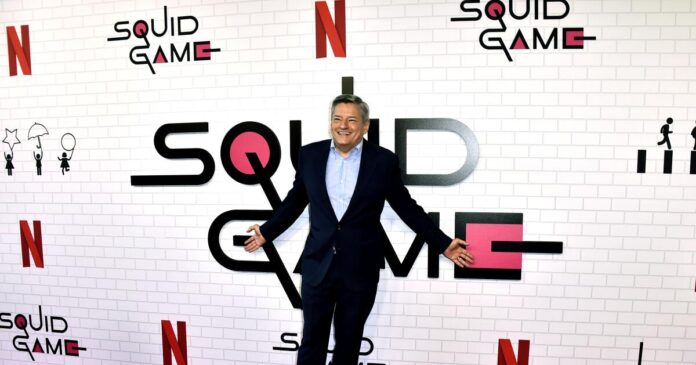
Netflix expanded its reach globally, creating a production pipeline abroad. Its biggest international hits include 2021 Korean language series “Squid Game,” Netflix’s most popular show of all time, with its first season generating 265.2 million views in its first three months.
But as Netflix’s strategy changed the Hollywood landscape, it also angered theater owners and competitors who were upset that the streamer was playing by different rules that challenged long-standing practices in the entertainment industry.
Sarandos in particular has taken direct aim at the traditional practice of releasing movies in theaters first — and keeping them there for months before making them available for home viewing.
Netflix generally releases movies in theaters only for short periods in order to appeal to fans or qualify for awards. They appear on its platform shortly after they debut in theaters.
Sarandos was promoted from chief content officer to co-CEO in 2020, running the company with Hastings, who had previously served as Netflix’s CEO.
The duo faced their biggest challenge in 2022, when Netflix’s subscriber numbers plunged by 200,000 subscribers in its first quarter, the first decline in more than a decade.
Analysts feared that the streaming revolution was over and Netflix had reached a ceiling to its growth.
But Netflix was able to find new revenue streams by cracking down on password sharing and entering new areas of business it previously overlooked, including advertising and live events like sports, including NFL football.
In 2023, Hastings stepped down from his role to be executive chairman, and Peters, chief operating officer, was named to the co-CEO role.
Today, Netflix is widely heralded as the winner of the streaming wars years after many rivals tried to enter into the space, putting the company in an ideal position to make a significant cash and stock bid for the Warner Bros. Discovery assets it was seeking.
Unlike many of its competitors, Netflix is profitable — the company generated $2.5 billion in net income in the third quarter, up 8% from a year earlier.
Netflix has offered Warner Bros. Discovery shareholders $23.25 in cash and $4.50 of Netflix stock for each share. In September, before Paramount started the bidding, Warner Bros. was trading around $12.
“These assets are more valuable in our business model, and our business model is more valuable with these assets,” Sarandos said in a call with investors on Friday.
If the deal is approved, Netflix would be the third owner of Warner Bros. and HBO in a decade. On the call, Peters addressed his earlier critique that most big media mergers fail.
“We understand these assets that we’re buying,” Peters told investors on Friday. “Things that are critical in Warner Bros. are key businesses that we operate in, and we understand a lot of times, the acquiring company, it was a legacy, non-growth business that was looking for a lifeline. That doesn’t apply to us. We’ve got a healthy, growing business.”
Sarandos expressed confidence the deal would go through.
“This deal is pro-consumer, pro-innovation, pro-worker, pro-creator, pro-growth,” Sarandos told investors. “Our plans here are to work really closely with all the appropriate governments and regulators, but really confident that we’re going to get all the necessary approvals that we need.”
Sarandos is one of Hollywood’s most well-compensated CEOs, with a package that was valued at $61.9 million in 2024.
Long seen as friendly to talent, he has weathered some controversies over the years.
During dual strikes in 2023, writers and actors complained bitterly about how Netflix was compensating them for their work on streaming shows.
Sarandos was seen as one of the key Hollywood players in helping bridge the gap. One of the outcomes of the strikes was studios including Netflix would release viewership data to the unions and give bonuses to talent based on certain viewership metrics.
In 2021, Sarandos faced internal backlash within Netflix when some employees organized a walkout over transphobic comments said on comedian Dave Chappelle’s special “The Closer.” Sarandos had stood by the comedian, saying in a staff memo that “content on screen doesn’t directly translate to real-world harm.” But days later he told Variety that “I screwed up that internal communication.”
“I should have led with a lot more humanity,” Sarandos said.
Despite its dominance in streaming, Netflix continues to face challenges from other forms of entertainment, including YouTube and social media sites like TikTok or gaming communities like Fortnite that all compete for eyeballs.
“In a world where people have more choices than ever how to spend their time, we can’t stand still,” Sarandos said Friday. “We need to keep innovating and investing in stories that matter most to audiences, and that’s what this deal is all about.”
More to Read
Disclaimer : This story is auto aggregated by a computer programme and has not been created or edited by DOWNTHENEWS. Publisher: latimes.com