PALM BEACH GARDENS, Fla. — There are a multitude of variables to consider when betting on a golf tournament.
For instance, who has consistently placed in the top 10?
Whose strokes gained metrics stand out?
Does the course favor specific skill sets?
What effects will the weather conditions have?
But in the TGL, none of this applies.
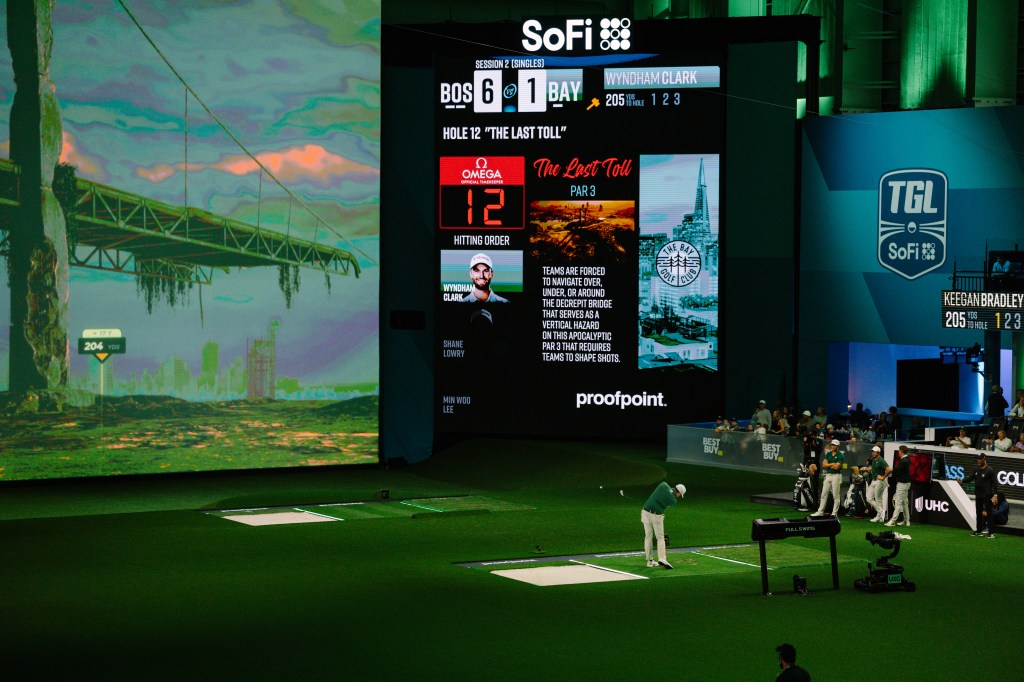
“Tomorrow’s Golf League,” co-founded by Tiger Woods and Rory McIlroy in 2022, is an indoor simulation league aimed at reimagining the golf spectacle through innovative technology.
There are 15 matches designed for a two-hour primetime window on ESPN in December through March, the driest portion of the golf calendar. They’re played inside the SoFi Center in Palm Beach Gardens, Fla., a $50 million arena built for 1,500 fans to watch the best players on the PGA Tour compete as if it were a football game.
It’s team golf under a match play format, so each hole is worth one point. Six clubs each represent different major U.S. cities, but unlike other team events like the Ryder Cup, the league adopted a three-on-three alternate-shot format for the first nine holes, followed by singles for the final six.
Players hit their tee shots into a 3,000-square-foot screen, and once within chipping distance of the green, they pivot onto a putting green that rotates and changes pin placement each hole.
With so much of the game governed by computer systems, how can bettors be confident that shot outcomes are consistent?
“We try to make this as realistic as possible. That was the overarching principle of the design: accuracy, reliability, and redundancy,” TMRW Sports Chief Technology Officer Andrew Macauley told The Post. “If any part of the system stops working, the game stops until it’s fixed — though that has never happened.”
Unlike a standard golf sim, the facility is rigged with cameras and radars that track every shot from tee to screen, capturing spin, speed, and ball flight with real-time accuracy. These overlapping systems provide redundancy, ensuring that even if one sensor fails, the shot is still measured precisely.
There were 960 total shots in the first season of TGL. With the exception of a Tommy Fleetwood divot that reflected 25 yards in distance as opposed to 180 (causing him to retake the shot before the malfunction was permanently fixed), there were no errors — and none since in the second season.
“Players need to trust the system completely, and the wagering market requires equity,” Macaulay said. “On top of that, operational processes and cybersecurity protocols prevent both external and internal interference.”
A traditional golf tournament has fields of more than 100 players, which offer longer odds that bettors can target based on the aforementioned factors. These outright bets are lucrative; Scottie Scheffler, who is the safest weekly outright bet to place since Woods’ prime, opened as the +480 favorite to win THE PLAYERS Championship last week. Markets like top 5, 10 or 20 finishes can all pay handsomely, too.
TGL’s format strips away that payout potential, but it offers something other golf events can’t: live betting. A golf broadcast shifts to different holes for shots that happen simultaneously, so live shot markets are impossible, whereas in TGL, bettors can target head-to-head outcomes, longest drives, and closest to the pins.
TMRW Sports Vice President of Digital Media Jon Kropp calls the evolution of TGL betting a “crawl, walk and run” scenario. As the regular season concluded earlier this month and the playoffs commence on March 17, the “walk” phase is underway.
This season, TGL partnered with IMG Arena, a global sports marketing company recently acquired by Sportradar, to provide an official betting feed to operators who can automate pricing.
“If this is the ‘walk’ phase, then next year is when we hope to start ‘running’ and working with Sportradar to really create some markets that are unique to our format,” Kropp said.

One of TGL’s most distinctive elements is “The Hammer,” a strategic scoring tool allowing a team to increase a hole’s value from one to two points — or three if both teams use one of the three they have in a match.
“That could include things like Over/Unders on hammers accepted, points totals, stat leaders or even something like highest ball speed,” Kropp told The Post. “Those types of markets highlight what’s unique about TGL compared with traditional golf.
TGL wagering is currently approved in 29 states and three additional jurisdictions in Washington D.C., Puerto Rico and Ontario. Since action unfolds on a simulation screen, several state gaming commissions initially questioned whether it should be classified as an esport or not. Many states regulate esports differently — or not at all — when it comes to sports wagering.
Kropp said once regulators understood the mechanics of the competition, the concern faded.
“We explained to them that in esports, a simulated action takes place on a screen — the input is thumb movements on a game controller,” Kropp said. “In our game, the input is world-class golfers hitting a golf ball 35 yards.”
Betting on golf?
Even so, the approval process was lengthy in several states. New York — the largest sports betting state in the country — did not approve TGL wagering until the Friday before the Super Bowl this year.
Other states took a similar “wait and see” approach during the league’s inaugural season.
With no historical data to model or a preseason to test things out, many operators capped how much customers could wager.
“There was no data from which to base their decisions on, so they were tweaking constantly throughout the matches and throughout the seasons,” Kropp said.
Those limitations are gradually loosening as the league accumulates data.
Even with the official data feed now available, many sportsbooks still price TGL markets manually rather than relying entirely on automated models as they continue learning how the new format behaves.
The conception of TGL was to appeal to a younger generation of golf fans and cultivate what Kropp calls an “aggregate fandom,” where “betting is one piece of the strategy.”
Why Trust New York Post Betting
Sean Treppedi handicaps the NFL, NHL, MLB and college football for the New York Post. He primarily focuses on picks that reflect market value while tracking trends to mitigate risk.
Disclaimer : This story is auto aggregated by a computer programme and has not been created or edited by DOWNTHENEWS. Publisher: nypost.com