
The CFMEU led a years-long campaign of pressure through, and then on, key government figures before using its influence on the safety regulator to try and achieve its aims on Queensland’s multibillion-dollar Cross River Rail project, an inquiry has heard.
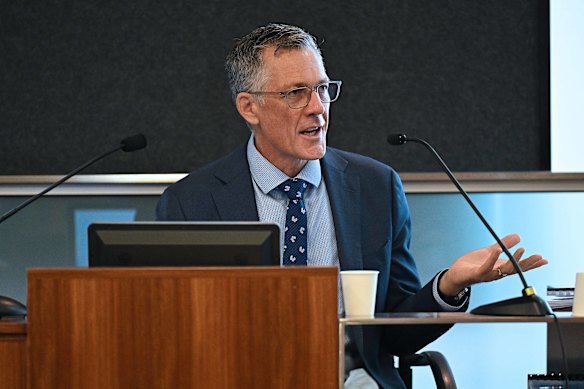
Queensland’s powerful inquiry into the union and broader construction sector has over the last two days taken evidence, culminating on Wednesday, from the project’s delivery authority chief executive Graeme Newton about the union’s activity.
The inquiry has turned to the project after last week laying out a line of inquiry into the potential institutional corruption of Workplace Health and Safety Queensland by the union, with staff telling of unlawful directions targeting CFMEU adversaries.
The Crisafulli government launched the $19.7 million probe last year after reporting by this masthead and 60 Minutes into criminality, corruption and misconduct in the union and construction sector nationwide.
Through the witness box and an extensive witness statement and accompanying documents totalling more than 480 pages, Newton laid out in detail the efforts of the union from the earliest stages of the project to sway decisions, from personnel at meetings to major contractor selection.
The CFMEU and Electrical Trades Union initially declined to attend one meeting offered by the authority to all unions laying out the project scope in November 2018, and subsequently refused to meet with the authority if its workplace relations director Rob McPherson was present.
In an early December email to Newton and the authority’s general manager for strategy, Matthew Martyn-Jones, McPherson said he was “of the firm view I should attend” an upcoming meeting and that the authority “cannot accept the demand of the union”.
McPherson said this would create a precedent where the union could have anyone they disliked or disagreed with “removed or sidelined” and send a message that the authority was “prepared to acquiesce to their demands”.
He said this was particularly important because the CFMEU and others in the Building Trades Group were pushing for an unlawful project agreement with the authority itself, rather than the successful contractors, which could add hundreds of millions of dollars to project costs.
Newton told the inquiry McPherson ultimately did not attend subsequent meetings, but remained employed by the authority and advised it in the workplace relations space. Newton also accepted responsibility for the decision to sideline McPherson to “avoid antagonism”.
Commissioner Stuart Wood AM KC, in a comment to Newton, questioned the “strange” decision, noting that “if you give in to them, you get more agitation”. “I don’t disagree with you,” Newton replied.
While the CFMEU and Building Trades Group were pushing to replicate Queen’s Wharf development deals as a way to land generous conditions for workers and break into the Australian Workers’ Union’s civil construction turf, the AWU were already talking to announced bidders.
At a meeting with the union group later in December, also attended by then deputy premier Jackie Trad and some of her staff – but not the AWU – the unions questioned why the authority had not helped get them in front of bidders.
Trad, in what Newton agreed was an effort to “placate” the unions, said she would write to the authority with expectations around how it would adhere to new “best practice principles” being placed on major projects.
This letter in February 2019 suggested the authority consider a “project specific” agreement, with consideration of Queen’s Wharf.
The AWU ultimately landed the initial two deals for the project after a period of authority involvement in the bargaining process via advisors with close ties to the government or CFMEU, which representatives of contractor CPB considered “unusual”.
After this point, the union escalated pressure on the authority, various ministers including then premier Annastacia Palaszczuk, and even Newton himself through private and public commentary to try to damage the authority and the project more broadly, Newton said.
This included a campaign of “misinformation” through media and the union’s own social media about safety concerns on the project, on which Newton said key indicators were, in fact, below the national average.
After the serious injury of a worker in mid-2023, a “safety reset” driven by the CFMEU through its presence on sites via subcontractor workplace agreements saw CPB then cede to the union’s demands for its own health and safety representatives, the inquiry heard last year.
This led to an escalation of the work stoppages initiated by those representatives of which a “significant portion … lacked clear or substantiated basis” and were later overturned or resolved without the need for action, Newton’s statement laid out.
Counsel assisting noted this coincided with a decline in the use of media and other external public pressure by the union. “They had their troops inside by then,” Wood noted.
Newton said ultimately the union’s activity contributed to up to two-year delays on some work between 2022 and 2025 – a period in which the project’s estimated completion jumped from 2025 to its current timeline of 2029.
While not solely attributing an increase in the “apples with apples” cost increase from an initially budgeted $6.88 billion to $9.83 billion today to the union, Newton told the inquiry “protracted industrial actions” did play a role.
The inquiry continues on Thursday.
Start the day with a summary of the day’s most important and interesting stories, analysis and insights. Sign up for our Morning Edition newsletter.
 Matt Dennien is a reporter at Brisbane Times covering state politics and the public service. He has previously worked for newspapers in Tasmania and Brisbane community radio station 4ZZZ. Contact him securely on Signal @mattdennien.15Connect via email.
From our partners
Disclaimer : This story is auto aggregated by a computer programme and has not been created or edited by DOWNTHENEWS. Publisher: www.smh.com.au