Breville had been a long-time market darling when Donald Trump threw a tariff grenade into its operations.
The company, which counts billionaire retailer Solomon Lew as its largest shareholder and which is known for its coffee machines and toasters, had to find a work-around and in quick time.
Not only was the US Breville’s biggest export market, but much of its manufacturing was undertaken in heavily tariff-affected China – a double whammy.
Since the start of Trump’s tariff terrorism (which admittedly has waxed and waned), Breville has become one of the most heavily shorted stocks on the Australian stock market. In other words, huge bets have been placed on the company’s share price falling precipitously. And early last year investment analysts set off warning bells about the potential for an earnings hammering.
Breville has been hit by tariffs, but its resilience has surprised the punters. Absorbing tens of millions of dollars in tariffs and holding the line on profit was described by one shareholder as Herculean.
The company’s dodging of the full force of the US duties bullet was testament to its agility but also to consumers’ love of its coffee machines, air fryers and other kitchen gadgets, and Breville’s pursuit of new product development.
This even includes its recent move into direct ground-coffee sales through its Beanz service. Breville reported a 75 per cent lift in the number of kilograms of coffee shipped to customers through this service in the 2025 calendar year compared with 2024, while its customer subscriptions also jumped.
The ASX-listed appliance maker also reported healthy growth in its US sales, which rose 11.6 per cent to $549.5 million, while sales in the Asia-Pacific region (which includes Australia) were up 5.9 per cent to $190.3 million. In other regions, including Europe and the Middle East, the company enjoyed sales growth of 13.7 per cent, to $233.8million.
The half-year result it produced on Thursday showcased a speedy adaptability that allowed it to report earnings in line with last year’s result and reward shareholders with a slight lift in dividends.
This came on the back of a 10 per cent growth in revenue for the half to more than $1.1 billion, which is both a record and a doubling over the past six years.
The share price, which had drifted down over the past year by more than 7 per cent, came back to life on Thursday, gaining more than 3 per cent by lunch after the company said it expected the full year to produce a slight improvement in profit.
The full-year result last year also defied the odds, coming in 10 per cent higher than the previous year.
Breville has not only diversified its geographic markets but in rapid time has shifted a large part of its manufacturing out of China and into countries with lower US tariff rates.
It now has 80 per cent of its 180-voltage products being manufactured outside China and relocated to other parts of the world.
But it has also amped up its push into other consumer markets, including China, Mexico, South Korea and the Middle East.
Although the manufacturing exodus from China was started a few years ago, how it managed to geographically re-engineer its manufacturing is one for the textbooks.
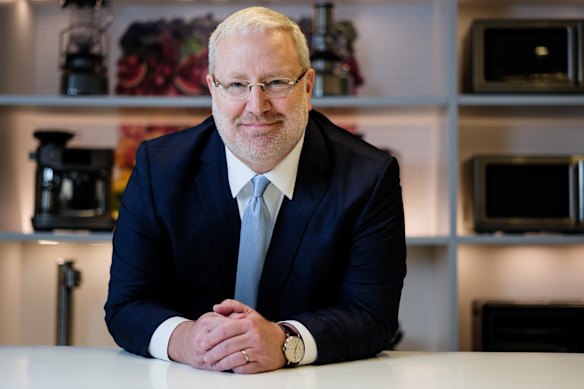
Breville chief executive Jim Clayton said: “We held our prices on our US core range and took selective price increases on our tail range, and we worked our distribution mix. This clawed back some of the remaining on cost, with some also offset by gross profit increases in other theatres [markets].”
While Breville has tackled some of the risks with diversification, the Trump cloud and his moveable feast on tariffs, won’t allow the management to relax.
“Tariff uncertainty remains, with the Supreme Court ruling still awaited, the USMCA renewal in July and feasibly new tariffs. We are ready to tactically respond to these new challenges if and when they occur,′ Clayton said.
So there were plenty of caveats in the 2026 forecast for a slight lift in Breville’s profitability, including no change in duties, no big change in the economy and no supply chain interruptions.
Being hostage to Trump’s erratic decision-making would be any company’s worst nightmare.
The Business Briefing newsletter delivers major stories, exclusive coverage and expert opinion. Sign up to get it every weekday morning.
From our partners
Disclaimer : This story is auto aggregated by a computer programme and has not been created or edited by DOWNTHENEWS. Publisher: www.smh.com.au