
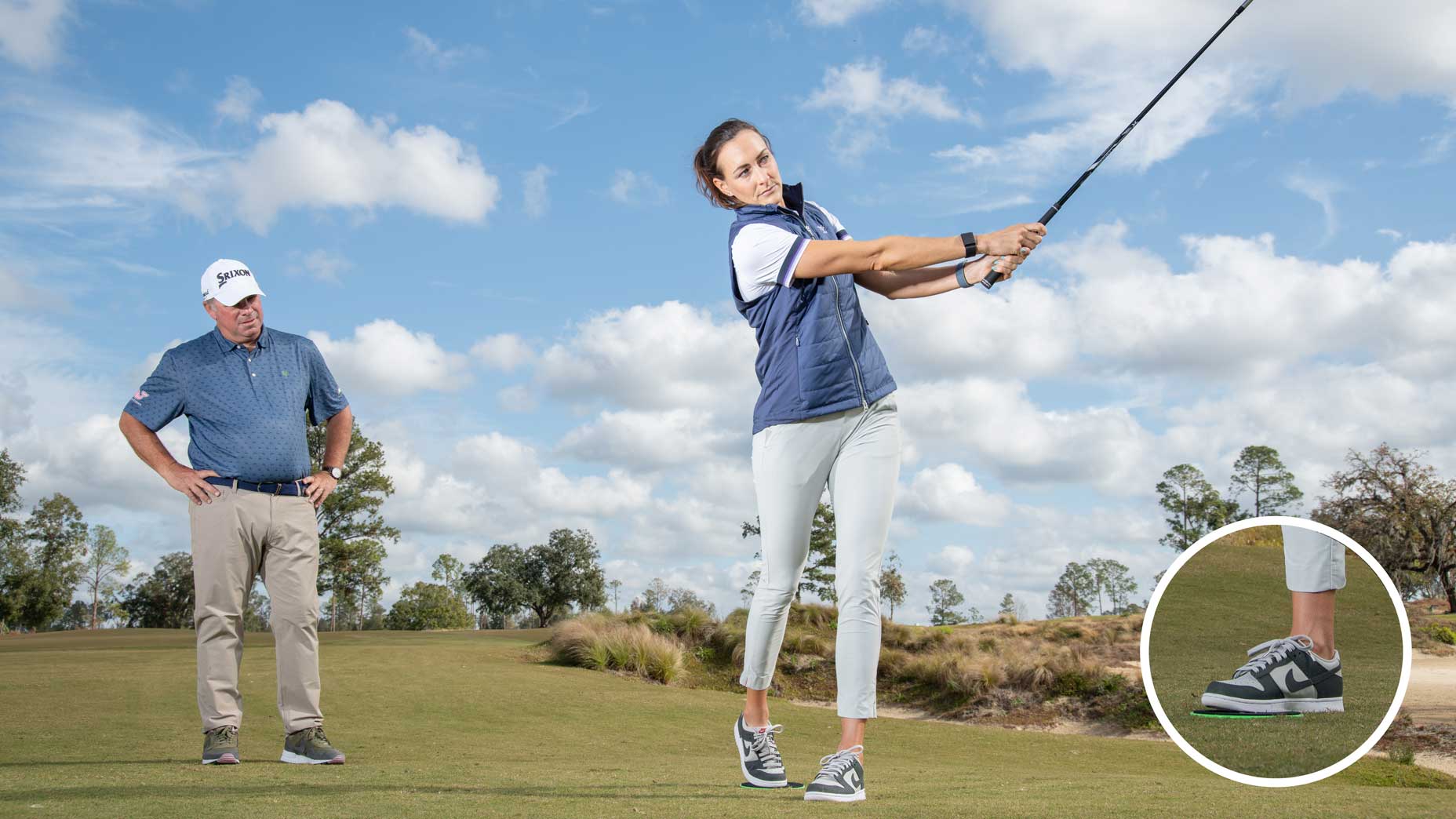
One of the biggest misconceptions in golf is about where the club makes contact with the ball and the ground. Tony Ruggiero, a GOLF Top 100 Teacher, explains that the low point of your swing—or the bottom of your swing arc—actually occurs just in front of the ball, on the target side.
“In order to make the low point happen on the target side of the ball, we want your body and the pressure to be moving towards the target,” Ruggiero says, “You actually want to try to get your center of your body moving towards the target and at the ball or in front of the ball.”
It sounds simple enough, but many amateurs still struggle to get their low point far enough forward. Fortunately, Ruggiero has a few clever drills that can help you practice moving your body and pressure towards the target.
Without a ball, place a slider—which you can buy here—under your trail foot and get into your normal set up. Take the club back, and as you make your forward swing, Ruggiero says to think about sliding your trail foot back.
“[This move] makes all the pressure or weight have to go towards the lead leg,” he says, “and it makes you learn to stay in posture and rotate your trunk over to the [lead] leg.”
If you’re doing it right, you should notice that the club brushes the ground just in front of where the ball would be.
Impact drill with resistance
For the next drill, you’ll need a light resistance band and something to anchor it to, or a partner to hold it. Loop it around the handle of your club, then step away just enough to take the slack out of the band. From there, move into your impact position and hold it. As you rehearse this position, you should begin to feel a slight amount of resistance from the band.
Ruggiero explains that an optimal impact position should look like your chest rotating over the ball as your hips begin to open and clear out of the way.
Once you’re in a proper impact position, continue turning through the shot. As you rotate, you should feel more resistance from the band—almost like it’s pulling you back. Ruggiero says that feeling will help train you to push off the ground and move through the ball, rather than hanging back.
Early release drill
This third and final drill, is inspired by players like Annika Sorenstam and David Duval. Best practiced with small, or slow swings, it’s all about the release.
“In the old days, their [Sorenstam and Duval] eyes would release early down the range, and they’d almost be looking out down the range before they hit the ball,” Ruggiero says.
To practice this drill, make small swings while emulating that early release, training your body to naturally let your eyes, nose, hands and club release all together—pointing at the target.
Disclaimer : This story is auto aggregated by a computer programme and has not been created or edited by DOWNTHENEWS. Publisher: golf.com








