
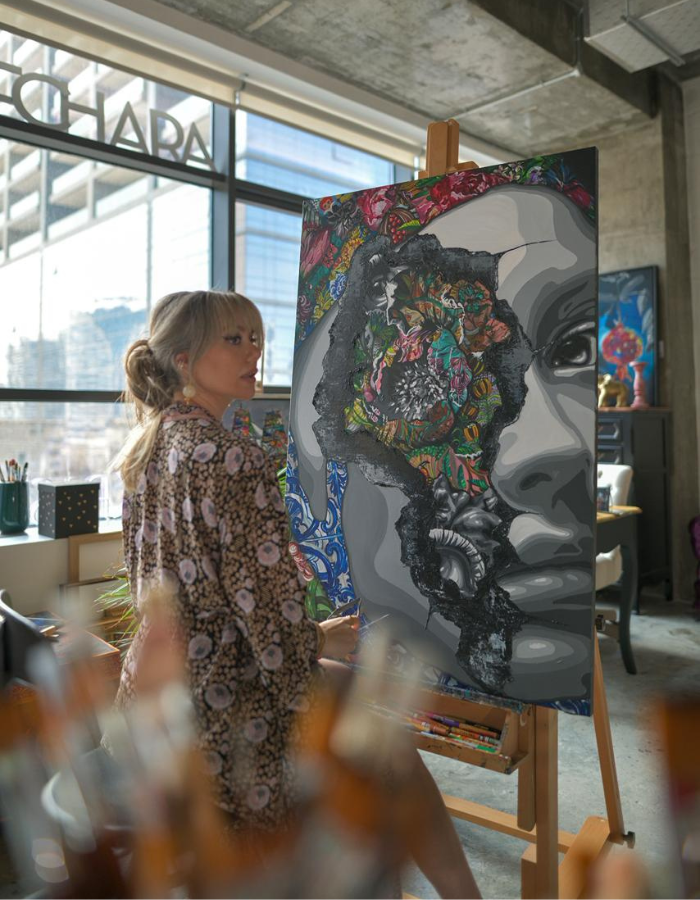
Women’s art. Don’t you just hate that qualifier: women’s. Women’s art, women’s football, women’s rights… Why do we not talk of men’s art, men’s football, men’s rights? Because male endeavours require no qualifier. Men’s football is football; men’s rights are rights, and men’s art is art. It’s ironic then, that one can’t delve into the history of women’s art without talking about men. Having shaped and dominated the artistic discourse for millennia with nary a mention of women, except in passing as loyal muse, generous patron or humble attendant, patriarchal standards might have framed women’s art, but it has not bookended it, leaving investment in the genre making not only cultural, but economic sense. “An artist is an artist, and it is not a male,” says Lebanese artist, painter and muralist, Chafa Ghaddar. “A creator is not a male, but that is what has always been understood in the wider realm globally.” “Historically, women’s art has been assigned less importance than men’s due to factors such as professional recognition, historical documentation and cultural norms that shaped who could become an artist – and what counted as ‘serious’ art,” says Egyptian artist and curator Samar Kamel. “For centuries, women had limited access to formal artistic education, while traditional gender roles prioritised women as wives and mothers rather than professional artists. Artistic careers required time, mobility, and financial independence – resources many women did not have access to.”
Patriarchal sovereignty at all levels whether social, political, religious and, importantly when we talk about art, institutional (galleries, salons, academies, museums), along with the limitations imposed on women by these enforced rules and standards worked to not only suppress burgeoning female creativity – or at the very least keep it in the home and out of public view – but also to deride and dismiss it. “Those constraints were reinforced by representational regimes in which women appeared far more reliably as subjects than as authors, with visual culture conditioned by gendered spectatorship and the disciplining of taste,” says Dr Laura Cherrie Beaney, author, academic, and director of communications at Tabari Artspace in Dubai. “The result was a canon that often naturalised male authorship and treated women’s work as peripheral, amateur, or ‘minor’.” She adds: “Across generations and geographies, women artists from the Middle East and North Africa have played a formative role in shaping the region’s modern and contemporary visual culture. Their work has generated distinct formal languages while intervening in debates surrounding identity, political authority, and social change. The growing international visibility of these practices reflects a longer history of artistic and intellectual production that has remained underrepresented within dominant narratives of global art history.”
Kristel Bechara
Twentieth-century Modernism proved if not a turning point, then at least an offramp for female artists to begin unshackling themselves from the constraints of the past. Regionally, today’s female artists owe an immense debt of gratitude to the likes of Lebanese-American poet, essayist and visual artist Etel Adnan whose vibrant use of colour reflected not only the landscape around her but highlighted the intersection of poetry, painting and political discourse; to Iraqi artist Madiha Umar whose melding of calligraphy with abstract art is lauded as the precursor to the Hurufiyya movement; to Lebanese painter and sculptor Huguette Caland and to Iraqi painter and educator Naziha Salim – “the first Iraqi woman who anchored the pillars of Iraqi contemporary art”. “Adnan created a whole language on her own,” says Lebanese digital artist, Kristel Bechara. “These women stuck to what they believed in. They did not follow trends; they facilitated and opened the space for us.” Says Dr Beaney: “From the early Modernist period onwards, women artists increasingly participated in avant-garde movements, exhibitions and artistic debates. Yet these advances were within a wider culture in which women’s intellectual and creative contributions were frequently undervalued.” There’s a sinister precision to the word ‘undervalued’ in that it requires an acknowledgement of the power dynamics at play and an awareness of one’s position in the food chain. “Your work is good,” the hegemony is saying, “but because you’re not as influential or as well platformed as I am, I’ll offer you less than what it’s worth Devalued resonates on many levels, and in the Venn diagram of devaluation with its overlapping circles of the lived female experience as it relates to creativity, money and power, the female artist sits at the centre.

Rabab Tantawy
“There is a devaluation of day-to-day roles, language and craft,” says Ghaddar. “And when you do have a feminine voice emerging from all of that it is critiqued as disruptive and resistant. But it is strong because it acknowledges that it had to pierce a very rigid eco-system in order to emerge.” Patience is a word that comes up again and again in conversations with female artists. Patience that has been forced upon them, patience they have convinced themselves they must possess because that’s the way things are and always have been, and also the good kind of patience, the one that whispers into your ear that the muse cannot be hurried. But what’s a female artist to do when she’s relentlessly exhibiting patience not art? “My journey has often been about been waiting for something to happen and then telling myself: ‘You know what? I can actually do this without waiting for someone’,” says Egyptian multidisciplinary artist, Rabab Tantawy. “I waited for my first solo show, I submitted my work to galleries, I did all the open calls and was getting rejection after rejection. So, I found a freelance curator, I found a space, I did my own opening night sent out my own press releases. Once I knew I could do that I didn’t have to wait for someone to rescue me or discover me on all these terms.” Now 54, recognition came later in life for the muralist, but when it did, she was ready. The creator of the Yas murals for Aldar Properties, as well as public artworks in Al Seef and a 500 square metre mural in Al Quoz Creative Zone, Tantawy was the first artist to design a Formula One car, the McLarens driven by Lando Norris and Daniel Ricciardo during the 2021 Abu Dhabi Grand Prix. And as co-founder of Studio Thirteen in Al Quoz, she is familiar with the collective power of women coming together through art.

Chafa Ghaddar
“I was still waiting for something to happen somehow when I found a lot of artists like me who were looking for studios to work out of,” she says. “When I found Studio Thirteen, I started contacting other artists and it was the men I contacted who were discouraging. They talked about all the risks but no rewards. And the women were the ones supporting me, saying: ‘We are in this with you’.” Technology too has contributed to the way in which women navigate the art world. For Bechara, the rise in NFTs proved a great equaliser in her artistic landscape. “As a digital artist, I was an early adopter of blockchain technology and I understood what it did for collectors,” she says. “NFTs levelled the playing field because digital became as valuable as my traditional paintings. Collectors were international and I didn’t have to go through galleries or middle men, the work was advertising itself. With NFTs, the work was new, it wasn’t based in history or accepted norms, or reliant on galleries and all the gatekeepers that traditionally were there.” “Prices tend to follow visibility, and visibility is shaped by prior collecting patterns, museum exhibitions and critical discourse,” Dr Beaney says of the state of art for sale and at auction. “Even where institutions and galleries have made deliberate efforts to revisit historical imbalances, the market continues to reflect the accumulated advantage of male careers.” She points out that according to the Art Basel and UBS Global Art Market Report 2025, women artists constituted 41 per cent of artists represented by galleries globally, accounting for approximately 42 per cent of primary market sales, indicating substantial progress in representation and demand. Yet the highest value tiers remain far more concentrated. In the first half of 2025, only 13 women appeared among the 100 top-selling artists at auction, according to the 2025 Artnet Intelligence Report, demonstrating how entrenched reputational hierarchies continue to imprint the secondary market. “Investing in art by women means you are supporting a much broader and more accurate understanding of cultural history by bringing attention to artists whose perspectives were often overlooked,” says Maan Jalal, Consultant, and Founder of The Culturelist.
“Women artists frequently explore experiences, narratives, and social realities that have not always been centred in traditional art histories. Supporting their work helps expand the range of stories and viewpoints represented in museums, collections and public discourse.” For Mariam AlDhaheri, curatorial assistant at Louvre Abu Dhabi, it’s about actively contributing to the future of art. “It expands art history as a dynamic, plural narrative shaped by many voices rather than a single male lens,” she says. “Investing in art by women contributes to a more balanced cultural landscape. It helps preserve diverse perspectives, experiences, and stories that shape how societies understand themselves. Such investment supports dialogue, encourages innovation, and ensures that future generations inherit a more complete and nuanced artistic record. Beyond the narratives of the past highlighting male artists, the female existed, produced and must be showcased.” If investing in art specifically by women feels purposeful, that’s because it is. Actively seeking out the under- or mis-represented across the artistic spectrum requires more to be asked of the collector beyond that of investor or audience. They become a champion of it whether intentional or not. This kind of intentionality in addition to established factors can effect change. “Our experience in the MENA region suggests a more nuanced picture,” says Dr Beaney. “Across both established and emerging practices, women artists from the region are achieving prices comparable to, and in some cases exceeding, those of their male peers in the gallery context and increasingly at auction.
Strong institutional programming, engaged collectors, and sustained curatorial attention have contributed to an ecosystem in which women artists enjoy a central position within our contemporary art scene.” F. Scott Fitzgerald ‘borrowed’ from his wife Zelda’s writings and journals; Margaret Keane’s husband Walter claimed he painted her celebrated pieces; photographer and surrealist Lee Miller’s work on the solarisation technique was credited to her lover Man Ray; with history famously said to be written by the winners, revisionism has become a powerful tool in modern attempts to right the wrongs of the past. In 1998, New Yorkbased feminist artist collective The Guerrilla Girls unveiled a seminal work: The Advantages of being a Woman Artist. The poster ironically listed 13 reasons extolling the virtues of being a female artist, which included, “Being reassured that no matter what kind of art you make it will be labelled feminine”, “Seeing your ideas live on in the work of others”, and “Being included in revised versions of art history”. What is the point of glory, it starkly asks, if the artist is not only no longer around to enjoy it, but was actively censored during their lifetime?
Most recently evidenced in Katy Hessel’s lauded 2022 illustrated history of women artists, The Story of Art Without Men, while the intentions of revisionism are unquestionably noble, the fact of its necessity remains emotionally evocative. But, with no alternatives, better late than never is all we have. “Women artists occupy a central position within the contemporary art ecosystem of the Gulf and wider Middle East, and many have achieved substantial international recognition,” says Dr Beaney. “The prominence of women artists in the region also reflects the wider structure of the Gulf’s cultural sector. Women in the Gulf hold influential roles across galleries, fairs, institutions, curation, auction houses and collecting networks throughout the region.” She adds: “There is also an interpretive dimension. Women artists often draw attention to experiences and social structures that historically remained outside dominant visual narratives. Through their subjectivity, they uniquely raise the gendered experience in a way that male artists cannot.”
– For more on luxury lifestyle, news, fashion and beauty follow Emirates Woman on Facebook and Instagram
Images: Supplied
Disclaimer : This story is auto aggregated by a computer programme and has not been created or edited by DOWNTHENEWS. Publisher: emirateswoman.com







