
In Delhi’s winter flea markets, university campuses and online craft stores, the Kashmiri pheran has quietly emerged as a seasonal fashion staple. Retailers and designers across North India say demand for handmade pherans has risen sharply over the past few winters, with buyers drawn to their warmth, embroidery and cultural appeal.
This growing demand outside Kashmir is reshaping livelihoods back in the Valley, where women artisans are increasingly leading a revival of the centuries-old garment.
Afroza Bano, 35, begins her mornings in a small room in her home in North Kashmir’s Bandipora, where bundles of raw wool lie beside a handloom. A mother of two school-going children, she once depended entirely on her husband’s irregular daily wages.
Three winters ago, when expenses rose and work became scarce, she joined pheran-making.
Today, she earns between Rs 9,000 and Rs 12,000 a month stitching traditional Kashmiri winter gowns — income that now pays for her children’s education, winter ration and basic savings.
“Earlier, I waited for others to support the house. Now the pheran supports us,” she says.
Before joining pheran-making, Afroza had no personal income and relied entirely on her husband’s irregular daily wage work, which brought in Rs 6,000 to Rs 7,000 a month during winters, sometimes even less when work was scarce.
Of the artisans linked to the initiative run by Abdul Rouf Shah, around 40 women work at the centre, while another 20–25 operate home-based units across North Kashmir, stitching, embroidering and selling pheransthrough traders and WhatsApp orders.
Once on the brink of fading away amid modern fashion trends, the pheran is finding new life — both as a cultural symbol and a source of livelihood for dozens of families in North Kashmir.
From Persian roots to a Kashmiri identity
The pheran’s journey in Kashmir dates back to the 15th century, when Persian travellers introduced the garment to the Valley. Over time, Kashmiris adopted it not only for its elegance but also for its practicality in harsh winters.
The loose, gown-like structure allowed space to keep a kangri— a traditional earthen pot filled with burning charcoal — helping people stay warm long before modern heating systems became common.
/filters:format(webp)/english-betterindia/media/media_files/2026/03/06/pherans_snowfall-2026-03-06-12-52-21.jpg)
Gradually, the pheran became deeply embedded in Kashmiri life. Worn by both men and women, rich and poor alike, it blurred social distinctions and emerged as a unifying cultural symbol.
“The pheran is one outfit that never separated people by class,” says Abdul Rouf Shah, a resident of Bandipora district. “Everyone wore the same garment, whether rich or poor. That is what made it special.”
Traditionally made of wool, velvet or cotton, the pheran followed a simple stitching pattern that remained largely unchanged for centuries. However, modernisation and Western clothing trends gradually pushed it out of everyday use, especially among the younger generation.
Reviving a fading craft in Bandipora
Concerned about the decline of this centuries-old craft, Abdul Rouf Shah opened a handloom centre in his village in Bandipora several years ago. Having learned the craft at a young age, Rouf realised that only a handful of ageing artisans were still engaged in pheran-making.
“Our ancestors were associated with this work, and I joined it when I was in Class 5,” Rouf tells The Better India. “Even after completing my bachelor’s degree, I continued this work side by side. But I saw that this artistry was slowly fading.”
Demand, he says, has risen steadily in recent years.
“Before 2020, we received hardly 150–200 orders per winter. Last season, the centre handled over 600 pheran orders, apart from shawls and suits, nearly a threefold rise in four years.”
During peak winter between October and February, the centre produces about 500–700 pherans per season, depending on embroidery work and wool availability.
At the centre, 30 to 40 artisans now work daily, producing pherans using traditional methods. Unlike many pherans sold in markets — often made of tweed or synthetic materials — Rouf’s centre uses 100 percent pure wool sourced directly from sheep reared in Kashmir.
/filters:format(webp)/english-betterindia/media/media_files/2026/03/06/wool-ready-to-use-for-pherans-and-shawals-2026-03-06-12-55-38.jpg)
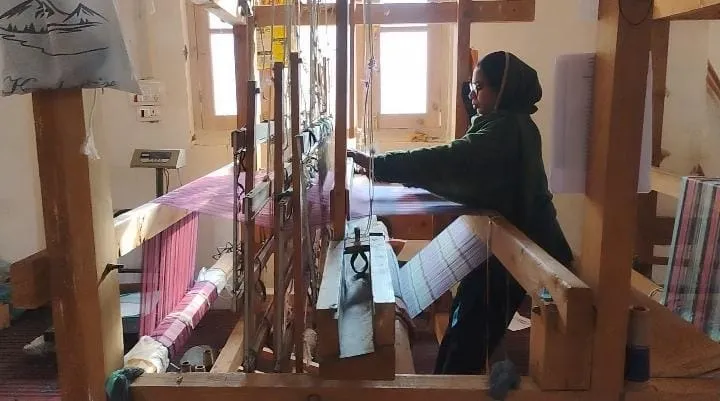
Although the centre was founded by Rouf, most of its production, embroidery design, finishing and order handling is now managed by women artisans, many of whom work independently from home. Several women negotiate prices directly with buyers and choose designs themselves, reflecting a shift from male-dominated craft production to women-driven entrepreneurship.
/filters:format(webp)/english-betterindia/media/media_files/2026/03/06/woolpheran-2026-03-06-13-04-06.jpg)
Not all artisans work from the centre. Some have converted their homes into small production units.
Rukhsana Begum, 29, from Hajin, works from her living room, where she designs neck patterns and embroidery.
She finishes around 12 to 15 pherans each month and sells them to traders and individual customers through WhatsApp and local exhibitions.
“Working from home lets me earn without leaving my children behind,” she says. “Earlier, I had no income at all. Now I handle my own orders and payments.”
How a pheran is made
The process begins with purchasing raw wool from grazers in remote areas of the Valley. The wool is carded, sorted and spun into yarn, which is then woven and stitched into pherans.
Completing one pheran typically takes two to three days, from spinning to final stitching, and costs between Rs 2,000 and Rs 2,500.
/filters:format(webp)/english-betterindia/media/media_files/2026/03/06/kashmiripherans-2026-03-06-12-58-30.jpg)
“Our pherans are lightweight but much warmer than synthetic ones,” Rouf says. “Everything is handmade, and the process is known to everyone.”
Though pherans dominate winter production, the centre remains active year-round by making shawls, woollen suits and embroidered garments, allowing artisans to maintain income beyond the cold season.
Demand spreads beyond Kashmir
While Bandipora has emerged as a visible hub, a similar revival is underway in Baramulla, Kupwara and parts of Ganderbal, where women artisans are returning to pheran-making as demand for handmade winter wear increases across India.
Once confined largely to Kashmir, the traditional pheran is now gaining popularity in cities such as Delhi and Mumbai.
Manikshi, a student at Jawaharlal Nehru University in Delhi, tells The Better India that handmade designs and embroidery are driving its popularity among young people.
She says many of her friends wear pherans during winters.
“Pheran was limited to Jammu and Kashmir but because of its unique designs and handmade work, it became famous and has kept the identity of a region alive.”
/filters:format(webp)/english-betterindia/media/media_files/2026/03/06/pheran-designs-made-by-rouf-and-his-team-2026-03-06-13-00-25.jpg)
According to Rouf, most of his orders now come from cities such as Mumbai and Delhi, where customers increasingly prefer handmade wool garments.
Women artisans are also directly handling outside-Kashmir orders. Finished pherans are packed and shipped to cities like Delhi, Mumbai, Chandigarh and Bengaluru through traders and courier services.
Some artisans promote their designs through Instagram and WhatsApp groups, receiving repeat orders from customers who first discovered pherans at exhibitions or through friends.
“Last winter I sent more than 20 pherans to Delhi alone,” says Rukhsana. “Now people call back every season asking for new designs.”
Some traders also report occasional international orders from members of the Kashmiri diaspora in the Gulf, UK and Canada. While still limited, artisans say such orders fetch higher prices and signal growing global visibility for the traditional garment.
North India demand drives orders
Traders in Delhi’s winter markets say pheran sales have increased steadily in recent years, especially among students and young professionals looking for handmade winter wear.
“Over the last three winters, we’ve seen a clear rise in customers asking specifically for pherans, especially students and young professionals,” says Raman, a Delhi-based winterwear seller who stocks Kashmiri garments.
/filters:format(webp)/english-betterindia/media/media_files/2026/03/06/afroza-2026-03-06-13-05-14.jpg)
“Many students prefer them because they’re warm, comfortable and different from regular jackets. During peak cold weeks, pherans often sell faster than other woollen items.”
Online sellers on Instagram and Facebook report orders from cities such as Chandigarh, Jaipur, Lucknow and Dehradun, indicating a widening North Indian customer base.
Artisans say the biggest change in recent years is not production capacity but demand. Order volumes, particularly from outside Kashmir, have increased rapidly, encouraging more women to learn the craft.
Women artisans step forward
Nearly a decade ago, Rouf says only six to eight ageing artisans in his village were still making pherans, as machine-made garments flooded local markets and younger people abandoned the craft.
Today, his centre alone engages around 40 artisans, most of them women, while another 20–25 women work from home across Bandipora’s Hajin and nearby villages.
A decade ago, the craft was close to disappearing. Machine-made and synthetic pherans flooded markets, while handloom work became slow and poorly paid. In many villages, only four or five ageing artisans remained.
Some craftsmen earned less than Rs 200 a day and eventually left the trade for manual labour.
/filters:format(webp)/english-betterindia/media/media_files/2026/03/06/nahida-and-her-friend-crafting-a-pheran-2026-03-06-13-01-49.jpg)
At Rouf’s centre, most artisans producing handloom products — including pherans, shawls and suits — are married women supporting their families. A few younger women have also joined the craft, learning the skill in the absence of government job opportunities.
In Bandipora, the average daily wage for unskilled labour ranges between Rs 300 and Rs 350, translating to roughly Rs 7,000 to Rs 9,000 a month if work is regular — something winters rarely guarantee.
In comparison, skilled pheran artisans earn between Rs 7,000 and Rs 15,000 a month from home-based work.
His centre remains open about 10 hours a day throughout the year, where many young women receive training before starting work from their homes.
“In winters we make 100–150 pherans in a month, which makes good profit for both artisans and us,” Rouf tells The Better India.
/filters:format(webp)/english-betterindia/media/media_files/2026/03/06/equipmentpheran-2026-03-06-13-02-41.jpg)
Afroza says many men left the craft when demand declined and shifted to manual labour.
“Earlier, this work was mostly done by men,” she says. “But as the demand reduced, they moved to other jobs. Now women are doing this work to support their families and keep the tradition alive.”
Most women now treat pheran-making as their primary winter livelihood. On average, artisans work five to six hours daily and earn between Rs 7,000 and Rs 15,000 a month depending on orders and embroidery work.
The money helps cover school fees, groceries, heating fuel and medical expenses during harsh winters.
“Now we plan our expenses ourselves,” Afroza says. “It gives us dignity as well as security.”
Tradition meets fashion
The transformation of the pheran has also played a key role in its revival. What was once a simple, loose garment has evolved into a fashion statement, with fitted designs and intricate embroidery such as tilla, sozni and aari work.
Sadaf, a 23-year-old nursing student from Bandipora, says younger people are now more willing to wear pherans because of these changes.
“The youth are taking interest because of new designs, stitching, and embroidery,” she says.
She added that many of her friends outside Kashmir admire pherans for their handmade quality.
“Earlier, some people hesitated to wear pherans on special occasions,” Sadaf says. “But now pherans are promoted in fashion shows, and even celebrities have worn them.”
As Western fashion continues to influence Kashmir, artisans believe preserving traditional attire is essential.
“If we leave our culture, we lose our identity,” Rouf says.
As winter fashion trends evolve across North India and beyond, it is not designers or factories but women artisans in Kashmir’s villages who are shaping the pheran’s resurgence.
What was once a fading local tradition is now sustained by their skill, income needs and growing markets far beyond the Valley — ensuring the garment survives not as nostalgia, but as a living craft carried forward by women’s hands.
All photos courtesy Seerat Un Nisa
Disclaimer : This story is auto aggregated by a computer programme and has not been created or edited by DOWNTHENEWS. Publisher: thebetterindia.com



