Moneywise and Yahoo Finance LLC may earn commission or revenue through links in the content below.
Markets hate uncertainty, and right now, there’s plenty of it.
Escalating tensions in the Middle East have rattled global markets, disrupted energy trade routes and sparked debate among investors about what the conflict could mean for oil prices, inflation and economic growth.
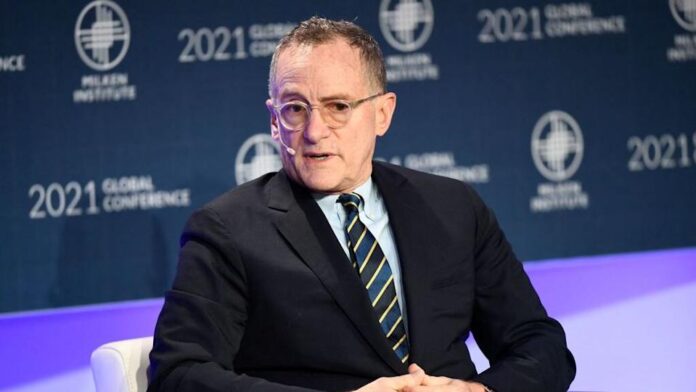
But veteran investor Howard Marks, co-founder of Oaktree Capital Management, says reacting emotionally to the headlines may be the worst possible response.
“The main thing to keep in mind is how much we don’t know,” Marks said during a video appearance at the Australian Financial Review Business Summit, according to Bloomberg (1). “Nobody knows how long this is going to last, how big it’s going to get or what the outcome is going to be.”
The uncertainty is real. President Donald Trump has said there’s no fixed timeline for the conflict (2). At the same time, global energy markets remain on edge after disruptions to shipping through the Strait of Hormuz — a natural chokepoint responsible for roughly one-fifth of global oil consumption, according to the U.S. Energy Information Administration (3).
Investors now debate what the war could mean for everything from oil prices to credit markets. But Marks warns that uncertainty itself often leads investors into their biggest mistakes.
“It’s easy to let it affect your emotions,” he said. “But that’s probably not very helpful.”
History suggests he may be right.
Research from investment firm Vanguard shows that investors who react emotionally to market volatility often underperform those who simply stay invested and maintain diversified portfolios (4).
Panic selling during market downturns can permanently lock in losses that long-term investors might otherwise recover from.
The smarter move is to prepare. Here’s how.
When markets become volatile, investors often feel compelled to act, even when doing nothing might be the wiser choice.
During periods of uncertainty, common mistakes include selling stocks at a loss, concentrating too heavily in a single asset class like commodities, or sitting in cash for too long and waiting for markets to “feel safe” again.
While understandable, reacting emotionally to market swings can hurt long-term returns.
According to research from the behavioral finance firm DALBAR, the average investor has historically earned significantly less than the broader stock market, largely due to poorly timed buying and selling decisions driven by fear or overconfidence (5).
That’s where professional guidance can help. A financial advisor can crunch the numbers and build a plan that works for you even in hard times.
But hiring an advisor can be a lifelong commitment, not just a wartime one. That’s why finding reliable advisors is crucial.
A platform like Advisor.com can help connect you with a qualified expert for free.
Advisor.com does the heavy lifting for you, vetting advisors based on track record, client ratios and regulatory background. Plus, their network comprises fiduciaries, who are legally required to act in your best interests.
Just enter a few details about your finances and goals, and Advisor’s AI-powered matching tool will connect you with a qualified expert best suited to your needs.
Set up a free initial consultation with no obligation to hire to see if they’re the right fit for you.
Read More: I’m almost 50 years old and don’t have retirement savings. Is it too late to catch up?
Read More: Non-millionaires can now invest in this $1B private real estate fund starting at just $10
Wars don’t just move markets — they move commodities.
The Middle East conflict has already sent oil prices higher thanks to concerns around the Strait of Hormuz. Energy shocks can ripple across the global economy, pushing up transportation costs, consumer prices and inflation.
The oil embargo of the 1970s, for example, helped trigger a major inflation spike that reshaped global economic policy for years (6).
In times of geopolitical stress, some investors focus on assets that hold their value despite market turbulence.
Gold has historically performed well during periods of geopolitical instability and market volatility, according to research from the World Gold Council (7).
Because the metal moves independently from stocks and bonds, it serves as an important portfolio diversifier during uncertain times.
If you’re worried about inflation or currency volatility tied to energy shocks, you might consider investing in physical precious metals as part of a long-term wealth preservation strategy.
You can take advantage of the benefits of gold today by opening a gold IRA with Priority Gold.
Gold IRAs allow investors to hold physical gold or gold-related assets within a retirement account — combining the tax advantages of an IRA with the protective benefits of investing in gold — making it an attractive option for those looking to hedge their retirement funds against economic uncertainty.
Download your free information guide today to learn how you can get up to $10,000 in free silver on qualifying purchases.
Marks himself suggested that trying to predict the outcome of the conflict may not lead to any smart moves.
“Since we don’t know what it means,” he said, “there is probably nothing smart to do.”
But doing nothing doesn’t necessarily mean leaving your money completely idle. During volatile markets, investors often increase their cash holdings while waiting for more clarity.
The problem is that traditional bank accounts often pay very little interest. According to the FDIC, the average account still pays a fraction of a percent in annual interest, meaning inflation can quietly erode purchasing power (8).
Some investors use automated investment platforms or high-yield accounts to generate returns while maintaining flexibility.
One way you could do this is with the Wealthfront Cash Account.
A Wealthfront Cash Account can provide a base variable APY of 3.30%, but new clients can get a 0.75% boost over their first three months on up to $150,000, for a total APY of 4.05% on your uninvested cash. That’s ten times the national deposit savings rate, according to the FDIC’s January report.
With no minimum balance or account fees, 24/7 withdrawals and free domestic wire transfers, your funds remain accessible at all times. Plus, balances of up to $8 million are insured by the FDIC through program banks.
This approach allows you to keep your money working while still maintaining liquidity if markets shift.
One of the most quoted pieces of investing advice comes from Warren Buffett.
“Be fearful when others are greedy, and greedy when others are fearful,” the Berkshire Hathaway chairman famously wrote in a 1987 shareholder letter (9).
Buffett’s point can be distilled to this: Don’t mindlessly do what the masses are doing. If the markets are booming, hold off on buying. If the markets are low, buy at a reasonable (low) price.
Buffett has also repeatedly advised that most long-term investors are better off simply buying diversified index funds and holding them rather than trying to time the market.
Research supports that view. According to studies by firms like Hartford Funds, markets have historically recovered relatively quickly from geopolitical shocks ranging from wars to terrorist attacks (10).
The bigger risk for many investors is missing the rebound after panic selling.
Automated investing tools like Acorns can help investors maintain discipline even during turbulent markets.
Acorns uses dollar-cost averaging to help users steadily build a diversified portfolio over time. Even small amounts can grow significantly.
Signing up for Acorns takes minutes: Just link your cards, and Acorns will round up each purchase to the nearest dollar, investing the difference into a diversified portfolio.
With Acorns, you can invest in a dividend ETF with as little as $5 — and, if you sign up today, Acorns will add a $20 bonus to help you begin your investment journey.
That approach can help investors continue building wealth even when markets fluctuate, without the temptation to react emotionally at the drop of a headline.
When it comes to uncertain times, history suggests the investors who fare best aren’t the ones who react first — they’re the ones who stay prepared.
Join 250,000+ readers and get Moneywise’s best stories and exclusive interviews first — clear insights curated and delivered weekly. Subscribe now.
We rely only on vetted sources and credible third-party reporting. For details, see our editorial ethics and guidelines.
Bloomberg (1); Semafor (2); U.S. EIA (3); Vanguard (4); DALBAR (5); The Guardian (6); World Gold Council (7); FDIC (8); Berkshire Hathaway (9); Hartford Funds (10)
This article provides information only and should not be construed as advice. It is provided without warranty of any kind.
Disclaimer : This story is auto aggregated by a computer programme and has not been created or edited by DOWNTHENEWS. Publisher: finance.yahoo.com