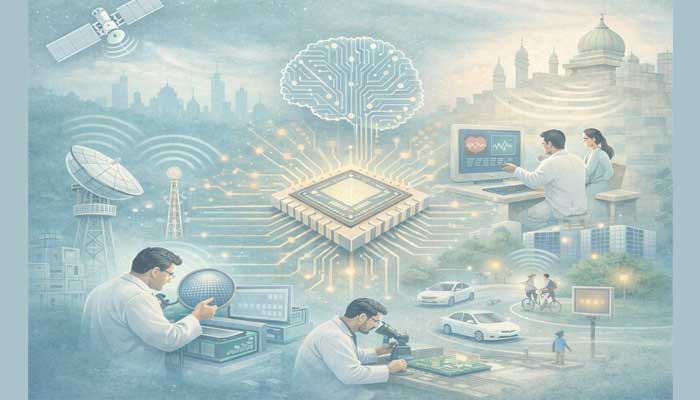
Hyderabad: Amid the country’s push to grow its semiconductor ecosystem, a research group at the International Institute of Information Technology, Hyderabad (IIIT-H) is working on something less visible but more foundational — designing electronics that move from silicon to real-world systems.
The Integrated Circuits Inspired by Wireless and Biomedical Systems (IC-WiBES) group, led by Prof. Abhishek Srivastava, develops application-specific integrated circuits alongside full systems built around them. Instead of treating chip design, signal processing and applications as separate areas, the team works across all three, refining hardware based on field feedback.
“For strategic areas like healthcare or critical infrastructure, generic hardware can become a bottleneck,” Prof Srivastava said. “We design custom chips where they matter most.”
Prof Srivastava said the company’s focus area is millimetre-wave radar sensing. Unlike cameras, radar works in fog, rain and low light, and does not capture images. The lab has built contactless systems that measure heart rate and breathing using subtle radar reflections, with clinical trials underway in hospital settings. The same technology is being tested for road monitoring, where it can detect vehicles and pedestrians in poor visibility without raising surveillance concerns, they informed.
“When deployments expose signal noise or interference, those insights feed back into new chip designs, including programmable radar generators and low-noise circuits tailored to specific needs,” Srivastava explained.
The lab operates a high-frequency measurement setup up to 44 GHz, facilities available at only a handful of institutions in the country, and has also completed its first fully in-house chip tape-out and participates in international semiconductor design programmes.
“Our students learn how circuit constraints shape system intelligence,” Prof. Srivastava said, the group’s aim is to train engineers who understand the full electronics stack. The work now sits at the intersection of chip design and public systems, where hardware decisions influence how technology serves society.
Disclaimer : This story is auto aggregated by a computer programme and has not been created or edited by DOWNTHENEWS. Publisher: deccanchronicle.com