The most relaxing part of my morning drive is the walk from the back car door to the driver’s seat after strapping the kids in. Today, at 7.54am, I’d slept six interrupted hours. My daughter was belting out Let It Go, demanding I turn it up but under no circumstances sing along. My son had dropped his Mickey Mouse toy and insisted I retrieve it immediately. Meanwhile, I was merging into peak-hour traffic, watching cyclists, clocking school zones and trying to keep everyone alive.
For me, the highest-stakes version of the parenting mental load is driving with kids in the car while I’m exhausted and required to be flawlessly alert. Research backs what us parents already know: kids are among the most significant distractions while driving. A Monash University study found parents spend over three minutes of a 16-minute trip with their eyes off the road.
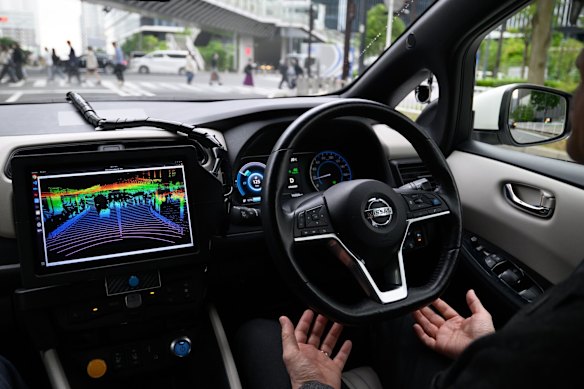
A driver takes their hands off the wheel of a Nissan Leaf electric vehicle equipped with autonomous driving technology during a test ride in the Yokohama, Japan.Credit: Bloomberg
I’m an anxious driver at the best of times, and the school run is never the best of times. So when my brother Josh offered me a spin in his new self-driving car, my first instinct was: No, thank you.
I didn’t know anyone else who’d driven one. Tesla’s Full Self-Driving (Supervised) mode only launched in Australia in September, making us the first right-hand-drive market to get it. I felt reassured that the rules are pretty strict: hands near the wheel, eyes on the road, full legal responsibility remains yours. Still, Josh claimed the car basically does everything. Everything?
Against my instincts, I tried it, and my reaction was immediate: Oh. I need this.
Once we were out of the driveway, the car just … took over. Like I’d handed the wheel to a competent stranger who’s never once sworn at a roundabout. I was still in the driver’s seat, but I was suddenly the passenger. It braked at a red light then glided through a right-hand turn without needing a single word of encouragement. It changed lanes with the confidence of someone who always gets enough sleep. In front of us, a pedestrian stepped off the curb mid-scroll and the car stopped instantly.
The whole time I’m sitting there, hands barely on the wheel, mouth open. At one point I was gazing out the window, probably looking too relaxed, and the screen beeped at me to pay attention. It tracks your eyes to make sure you haven’t mentally checked out, which feels dystopian but also like a reasonable precaution.
Otherwise, the car is surprisingly unobtrusive. There’s no GPS voice narrating its every move like I expected. You keep a light hand on the wheel to keep it satisfied, but all those micro-corrections, the ones that stack up when you’re tired and operating under strict Frozen-related performance notes, were suddenly not my problem. And I haven’t stopped thinking about it since.
I think that’s what surprised me most: I’m not a car person. I drive the way I do laundry – begrudgingly. For people like me, driving is a RAV4 cutting you off in peak hour, or getting stuck behind someone doing 35 in a 60 zone. It’s staying laser-focused when you’d rather be asleep.
Which made me realise self-driving cars aren’t for tech bros or rev-heads like I originally thought. I think they’re for the rest of us, the anxious drivers, the tired parents trying to do a hook turn while mediating a civil war over snacks, anyone who’s ever thought: this is just an unreasonable amount of responsibility.
Of course, this technology isn’t staying supervised forever. Fully driverless taxis are already operating overseas. Waymo has driven more than 100 million autonomous miles with significantly fewer crashes than human drivers.
I’m not suggesting anyone rush out to buy a self-driving car. I can’t afford one either, and persistent questions remain about whether self-driving cars meet our standards for safety. But for one brief moment, something else shared the hardest part of the mental load, the keeping-everyone-alive part. And unlike most tech, it wasn’t trying to replace, monetise or mine me. It just wanted me not to crash when my son dropped Mickey Mouse at 100km/h.
Now I’m back behind the wheel alone, watching brake lights and carrying the whole weight again. But I know what it felt like when I didn’t. And I can’t unknow it.
Ali Berg is a Melbourne writer, co-founder of Books on the Rail and co-author of four bestselling romantic comedy novels.
The Opinion newsletter is a weekly wrap of views that will challenge, champion and inform your own. Sign up here.
Most Viewed in National
Disclaimer : This story is auto aggregated by a computer programme and has not been created or edited by DOWNTHENEWS. Publisher: www.smh.com.au