
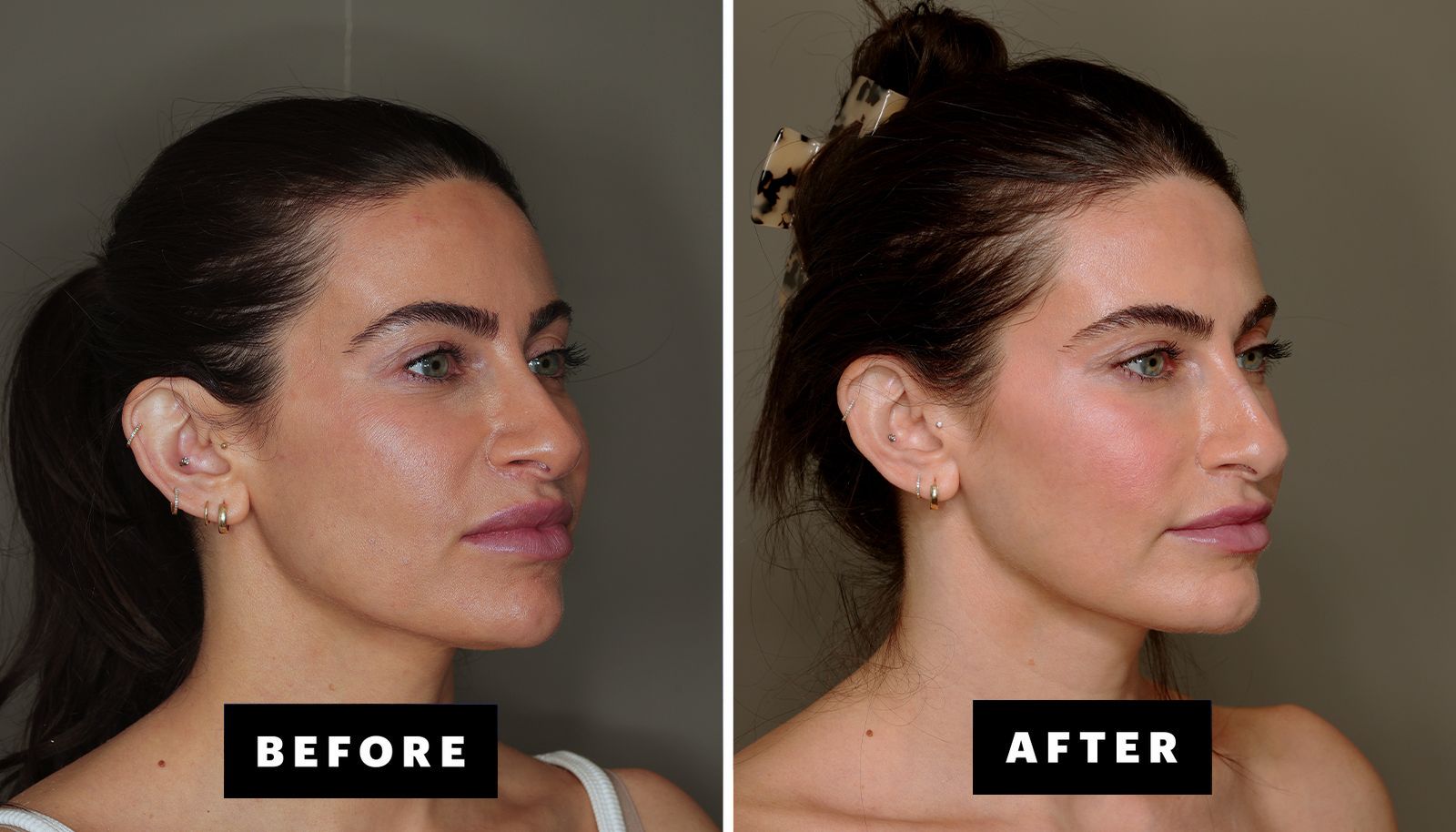
Though he said that I didn’t really need the procedure per se, as I have a relatively full face with minimal volume loss, in transferring fat to the areas where hollowing was starting to occur, I would simply be enhancing my features. “By even adding the smallest bit of fat into a face such as yours, it makes a huge difference in enhancing already great features,” Dr. Tepper explained.
I was excited at the thought that my own fat could correct hollowing and brighten any trace of dark circles under my eyes. Additionally, having fat injected into my temples would lift my brows slightly and round out the upper part of my face.
A few weeks after my consultation with Dr. Tepper, I decided to schedule my surgery for late February because I wanted to make sure I could take the time off from work (I am a teacher) and not have to go to school swollen and bruised and scare any of the kids away. (Although in hindsight, maybe that wouldn’t have been such a bad idea.) Unlike a quick trip to your dermatologist or plastic surgeon for hyaluronic acid filler, fat grafting involves going under IV sedation, a type of anesthesia administered through a vein, and requires much more forethought and planning.
A quick lesson (promise!) on facial fat grafting
I would be remiss as an educator if I didn’t give you some context on fat grafting and what the procedure actually entails. In the biz, we call it “prior knowledge” so listen up!
“[Fat grafting] is the idea that you’re taking fat from one part of the body and you’re placing it elsewhere,” says Dr. Tepper. The fat is taken by means of liposuction from your abdomen (as was the case for me), flanks, or, if you’re on the thinner side and don’t have enough fat in those areas, the middle and back of the thighs.
Once the fat is removed and placed in syringes, it’s reintroduced or injected into the areas in the face where you want to add volume. Again, in my case, it was reintroduced into my tear troughs (under eyes) and temples. Dr. Doft explains that once the fat is injected and settled, to only expect “about 50% of the fat to take.” Although in the face, she says, it could be up to 70%. Though fat is used to augment similarly to filler, fat is a live substance and filler is not, so the two are not interchangeable: “As a general rule of thumb, when fat is used for structural support to build foundation and volume, it’s very good,” says Dr. Tepper. “I think when it’s used simply as a replacement for filler, for fine lines and wrinkles, and areas of depression like the nasal labial folds, that’s not good. That’s not what it’s intended for.”
Goodbye filler, hello fat
Before my fat transfer, Dr. Tepper said I would have to prep the canvas first. So two weeks prior to my surgery, I had the remaining filler under my eyes dissolved. It was approximately five years old at that point and still causing me grief and swelling.
Disclaimer : This story is auto aggregated by a computer programme and has not been created or edited by DOWNTHENEWS. Publisher: www.allure.com





