I have spent my working life in the heart of the global energy machine. I advised former British prime minister Margaret Thatcher on energy and transport. I oversaw BP’s regional operations in Latin America and Australasia and I undertook drilling projects in the Middle East, Asia and North and South America. I have seen first-hand how quickly the world can go from calm to chaos if energy supplies hit a choke point.
The Strait of Hormuz is a critical choke point. This 50-kilometre stretch of water is the world’s busiest oil shipping channel, and it is effectively closed to most ships due to military threat. Ships aren’t moving into a zone where an escort or an escorted vessel is likely to be hit by aerial or undersea drones.
On Friday, the International Energy Agency advised governments around the world to consider measures to conserve fuel while the Iran war persists, including reduced speed limits on highways, asking citizens to work from home where possible, number plate rotation for buying petrol and encouraging a switch to public transport.
This is not a war of our making, but it is a crisis of our own making. Australia imports more than 90 per cent of its refined oil products. Our national fuel reserves sit at just 36 days, well below the 90-day international benchmark. Since the 1973 Yom Kippur War and the 1979 Iranian revolution, we have been painfully aware that being beholden to these maritime choke points is a fundamental weakness for our country. We have left ourselves exposed, and weak.
The world responded to the 1979 oil crisis by opening new oil fields in west Africa, South America, in deepwater in the Gulf of Mexico and elsewhere. But that is a last-century move that won’t fix a 21st century problem.
Doubling down on fossil fuels today doesn’t buy security. It keeps us vulnerable – tethered to the same volatile global markets and exposed shipping lanes. Today we have cleaner, cheaper and more reliable ways to power our nation – with wind, solar and electrification. These solutions are already onshore, and abundant, so they don’t require a naval escort.
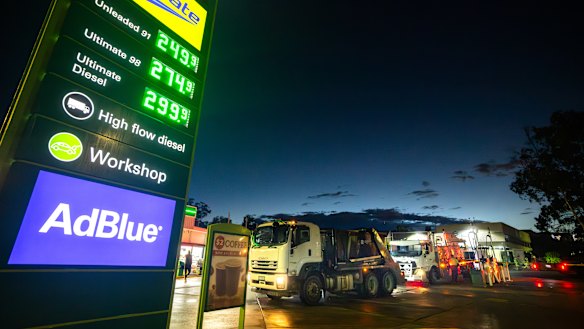
This conflict must be a wake-up call. Our reliance on coal, oil and gas is a direct risk to our national security and it is driving up our costs of living. Whenever global supplies of oil or gas are threatened, prices rise and Australian families pay. We are seeing the consequences at the bowser right now, and many households and businesses are rightly concerned about their next power bill.
But what we’re also seeing is that clean energy like solar and wind, battery storage and electrification can act as a shield to protect us. Australia’s main electricity grid is using record-high amounts of solar and wind, and record-low amounts of gas. Big batteries provided 3.5 times more energy in February this year than the same month last year.
Across Australia, there is also a record number of electric vehicles, at more than 450,000. That means 450,000 fewer drivers using petrol and diesel on our roads. Recent analysis from Mandala Partners reveals EVs have already materially increased Australia’s fuel independence, saving the equivalent of 1.2 days of petrol use. These are acts of economic resilience.
Which brings us to the federal budget in May.
It is short-termism at its worst for the government to be considering cutting the very incentives that are working to help families buy EVs and batteries, and that shield us against fossil fuel price shocks. At the same time, continuing to provide tax discounts for petrol-guzzling utes and a $10 billion diesel subsidy to multinational fossil fuel corporations seems out of kilter with today’s and tomorrow’s needs. The mining sector benefits most from the Federal Fuel Tax Credit Scheme. This effectively subsidises its continued use of diesel while holding back the economy-wide electrification of transport we desperately need.
The Albanese Labor government has an opportunity to deliver a budget for the times. To double down on the policies that support the electrification of homes and businesses, not walk away from them. To phase down subsidies that keep us tethered to volatile, polluting fuels such as oil and gas.
Right now, the government can protect households from price spikes by enforcing strong gas reservation policies that put local needs first. A levy on gas exports would make multinational producers pay their fair share. The proceeds could be returned to households and businesses to cushion bill shocks and accelerate decarbonisation.
But the only enduring fix is to phase out fossil fuels entirely. China understood this decades ago, diversifying into renewables and EVs to ensure its economy could withstand external shocks. Australia is an island continent with vast renewable resources. We have the wind, the sun and the technology to be a self-reliant energy powerhouse.
This type of global shock will happen again. The only question is whether we’ll keep exposing ourselves, or finally choose a safer, more stable and sensible path forward.
Greg Bourne is a councillor at the Climate Council, a former special adviser on energy and transport to British prime minister Margaret Thatcher and a former regional president of BP Australasia.
 Greg Bourne is a councillor at the Climate Council, former special adviser on energy and transport to British prime minister Margaret Thatcher and former regional president of BP Australasia.
From our partners
Disclaimer : This story is auto aggregated by a computer programme and has not been created or edited by DOWNTHENEWS. Publisher: www.smh.com.au