
India’s gaming industry may be growing at a blistering pace, but for many women building games behind the scenes, the journey has been far from easy. From proving credibility in male-dominated teams to personally financing projects due to a lack of investor confidence, women developers say the path has required resilience, persistence and a belief that their work will eventually speak for itself.
On International Women’s Day, ABP Live spoke with women producers across the industry to reveal both the progress made and the structural gaps that still exist in India’s rapidly expanding gaming ecosystem.
Breaking Through Isolation In A Male-Dominated Industry
For Megha Gupta, Producer for Spook-A-Boo and Co-Founder of Wala Interactive, entering the gaming industry a decade ago often meant confronting isolation.

Reflecting on her early experiences, Gupta said, “Ten years ago, I would walk into a room of 100 people and be the only woman there.”
She described the challenge as extending beyond representation to a deeper fight for professional credibility. “Beyond just the lack of representation, there was a persistent need to fight my way into the system and prove that I wasn’t just a girl who doesn’t know anything about gaming.”
Gupta added that she often had to push harder than her peers to ensure her voice was taken seriously. “I had to work twice as hard to ensure my voice was heard and my expertise was taken seriously.”
Despite those obstacles, she credits family support and a respectful team environment for helping her navigate the industry. Her latest project, Spook-A-Boo, developed by a team of just ten people, showcases that determination. The physics-based multiplayer game with couch co-op gameplay and multiple themed environments was completed within two years.
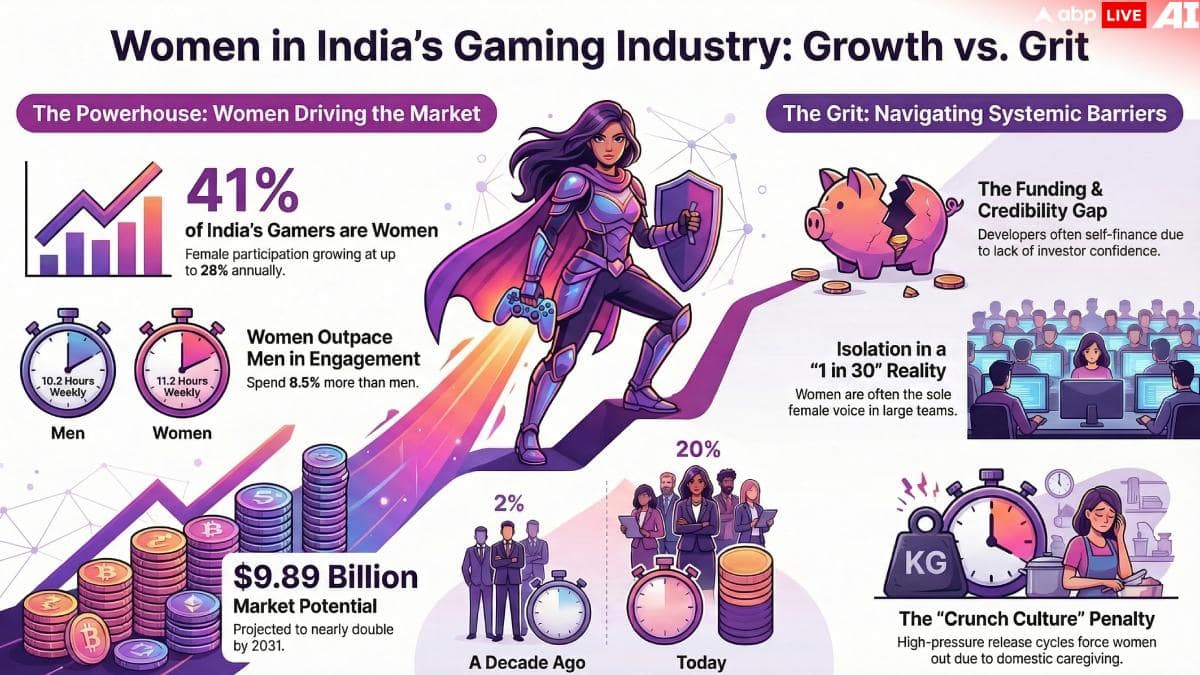
However, Gupta says structural challenges remain. While representation of women in the gaming industry has increased from around 2 per cent to roughly 20 per cent, she believes change is still slow.
Funding remains another major barrier. “I had to personally fund the entire production of Spook-A-Boo through my own savings and loans because the investment ecosystem often requires you to prove viability before offering support.”
Restarting A Career In A Fast-Moving Industry
For Vanita Mascarenhas, Producer at Dot9 Games, returning to the gaming industry meant starting over after stepping away earlier in her career.

“The video game industry is a $4 billion industry, and yet when I joined back in 2021, that number was not what I focused on. What drove me was something far simpler: Proving to myself that I still belonged,” she said.
Mascarenhas described how the industry’s intense “Crunch Culture” and the pressure around release cycles often create work-life challenges, particularly for those balancing family responsibilities.
“The work-life imbalance, the domestic and caregiving responsibilities had pushed me to leave earlier than I had intended,” she said.
When she returned years later, the industry had evolved rapidly. Technologies had changed, teams had expanded, and expectations had grown significantly.
“I had left at the peak of my career and restarted at the bottom, like everyone else, working my way up,” she said. Today, Mascarenhas works as a producer and often finds herself the only woman in a team of dozens of colleagues.
“Fast forward to today. I now hold the role of a Producer and the only woman in a room of thirty-odd men.” Yet she believes credibility ultimately comes from execution rather than identity.
“While conversations about diversity and representation are important, I believe in an equally important truth- capability creates credibility.”
Women Are Driving India’s Gaming Boom
The personal journeys of developers like Gupta and Mascarenhas unfold against the backdrop of a rapidly transforming gaming market in India.
Industry data shows the country’s gaming market was valued at about $5.02 billion in 2026 and could grow to nearly $9.89 billion by 2031. Women are increasingly central to that growth story.
Studies indicate that roughly 40 to 41 per cent of gamers in India are now women. Participation among female gamers is also rising quickly, with growth rates estimated between 15 per cent and 28 per cent annually.
Contrary to common stereotypes, women gamers in India are highly engaged. They spend about 11.2 hours a week playing games compared with 10.2 hours for men, and female paying gamers spend roughly 8.5 per cent more than male paying gamers.
Mobile gaming has played a major role in widening access. India’s mobile-first gaming ecosystem accounts for nearly 90 per cent of the country’s player base and has made gaming more accessible across smaller cities and towns.
The expanding participation of women gamers, combined with the rise of female developers and creators, is gradually reshaping the narrative around gaming in India.
As Gupta puts it, persistence remains key for anyone entering the field.
“My advice to the next generation is simple: if you truly love this art, pursue it with passion, and eventually, the industry will have no choice but to see you for your work.”
Related Video
News headlines at this hour in fatafat style | 6 December 2021
Disclaimer : This story is auto aggregated by a computer programme and has not been created or edited by DOWNTHENEWS. Publisher: abplive.com



