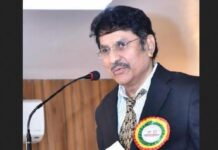
New Delhi: As India celebrates Vijay Diwas, Major General (retired) Lakhwinder Singh, a veteran of the 1971 India-Pakistan war, remembers a brief post-war interaction with an enemy soldier that left a lasting impression on him.
Commissioned into the Army in December 1967, Singh fought the war as a 23-year-old captain attached to a Field Regiment in Punjab’s Dera Baba Nanak sector, facing Pakistani positions across Kartarpur Sahib.
Days after the ceasefire was announced on December 16, 1971, a sentence spoken by a Pakistani soldier during a formal exchange between the two sides offered, in Singh’s view, an insight into how Indian Army officers were perceived across the border.
Speaking to The Times of India, the 77-year-old veteran, who was later known for his innovative use of artillery during the Kargil War, said, “I fought the adversary in the Dera Baba Nanak sector opposite Kartarpur Sahib on the western border. A few days after the war ended on December 16 with the declaration of a ceasefire, I was asked to lead a small contingent to exchange sweets and pleasantries with Pakistani counterparts to mark Eid.”
The meeting took place at a designated spot near the border, a brief pause between two armies that had just finished a brutal conflict.
“After reaching a common spot near the border, we exchanged greetings and sweets. After a few minutes, one of them asked about the officer handling artillery on our side, which was me. No one from our side revealed my name, but asked why they wanted to know. They said it was because artillery had caused heavy damage to them,” Singh added.
Then came a moment that caught everyone off guard. He recalled that a Pakistani soldier looked in his direction and said, “Agar India ke officers aur Pakistan ke jawan mil jaayen to duniya mein koi humein shikast nahi de sakta (If Indian officers and Pakistani soldiers come together, no one in the world could defeat us).”
“I simply smiled and thanked him,” Maj Gen Singh said, describing a sentence that revealed far more than battlefield tactics. To him, the statement reflected the deeply ingrained culture of Indian Army officers leading from the front, a quality he believes left a lasting impression across the border.
“Having said that, it is not that Indian soldiers are not brave, they are extremely courageous. But the statement surprised us. We heard something similar again more than two decades later during the Kargil War, which suggested that stories about Indian Army officers were passed down generations on the other side,” he said.
Drawing from his combat experience, he added another detail that reinforced the Pakistani soldier’s words.
“In the 1971 war, we largely encountered Pakistani JCOs (Junior Commissioned Officers) and NCOs (Non-Commissioned Officers) fighting at the front, which further reinforced that soldier’s remark,” he said.
Retired Lieutenant General Mohan Bhandari, who served along with Major General Singh during the Kargil conflict, echoed the same, offering an assessment based on years of experience on the battlefield.
“It is well known that Pakistani officers rarely lead their men from the front, unlike Indian Army officers. Indian officers are trained to lead from the front, not issue orders from behind,” he said.
He went on to explain the human cost of that leadership style. “That is why the proportion of Indian Army officers making the supreme sacrifice during conflicts is higher. They are prepared to kill and to die for their men without a second thought,” he added.
For Major General Singh, the memories of 1971 hold more than tactical lessons. One incident from the Dera Baba Nanak sector continues to feel deeply personal, almost spiritual.
The veteran described it as “something divine”. “It was December 6, 1971. I, along with soldiers, including those from 1/3 Gorkha, was tasked with attacking an enclave held by the Pakistan Army. The operation began in darkness, with heavy firing from our side,” he said.
As his unit advanced, they came across a fortified Pakistani pillbox. “While advancing, we encountered a Pakistani pillbox, which we fired upon for three to four minutes, a long duration in combat. We were certain that anyone inside would have been killed,” Maj Gen Singh recalled.
Then came the moment no training manual prepares a soldier for. “Just then, a Pakistani soldier emerged from the pillbox and ran towards safety. We froze and could not bring ourselves to pull the trigger. It felt like the Almighty had willed that he live,” he said.
On Vijay Diwas, as India remembers its decisive victory in 1971, stories like these reveal a less visible and human truth of war. Beyond strategies, uniforms and borders, certain moments linger because they expose the shared humanity that exists even between enemies.
Disclaimer : This story is auto aggregated by a computer programme and has not been created or edited by DOWNTHENEWS. Publisher: ZEE News