
Opinion
The Secret Pilot takes you inside the world of airlines, offering expert tips and advice from a pilot’s perspective. In his Traveller column, this active airline pilot lifts the lid on air travel both inside and outside the cockpit.
As far as making small talk goes, being an airline pilot is usually a bit of a winner when it comes to filling the void. Certainly, I thought answering questions about autopilots or staff travel would be enough to get me through the trip to a new barber. Instead, he asked: “Surely you agree the Earth is flat?”
Closing my eyes and breathing deeply, I smiled and politely disagreed. The next 20 minutes of my life I’ll never get back, as I tried to work through enough facts to debunk his strange belief.
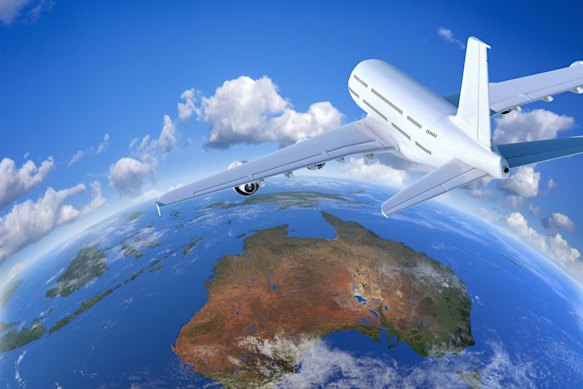
He was right about one thing though. Airline pilots are among the best placed to be able to know the shape of the Earth. But I can confidently report the third rock from the sun is an oblate spheroid, or as it is more commonly known, a sphere.
International pilots confirm this daily by taking the shortest possible route to their destination. On flights from Sydney to Johannesburg, that route goes over at least one other Australian capital city, but it’s not Perth – it’s Melbourne, or sometimes even Hobart.
This is where having a globe comes in handy, to look at the two locations on a spherical map and determine the great circle track between them. On a flat map these tracks appear curved, but they are in fact, the most direct line between two points on a sphere. While Melbourne or Hobart sit on the flight path between Sydney and South Africa, a flight from the US to Europe flies over Greenland. No doubt a view for Donald Trump to enjoy on the way to visit the King.
Sign up for the Traveller newsletter
The latest travel news, tips and inspiration delivered to your inbox. Sign up now.
The kooky bit of great circle track navigation is that the aircraft is continuously changing compass heading, unlike a rhumb line which maintains a constant bearing. On that Sydney to Johannesburg flight, for example, the initial compass heading is approximately 190 degrees but 12 hours later, having flown deep over the Southern Ocean while still maintaining a straight line, the compass heading is 340 degrees.
It is the compass which tells the story, because unfortunately the ability to actually see the curvature of the Earth is somewhat limited. Passenger aircraft have a cruising ceiling around 40-45,000 feet (12,000-13,700 metres), which is a whisker away from being enough. But those who were lucky enough to travel on the Concorde between New York and Europe were able to catch a glimpse as the supersonic wonder cruised at 55-60,000 feet (17,000-18,000 metres) above the ground.
US air force pilots responsible for flying the U2 reconnaissance plane have also witnessed the Earth’s curvature. Since the 1950s, the Dragon Lady as it is known, has climbed to 70,000 feet (21,000 metres) on top secret missions with the inky black of space meeting the thin layer of atmosphere that can sustain life, although these aircraft are being retired from service this year after more than 60 years of skimming the Earth’s atmosphere.
For everyone else, getting a sense of what the flight paths really look like comes back to having access to a globe. I once received one as a special gift. Mapping out the straightest line between two points is as simple as using a piece of string.
The confusion for flat-Earthers though, probably comes from the fact that carrying a globe around is a tad impractical, so in 1569 Gerardus Mercator created a cylindrical map type which remains known today as the Mercator projection. Most flat maps on the internet, or on the wall at the local travel agent, are designed using Mercator’s ruleset.
As well as flattening things out, the Mercator projection severely distorts the size of land masses, particularly closer to the poles. Looking again at Greenland, on a Mercator projection map it appears about 50 per cent larger than Australia, when in fact it is three and a half times smaller. Even its nearest neighbour Canada is more than four and a half times the size of Greenland. Antarctica is also distorted by the Mercator projection, with a land mass of 13.66 million square kilometres, just under double the size of Australia at 7.688 million square kilometres.
This flat map type shows lines of constant compass bearing as straight lines. This is ideal for nautical navigation, which is how they tended to travel when Mercator developed the projection in 1569. It’s also not bad to hang on the wall. But it isn’t very useful for flying around a spherical planet.
Of course, the ultimate sky-high view of the sphere belongs to the space travellers. The “Earthrise” picture is one of the best known from the Apollo space program and regarded as the most influential environmental photo ever taken. Astronaut Bill Anders snapping the extraordinary photo of Earth as a sphere on Christmas Eve 1968, as Apollo 8 swung around the dark side of the moon.
I’m unlikely to go back to that barber to see if I managed to change his mind, just in case he has a view about those Apollo moon landings as well. Or – even worse – chemtrails…
 The Secret Pilot takes you inside the world of airlines, offering expert tips and advice from a pilot’s perspective. In his Traveller column, this active airline pilot lifts the lid on air travel both inside and outside the cockpit.
From our partners
Disclaimer : This story is auto aggregated by a computer programme and has not been created or edited by DOWNTHENEWS. Publisher: www.smh.com.au






