By Oliver Brown
For a man who was still his country’s prime minister four years ago, life today in Pakistan could hardly be more desolate for Imran Khan.
Languishing in Rawalpindi’s Adiala prison, the 73-year-old cricket icon has, according to information shared with the United Nations, been spending 22 hours a day in solitary confinement, with his cell under constant surveillance. Even minimal family visits are understood to be denied, with his country’s military apparently hell-bent on snuffing out his last vestige of resistance.
Imran Khan went from World Cup winner, to prime minister to now prison.Credit: Aresna Villanueva
“It’s psychological torture that they’re employing to try to break him,” says his son, Kasim. “But he’s very, very tough to break.”
Kasim and Sulaiman, Khan’s two boys with his first wife Jemima Goldsmith, are at their wits’ end in pursuing a solution to a nightmare that has been deepening over 2½ years. This week marks the nadir, with an inflammatory social media post dictated by Khan about Asim Munir, the army’s chief of staff – a man whom he accused of “moral degradation” – offering a pretext to strip him of all rights and dignity.
Worse, his legal jeopardy is acute, with his 14-year sentence for corruption, based on what he claims is a politically motivated thirst for vengeance, complicated by the constant addition of fresh charges. The family fears there is no way out.
“There are over 200 cases,” Kasim explains. “Each time one case is overturned, two or three are put on him. It’s just a way to delay any resolution.”
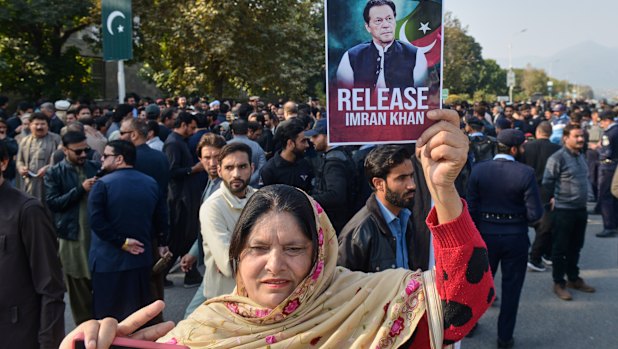
Supporters of Pakistan’s imprisoned former Prime Minister Imran Khan hold a demonstration outside Islamabad High Court earlier this month.Credit: AP
The prison conditions, Sulaiman indicates, are almost beyond endurance. “He’s in a very small cell, which has been described as a ‘death cell’, because this is where they’ve held people who are on death row,” Sulaiman says. “Sometimes the electricity is cut off. Sometimes he won’t be allowed reading materials.”
“The water that he showers in is not just dirty, but discoloured,” Kasim says. “A dozen prisoners in that jail have died of hepatitis, and all of them were supporters of PTI, his political party.”
The prison’s superintendent insists that anybody carrying an infectious disease is isolated from other inmates. But a report by Alice Jill Edwards, the UN’s special rapporteur, paints the bleakest picture, with Khan’s cell described as small, poorly ventilated, lacking in natural light, with extreme temperatures and insect infestations leading to nausea and weight loss.
How did we reach this point? We are talking, after all, about an emblematic figure in Pakistan’s history, one of the most sophisticated all-rounders cricket has produced and the architect of his nation’s solitary 50-over World Cup triumph in 1992. In that tournament, he famously exhorted his players to “fight like cornered tigers”, even wearing a T-shirt emblazoned with the animal to emphasise his defiance.
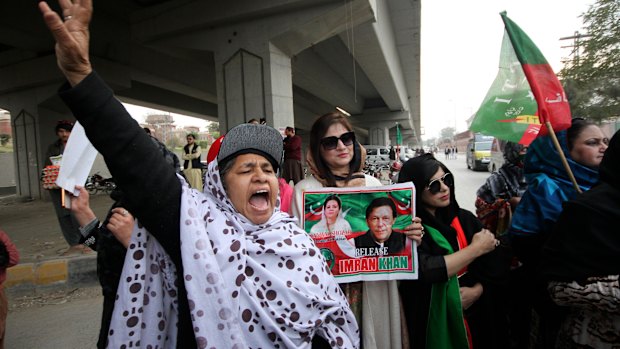
Supporters of imprisoned former prime minister Imran Khan chant during a protest in Peshawar condemning the court verdict.Credit: AP
His cultured image as a player was matched by his flamboyance beyond the boundary, with his single status and fondness for London’s Tramp nightclub making him a fixture of ’90s gossip columns. Johnny Gold, the club’s owner, likened his effect on women to that of George Best. “No man,” said the model Marie Helvin, “was as devastating as Imran.”
Jemima, the then 21-year-old heiress whom he married in 1995, was devoted to him. For all the intense scrutiny on the couple’s cultural differences and 22-year age gap, she said after the marriage: “Without in any way wishing to disparage the culture of the Western world, into which I was born, I am more than willing to forgo the transient pleasures derived from alcohol and nightclubs.”
Despite the sadness of their divorce in 2004, her concern for his condition, and for the agony his incarceration has inflicted on their two sons, remains acute. Just this weekend, she has written to Elon Musk to urge him to stop suppressing posts on X about Khan, alleging the company was guilty of “secret throttling”.
“She’s definitely concerned for us,” says Kasim, the younger brother at 26. “She knows how important he is to us.
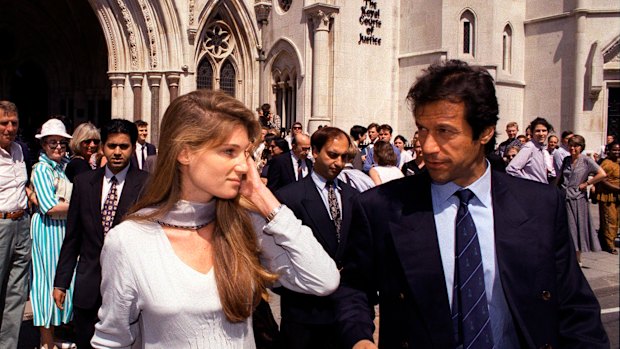
Imran Khan with his then wife, Jemima, in London in 1996.Credit: AP
“He’s not an estranged father at all. We grew up with him our entire lives, throughout our childhood. He would come to stay with us in Richmond, every single major holiday and some half-terms. We were constantly with him. It’s very difficult for her to watch her sons going through this.”
Both he and Sulaiman, three years Kasim’s senior, are hopeful that speaking up will help sharpen the public consciousness of Khan’s plight. At times, their lobbying on his behalf can feel futile. With cricket seldom in such an international spotlight as midway through an Ashes series, what better time could there be to highlight the desperate struggle of one of the sport’s enduring idols against the oppressions of the Pakistani state? And yet you look in vain for an official statement anywhere, even from England or Australia – never mind the Indian-dominated International Cricket Council, in whose hall of fame Khan sits.
The sons are concerned that raising their voices will only intensify the determination of the government of Pakistan’s prime minister, Shehbaz Sharif, to make an example of Khan. “It seems like every time we react or do anything, they make things worse,” Kasim laments.
“This time, they have an agenda to make it pretty dark.” But equally, there is an acceptance that they cannot stand idly by while the persecution escalates.
‘It’s psychological torture that they’re employing to try to break him. But he’s very, very tough to break.’
Imran Khan’s son Kasim
“I hated him being in politics when I was younger,” Sulaiman says. “I was constantly worried, because I would hear stories that his life was in danger. There have been two incidents already where he almost died: in 2013, he fell off a 20-foot platform during a rally in Lahore, and three years ago he was shot.
“As an adult, I have a different perspective on it now. Selfishly, I would love to be able to see him and for him to be with us here. But I also want him to keep going, because this is what he sees as his mission.”
It is among the more astonishing facts about Pakistani politics that over the past 50 years, every one of the country’s prime ministers has had to serve time in prison. Typically, these situations are resolved by bargaining: Dr Farzana Shaikh, an associate fellow at Chatham House and author of Making Sense of Pakistan, suggests that the only two outlets open to Khan are exile in London or house arrest in his homeland. I ask his sons if any part of them would be eager, if only to alleviate the torment of the bulletins from prison, for him to accept such a deal.
“I genuinely think he would be depressed if he came to London,” Kasim says. “It would be gnawing away at him that the country was in a shambles and run by these crooks, and I don’t think he’d be able to lead a happy life. What keeps him going, keeps him alive, is fighting against that.”
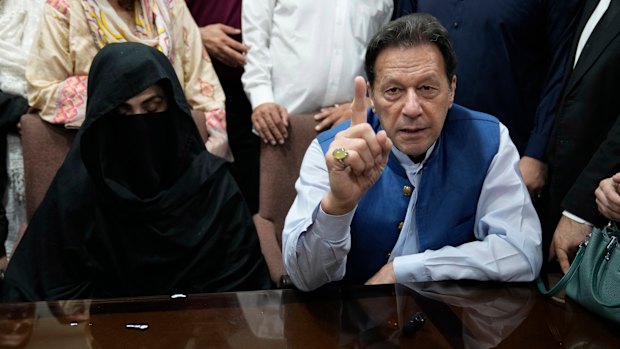
Pakistan’s former Prime Minister Imran Khan, right, and Bushra Bibi, his wife, talk to the media in July 2023.Credit: AP
As for enforced seclusion at his house in Lahore, Sulaiman argues that this, too, is off the table. “He wouldn’t be allowed to operate his party or even to speak about politics. He wouldn’t accept that.”
In an attempt to engineer a breakthrough, Sulaiman and Kasim travelled earlier this year to Washington to meet Brad Sherman, a Democratic congressman, and Richard Grenell, a special presidential envoy, garnering support for Khan’s release.
But the notion of President Trump enabling that possibility is, Sulaiman says, remote. “The army chief and Trump have, unfortunately, got quite a good relationship at the moment. Pakistan’s government has said that it will nominate Trump for the Nobel Peace Prize.”
This leaves only one option for the brothers: to travel to Pakistan themselves, appealing to the better nature of politicians who would rather see their father dragged through indefinite legal turmoil. But the risks are huge, with any action that could be interpreted as a protest leaving them open to arrest themselves.
“If we get arrested, it could mean that he loses his leverage, his unbreakable will,” Kasim says. “It might be the one thing that leads him to take a deal, because he never wanted us to be in politics, or to be muddled in his chaos. He would be conflicted, and I’d hate to be the reason for that.”
There is an even more urgent factor to consider. “I’d just love for us just to visit. He’s 73. It’s hard to know whether we’re even going to see him again.” Amid a benighted chapter in one of the richest sporting lives, this is, surely, the most sorrowful thought of all.
The Telegraph, London
Most Viewed in Sport
Disclaimer : This story is auto aggregated by a computer programme and has not been created or edited by DOWNTHENEWS. Publisher: www.smh.com.au