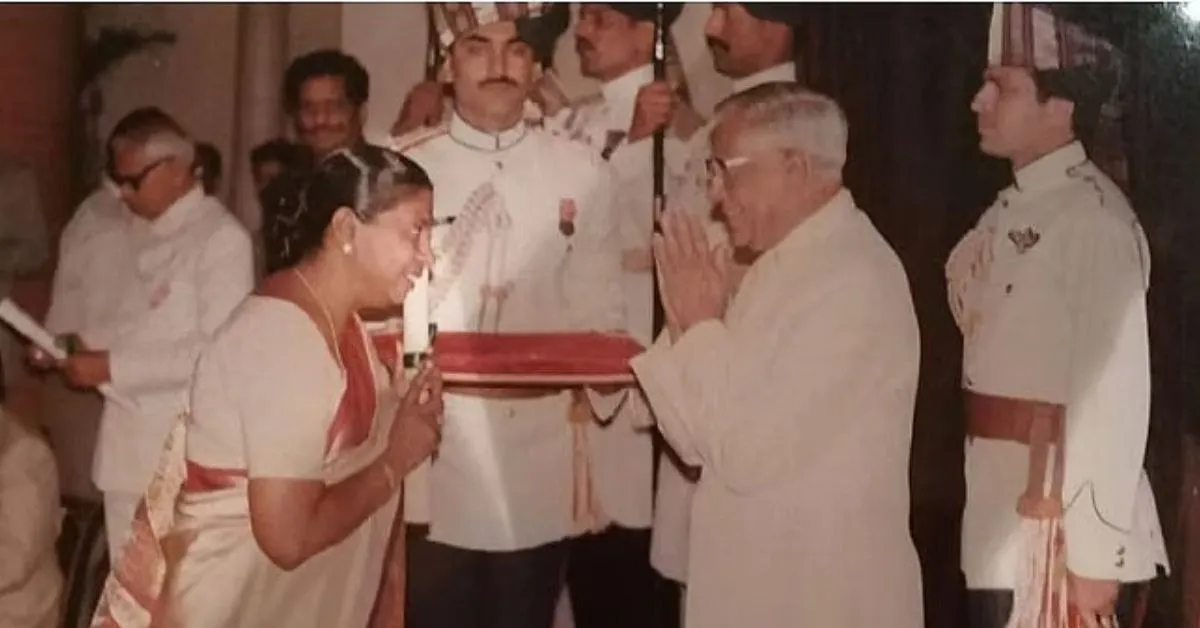
In walking the corridors of power, Anna Rajam Malhotra opened doors for generations of women to follow. India’s first woman IAS officer, Anna’s dedication to the job was unwavering. In rooms steeped in patriarchy, her calm resolve and hard work stood out. Every barrier placed before her became a step she climbed, not a wall that stopped her.
She did not raise her voice to be heard; instead, her persistence spoke for her. In choosing courage, day after day, she transformed resistance into history.
This is her story.
Born in Kozhikode, Kerala, Anna studied at the Malabar Christian College and completed her BA Honours at Presidency College, Chennai (then Madras). With few professional avenues open to women at the time, Anna began her working life as an upper division clerk at the Accountant General’s office in Chennai. She didn’t have plans of joining the civil service until her engineer cousin brought home an application form for the Civil Services Examination in 1950.
The family was simple. Even the Rs 140 application fee seemed a hefty amount, and a friend’s mother stepped in to pay.
During the interview round in 1952, when Anna expressed her desire to become an IAS Officer, the interview committee suggested she instead try for the foreign service since it was more suited to women.
As her younger sister Grace shared in an interview with The News Minute, “At that time, Chakravarti Rajagopalachari, former governor general of India, was chief minister (of the then Madras). He interviewed her [Anna], and he told her that he didn’t approve of women being in public service. But she argued with him. ‘You should give me a chance’, she said. And he was persuaded to post her to Hosur, which was on the border of the then Madras and Mysore (now Mysuru). She went through the training process, which included military training. She had to learn how to ride, to shoot, she had to do everything that men had to.”
Her first posting was as sub-collector of Tirupattur (in Tamil Nadu); Anna Rajam was allotted the Madras cadre. Often, Anna found herself in a room full of male officers. There were no established norms for how a woman in authority should be accommodated. Yet, she steadily won the respect of her colleagues through competence, fairness, and a quiet, unshakeable strength.
The IAS Officer and the elephants
One story that is often told to underscore the bravery of this IAS Officer was that of the time when a herd of elephants from the Denkanikottai forest (in Tamil Nadu) had lost their way and wandered eastward into open farmland, frightening villagers along the route.
After trekking nearly 18 miles, the animals reached Hosur, prompting anxious residents to gather outside the bungalow of Anna (then Sub-Collector) in search of help.
Anna was known for thinking on her feet; she remembered that elephants were often frightened by loud noise, and asked the villagers, in her limited Tamil, to bring tins, cans, and anything that could clang. Together, they advanced toward the herd and created a din in an effort to drive the elephants away. Her plan was successful.
As M K K Nair, an IAS Officer of the 1949 cadre and a close friend of Anna, mentions in his book Mango Seed and Other Stories, when the news of how Anna had helped drive the elephants away hit the press, “The men who read the news were not amused. Some raised eyebrows! What! A woman in the IAS? A she-elephant storming into the bastion of bull-elephants? How did the Government permit this? If a serious riot broke out, would a girl be able to quell it? Or give orders to shoot? Would she be able to face a charging mob of communal madmen and address them?”
This wasn’t the only instance that underscores how indefatigable Anna was. Grace also recalls how she persuaded the Madras Government to give people electricity, and during Indira Gandhi’s tenure as prime minister, she became involved in decisions regarding the Green Revolution, in her role as agricultural secretary.
A story often retold is of how she had to accompany Indira Gandhi on an eight-state tour to review food production, a trip she undertook despite a fractured ankle. Another feather in her decorated cap was the building of the Nhava Sheva port (Jawaharlal Nehru Port Trust (JNPT)) in Mumbai, which won Anna the Padma Bhushan in 1989.
Through her career, she maneuvered numerous roles — additional secretary of the department of animal husbandry and fisheries, chairperson of the National Seeds Corporation, head of the state farms corporation in 1981, and secretary of the department of education and culture in 1982. It’s said she also worked closely with Rajiv Gandhi when he was in charge of the 1982 Asian Games, to help set it up.
At no point did she ask for exceptions to be made due to her being a woman. Even at the time of appointment to the services, when a clause stated, “In the event of marriage, your service will be terminated,” she conceded. At the time, only unmarried women or widows could join the service.
But Anna was certain of the path she wanted to follow.
Knowing full well that her marriage to Ram Narain Malhotra, her IAS batchmate, would bring about social retaliation (because of their different religions; R N Malhotra was a Punjabi), Anna still went ahead with it, albeit the duo married in 1975 in Washington, DC. Ram rose to the rank of governor of the Reserve Bank of India, passing away in 1997.
Anna passed away in 2018. Her administrative service was followed by her role as director of the board of The Leela Group, which was pioneered by Capt Krishnan Nair. She busied herself with projects and board meetings.
There were no grand headlines loud enough to match the quiet revolutions she had set in motion. Yet long before the world paused to measure her legacy, she had already redrawn its possibilities. In corridors where doors once stood firmly shut, they now open a little easier for women — because she walked through first.
Sources
‘Anna Rajam Malhotra — A Luminary’: by Maddy, Published on 5 May 2020.
‘‘She had to argue to get her posting’: Remembering Anna, India’s first woman IAS’: by Cris, Published on 22 September 2018.
Disclaimer : This story is auto aggregated by a computer programme and has not been created or edited by DOWNTHENEWS. Publisher: thebetterindia.com