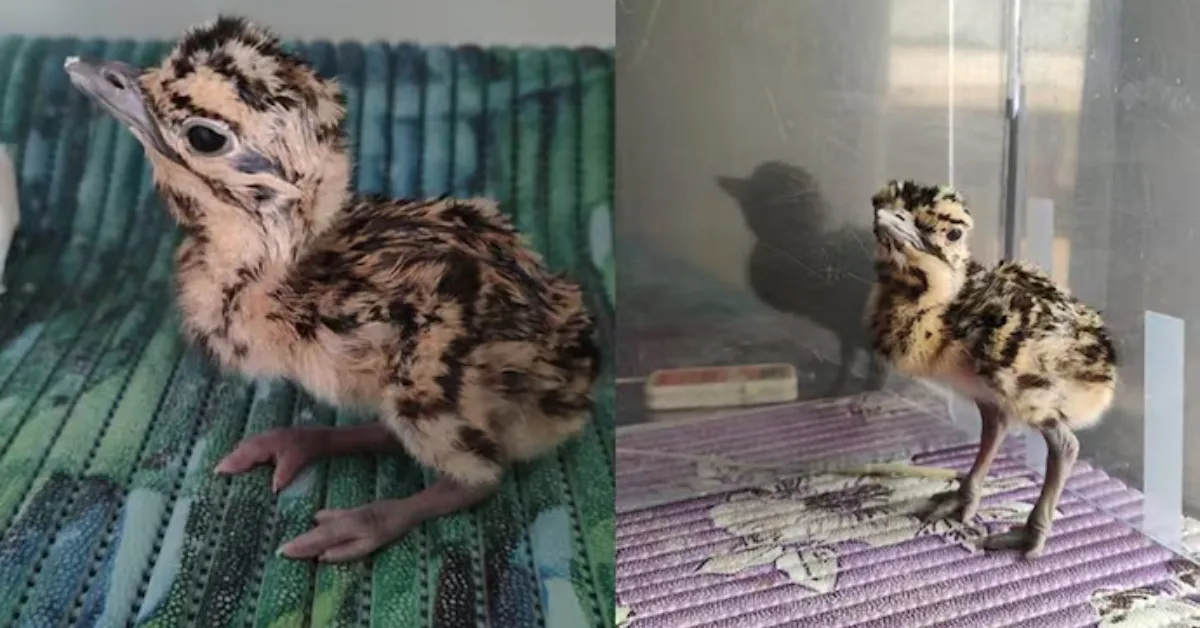
In the vast, wind-swept grasslands of Kutch, hope is walking on two fragile legs.
A week-old chick of the Great Indian Bustard, one of India’s most critically endangered birds, is being raised in the wild, marking a rare and significant breakthrough for conservationists working to save the species from extinction.
“The region has not seen a Great Indian Bustard chick in over a decade. This is the first time we’ve attempted a ‘jump start’ like this in the wild,” says IFS officer Dheeraj Mittal, Conservator of Forests, Kutch, Government of Gujarat. “A fertile egg was swapped with an infertile one in a natural nest. The egg hatched successfully, and the mother has accepted the chick.”
For a species that hasn’t recorded a successful chick birth in the wild for over 10 years, this moment is nothing short of extraordinary.
Small intervention, big shift
The idea behind the intervention was both simple and bold, working with nature rather than against it.
With wild populations dwindling and no viable mating pairs left in Gujarat, conservationists had little chance of obtaining a fertile egg in the wild. In fact, only three female Great Indian Bustards survive in the grasslands of Kutch.
To work around this, a fertile egg reared under Project Great Indian Bustard at a captive breeding facility in Rajasthan was transported over 770 km by road, from Sam to Naliya, in a carefully coordinated journey without halts, before being placed in a wild nest.
The hope was that the mother bird would continue incubating it, unaware of the swap, and raise the chick as her own.
And it worked.
“The mother is showing strong maternal instincts,” Mittal says. “We are monitoring the chick only through binoculars and drones within a contained zone. There is absolutely no physical handling.”
That restraint is deliberate. For conservationists, ensuring the chick bonds naturally with its mother is as important as its survival.
Most vulnerable month
Right now, the chick is in its most delicate phase. For the next few weeks, it will remain flightless, staying within a small, predictable area — making it especially vulnerable in an environment that has become more challenging over time.
“The first month is critical,” Mittal explains. “The chick cannot escape predators yet.” And the list of threats is long: jackals, foxes, wild cats, and increasingly, stray and feral dogs. To protect it, teams have mobilised around the clock.
/filters:format(webp)/english-betterindia/media/media_files/2026/04/07/avantika-featured-image-template-20-2026-04-07-12-35-33.png)
“There is 24/7 manpower deployed in the area,” he says. “We are not just guarding against predators, but also human disturbances such as grazing, vehicles, and even people unknowingly entering the zone.”
It’s an intensive, almost hands-on approach to a species that once thrived without such intervention — a reflection of how much its ecosystem has changed.
Bird on the brink
The Great Indian Bustard was once a common sight across India’s grasslands. Today, its numbers have plummeted drastically, with Kutch in Gujarat emerging as one of its remaining habitats.
“Across India, populations are now extremely fragmented,” Mittal notes. “In many places, numbers are too low for natural breeding to happen effectively.”
The reasons are complex but familiar: habitat loss due to expanding infrastructure, fragmentation of grasslands, and one particularly deadly threat — collisions with overhead transmission lines.
“These birds have poor frontal vision,” Mittal explains. “They often don’t detect power lines in time, which leads to fatal collisions.” Over time, these pressures have not only reduced numbers but also disrupted breeding patterns.
“With fewer individuals and fragmented habitats, finding a suitable mate in the wild has become increasingly difficult,” he adds. “That’s why we hadn’t seen chick births in the wild for years.”
Can this be a way forward?
The success of this intervention offers a new direction — one that blends scientific support with natural behaviour.
Unlike captive breeding, where chicks are raised in controlled environments, this method ensures the bird grows up learning survival directly in the wild — from foraging to evading threats. “This approach allows us to retain natural instincts while still supporting population recovery,” Mittal says.
But scaling it up won’t be easy. Each intervention requires careful planning, constant monitoring, and significant manpower. And even then, survival is not guaranteed.
/filters:format(webp)/english-betterindia/media/media_files/2026/04/07/avantika-featured-image-template-18-2026-04-07-12-36-56.png)
For now, all eyes are on the chick — from a respectful distance.
If the chick survives the next few weeks, it will attempt its first flight, a milestone that brings both relief and a new set of challenges. “Once it takes flight, tracking becomes much harder,” Mittal says. “That’s when uncertainty increases again.”
And yet, that uncertainty is also the goal, as it marks a return to the wild where the species can eventually sustain itself without constant human watch.
Fragile but powerful hope
In a landscape where the Great Indian Bustard has been steadily disappearing, this one chick represents more than just a successful hatch.
It represents a possibility. A reminder that even in the face of long decline, carefully designed interventions, rooted in patience and respect for nature, can still shift the story.
“It’s a hopeful beginning,” Mittal says. “But conservation is a long journey. This is just one step.”
For now, that step is enough. Somewhere in Kutch’s grasslands, a tiny bird is learning to walk, and with it, an entire species’ future.
Disclaimer : This story is auto aggregated by a computer programme and has not been created or edited by DOWNTHENEWS. Publisher: thebetterindia.com