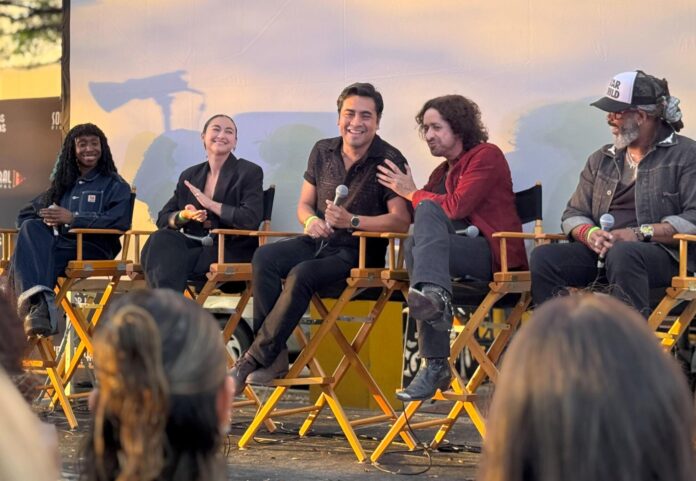
The golden-hour sun illuminated the crowd standing under the trees outside Mercado La Paloma, which had gathered on Saturday afternoon for a panel on the lack of Latino representation in the film industry as part of the South Central Film Festival.
“I’m a queer, undocumented Mexican immigrant. I am what inspires me to create stories,” said Armando Ibáñez, the 42-year-old, Los Angeles-based filmmaker known for his YouTube series “Undocumented Tales.”
Earlier that day, Ibáñez had won a jury award for his short film, “Her Last Day in the U.S.,” about an elderly undocumented immigrant woman returning to Mexico after living in the United States with her family for almost 40 years.
“I would always see movies from Hollywood about immigrants — characters that were supposed to represent me — full of stereotypes,” Ibáñez said. “We are more than just crossing the border and getting deported. We have feelings. We have a past. We have a present. We have complex stories.”
Filmmakers Kei Austin, from left, Sierra Fujita, Armando Ibanez, Daniel Eduvijes Carrera and Sekou Andrews speak at a panel March 28 during the fourth South Central Film Festival.
(Nicole Macias Garibay / De Los)
Now in its fourth year, and presented by Esperanza Community Housing and L.A. Grit Media, the South Central Film Festival invited Indigenous, Black, Brown, LGBTQ+, immigrant and disabled filmmakers to submit their work, including those in a language other than English. The festival, which took place March 27 and 28, featured over 40 short films, animation and experimental works.
“The name South Central Film Festival is an assertion that we are here, we cannot be moved and we don’t accept the renaming of our community,” said Nancy Halpern Ibrahim, executive director at Esperanza Community Housing.
Halpern Ibrahim says that as an anti-displacement-driven organization, Esperanza Community Housing is all about investing in the communities who have long lived in South-Central L.A., especially Black and Latino residents affected by gentrification due to private investors’ efforts to build luxury housing and USC’s expansion of student dorms.
“People who are born and raised in South-Central L.A. feel very strongly that’s the name of their neighborhood, which is being replaced by south downtown or USC-adjacent names that make the neighborhood friendly for developers, who are part of the difficulty that we have here,” said Halpern Ibrahim.
With this festival, Esperanza Community Housing is building a platform that is providing visibility to underrepresented voices, said Sandy Navarro, director at L.A. Grit Media and festival founder.
“We’re a huge population, nearly 20% of the [U.S.] population, yet we’re always seeing that lack of representation and the cultural erasure of Latinos,” said Navarro. “To be able to bring something to South-Central that is pushing back against that lack of inclusivity is meaningful.”
Investing in the talents of the community is a core mission for the festival, the organizers said. Earlier this month, the organization hosted a seminar with special effects makeup artist Veniesa Dillon on sculpting techniques and prosthetic application. In May, two additional workshops will be hosted, where a professor at Cal State Long Beach will teach an animation class.
“I’m very grateful with the festival because they are really doing a lot of work in order to empower and inspire filmmakers in our neighborhoods. They should have the right to dream big,” said Ibáñez, who has also facilitated several workshops for the organization.
For filmmaker Daniel Eduvijes Carrera, being recognized with a jury award at the 2023 edition of the film festival for his short movie, “El Paisa” — a film about a queer, goth skater, who falls in love with a Mexican cowboy in East L.A. — encouraged him to pursue storytelling that shows the “nuance, brilliance, heartache and the beautiful aspects” of the Latino community, he said.
“Having those awards and recognitions from precisely the spaces that you’re making films to represent, it really validates the work,” Eduvijes Carrera said. “The community embraced this project as something that reflects them in a way that they want to be reflected, and that, for me, is one of my goals whenever I do create a film.”
At the 2024 Cannes Film Festival, “El Paisa” was selected for the American Pavilion Emerging Filmmaker Showcase, taking home the LGBTQ+ showcase award.
“What does France know about the queer rancheros coming from different places in Mexico where they couldn’t really be themselves, but now hang out at Club Tempo in East Hollywood?” Eduvijes Carrera said. “To put my intersecting communities on the map, was one of the greatest feelings and one of the greatest accomplishments.”
South-Central L.A. native Angie Bravo, 26, attended the festival to watch “Eres Suficiente,” the short film by her wife’s cousin, Veronica Jurado. To them, the movie captured the experience of growing up Chicana in the U.S.
“It was pretty emotional watching it,” Bravo said. She doesn’t feel comfortable speaking Spanish because she doesn’t know how to speak it anymore, even though it was her first language. “Growing up, it was kind of hard, because I felt like I couldn’t have conversations with my grandparents. I wish I was able to ask them questions.”
For her, it’s important that the filmmakers “pay respect” to the people who built South-Central L.A. “If we’re gonna portray them, we might as well share the creations with the community that we’re inspired by, right?”
More to Read
Disclaimer : This story is auto aggregated by a computer programme and has not been created or edited by DOWNTHENEWS. Publisher: latimes.com