The movie is called “Yes” but it’s not the kind of yes that comes after someone offers you another cupcake. Nor is it the so-bad-it’s-good acquiescence to a guilty pleasure (or a guilty pain). What Israeli filmmaker Nadav Lapid is out to evoke is bone-deep submission: the kind of total capitulation and surrender that makes a person unrecognizable even to themselves. Of course, his film is a comedy, the darkest one in a while.
It’s not long into the running time that we get to know wiry, bearded Y (Ariel Bronz, impressively tamping down a jangle of nerves), who offers us his philosophy in a half-mutter. Pedaling down the beach during a pink-hued Tel Aviv dusk, he tells his infant son in the baby seat to give up. “Give up to the sea,” he says, and to all the good things: T-shirts in winter, a stranger’s smile. “As early as possible,” he insists. He knows no other way to beat down the constant text alerts of attacks that are breaking his brain.
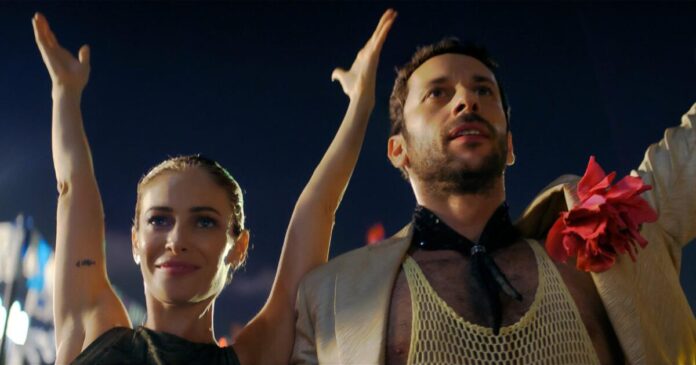
Seeing Y, a pianist and songwriter, and his wife, a hip-hop instructor named Yasmin (Efrat Dor), in their domestic bliss — they’re parents of a child who, in one of Lapid’s wicked flourishes, was born Oct. 8, 2023 — is already something of a shocker. If you can imagine the strutting Nicolas Cage and lithe Laura Dern of David Lynch’s “Wild at Heart” but with an apartment and a kid, that’s them. Normally, they’re out livening up parties thrown by Israel’s ruling class. They rip off their clothes, dunk their heads in the dip and lead dance battles to La Bouche’s “Be My Lover.”
Sometimes they relieve the babysitter in a crashed-out haze. Other nights, they let the wealthy take them home. (“Yes” is a film that brings newfound explicitness to both ear-tonguing and bootlicking.) Director Paolo Sorrentino’s majestically decadent 2013 film “The Great Beauty” kicked off in a similar vein of hedonism and while a belated sense of conscience is often the trajectory of stories like this, rarer is the plot that plunges us even further into the void — deeper into yes.
Lapid is not especially well-liked in his homeland. (He lives in Paris.) When his camera isn’t woozily circling like a merry-go-round, his edginess glints. He has turned the subject of being Israeli into a career-long preoccupation, approached with a sense of queasiness. Earlier movies — especially 2019’s “Synonyms” — were about characters trapped in cultural expectations.
Confidently, “Yes” ups the buffoonery in a big way, signaling an increased willingness to bruise viewers. Dwarfed by giant Israeli flags and pinned in a constant state of hypernationalist pride, Lapid’s characters are satiric creations: brutish IDF generals, a louche Russian billionaire on a yacht (Aleksey Serebryakov of “Anora”) and Trump-tanned mouthpieces with surreal phone screens for heads. As they sneak bites of steak under the table, Y and Yasmin know their non-careers are doomed to end. So when a lucrative commission comes to Y, inviting him to compose a patriotic anthem for the “victory generation,” you already know what his answer is.
It’s almost a magic trick that, after his delirious first hour, Lapid has an entirely different emotional register in store. Grappling with his shame at taking the assignment or just pretending to (it’s unclear), Y dyes his hair blond and does one of those artistic drives into the desert, ending up at the Dead Sea. He listens to Bach on headphones and broods. Nothing comes out.
But mainly he hopes to reconnect with Leah (Naama Preis), a no-nonsense friend from his past that you quickly realize is more than just an old flame but a conduit to a lost innocence that they both seem in need of rekindling. She’s become a propagandist for Israel but to watch them maneuver around the keys of a restaurant’s piano which they commandeer to the delight of the diners, you can tell their physical attraction remains.
They drive and seethe, Leah uncorking a devastating monologue about the Hamas-committed horrors she has witnessed, and “Yes” becomes a desperate confessional, the dusty road paradoxically taking them closer to the violence but somehow further away from understanding their own pain. Over a hill, Gaza can be seen burning, dark smoke rising as fighter jets pass.
These are tough sights to put in a film, tougher still to thread them to a notion of personal compromise. “Yes” won’t sway any hardliners but it should convince anyone with eyes of the absurdity of trying to write a hate song, even as Y screams its vicious lyrics into the wind. Lapid gets a touch too biblical during his middle section (hold that rock storm raining down on the guilt-ridden) but he’s made something that grinds at his unease.
The movie’s look is well-coordinated, Shaï Goldman’s cinematography riding the line between colorful mania — cartoonish to shrewd effect — and the kind of realism that would somehow include a live duck, perched on Y’s shoulder in one scene and hanging on for dear life as coked-up revelers pass. Later on, there’s a significant tangent into grainy video, a music performance that deserves to be left a surprise. (Suffice to say, “Yes” isn’t a wholly invented story.)
Yasmin, back home with baby Noah, is furious. And when she finally reunites with Y for the movie’s sleek “Contempt”-like endgame, both of them in thrall to private luxury, it’s hard to see how they’ll move forward. “Yes” channels that impasse into something profound. It’s a movie about a citizenry at war with itself, hoping to keep the plates spinning for one more night. You watch it and think how easy it would be to envision an American remake — and wonder, too, if a filmmaker like Lapid even exists here.
‘Yes’
In Hebrew and Russian, with subtitles
Not rated
Running time: 2 hours, 30 minutes
Playing: Opens Friday, April 3 at Laemmle Glendale
More to Read
Disclaimer : This story is auto aggregated by a computer programme and has not been created or edited by DOWNTHENEWS. Publisher: latimes.com