London — It’s been almost six months since Rachel Weisz wrapped filming on “Vladimir,” and she’s still unsure how to discuss her character on the series. The unnamed protagonist, known in the scripts as “M,” was so complexly drawn that Weisz is now struggling to externalize the experience of playing her.
“This is the first time I’ve spoken about it to anybody,” she says, sitting at a table in Goodfare, a restaurant in London’s Camden, on a frigid morning in early January. “I may be a little creaky.”
It’s a few days after the holiday break and Weisz, 55, is preparing to start production on a new film, “Séance on a Wet Afternoon.” Despite that, she hasn’t fully left M behind. As an executive producer on the series, she was involved in the edit, still ongoing at the time of our interview. Today, after a meandering back and forth about the character, she admits, “I suppose I still need to gather my own point of view on her.”
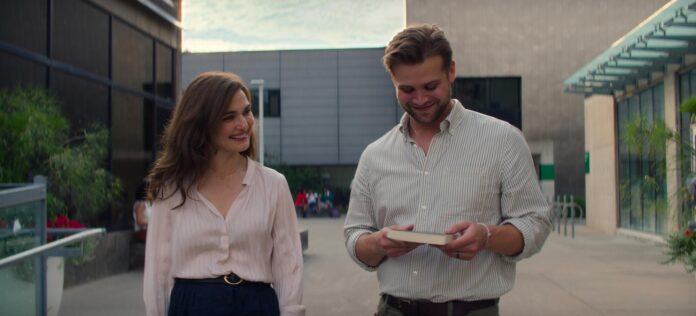
“Vladimir,” an eight-episode limited series premiering March 5, is based on playwright Julia May Jonas’ 2022 novel of the same name. Both the novel and the series center on a literature professor (Weisz) who teaches at a liberal arts college. Her husband (John Slattery) is under investigation for misconduct at the school as she becomes infatuated with a new colleague named Vladimir (Leo Woodall). Jonas wrote the pilot several years ago without a particular actor in mind for the lead character, who narrates the novel as if she were delivering an ongoing monologue. Weisz had read the book — it was recommended to her by a friend — before she was sent the script.
Rachel Weisz as M, a literature professor who becomes infatuated with the titular character, played by Leo Woodall.
(Netflix)
“It was a damn good piece of writing, the novel and the pilot,” she says. It led to a meeting with Jonas. “Ultimately, I think I was really intrigued about getting into the skin of this character,” Weisz adds. “I thought it would be challenging and hopefully fun.”
As M’s life goes farther off the rails, she becomes more obsessed with Vladimir, often indulging in torrid romantic fantasies about him, which the audience sees in juxtaposition to the more mundane reality. She eventually crosses lines at work and at home, all while narrating her unraveling directly to the viewer.
“The novel is very internal,” Jonas says, speaking later over Zoom from New York. “So it was about: How do we take that internal voice and translate it to the screen? One of the ways was her direct address, but we wanted to twist what that device usually does for an audience. In most direct addresses, the actor tells you the truth about what’s really going on.”
But that’s not what always happens here.
“I wanted to flip that to where she’s talking to someone and she’s always trying to massage the truth or sometimes outright lie,’” Jonas says. “She’s a completely unreliable narrator.”
Throughout the series, M confides in the camera, an unusual technique that draws its inspiration from Jonas’ theater background. Weisz remembers doing a Neil LaBute play in the ‘90s in which she broke the fourth wall but had never done so onscreen. The actor says she did have an audience in mind when speaking to the camera, but it would be “reductive” to overexplain it.
“There was somebody I was imagining,” she says. “On set, we called it my special friend. The other actors had to pretend it didn’t happen. It wasn’t so much choreographed as it was breaking out of the scene and chatting to my special friend and then going back into the scene.”
It eventually became second nature for her and the cast, she says.
“It was really interesting watching Rachel and all the creators involved navigate that,” Woodall adds, speaking separately on Zoom from London. “She did a really remarkable job at staying within a scene while also having to pivot and deliver a monologue and then come straight back into the scene. It was a new challenge for me, but I thought it was going to be more difficult than it actually was.”

“There was somebody I was imagining,” says Rachel Weisz about breaking the fourth wall with her character on “Vladimir.” “On set, we called it my special friend.”
(Sophia Spring / For The Times)
The episodes are snappy, at around 30 minutes each, and the tone of “Vladimir” often leans more funny than serious. Weisz tends to gravitate toward drama — her last series was a remake of David Cronenberg’s “Dead Ringers” — but she has flexed her comedic muscles in the past, notably in Yorgos Lanthimos’ satirical film “The Favourite.” She doesn’t see herself as a particular funny actor despite the many laugh-inducing moments in “Vladimir.”
“For me, everything was intensely serious,” she says. “It was about committing to her reality and what she cares about and what matters to her and how she’s trying to convince herself that everything’s just fine.”
She pauses. “I wouldn’t know how to be funny,” she affirms. “It’s not my wheelhouse. I was aware that there was a lot that was ridiculous, but life is often so ridiculous, isn’t it? Things are going very wrong in her life with her husband and everything. It gets harder and harder for her to toe that line as she tries to pretend it’s not going wrong.”
Weisz mostly relied on her “imagination and Julia’s words” to portray the character. She’s known a lot of professors over the years, especially when she lived in New York City, which helped. She understood that despite the character’s misbehavior in the series — like breaking into her boss’ office — she’s decently good at her job. “Times are changing and her husband is in this deep crisis and her reputation is on the line,” Weisz says. “But I think she thinks she’s a beloved teacher and an esteemed professor.”
To play M, Weisz had to be totally on her side. She knows it’s generally important to be able to defend the person you’re playing, but she also says the character felt “psychologically true.”
“It’s very hard to do something if it doesn’t feel like that,” she says. “The writing is the beginning of my job and this was so well written. But I wouldn’t be able to play someone unless I could totally be in their point of view.”
Jonas says what makes M compelling is that it’s hard to put a label on her or know what to expect.

“Vladimir” is an adaptation of Julia May Jonas’ novel. The author says M is difficult to pin down.
(Sophia Spring/For The Times)
“Is she right? Is she wrong? Is she psycho? Is she sane? Is she brilliant? Is she all of those things? Or none of them? You can’t pin her down,” Jonas explains. “And that’s what makes her so exciting to watch. You’re not quite sure what the choice is that she’s going to make next other than being deeply smart and well read.”
“Vladimir” began shooting in July 2025 in Toronto, which stood in for an undefined liberal arts college town. It was deliberately shot while Weisz’s young daughter with husband Daniel Craig was out of school for the summer. Although the actor felt tethered to the character while on set, she could easily dissociate at the end of the day. She’s repeatedly keen to clarify that she’s nothing like M even as she defends her, as if she’s slowly realizing just how unhinged the character comes off in the series.
“I deeply empathize with her and understand her,” Weisz says. “But I left her when I got home. She’s like a projection of what a viewer might want to live out.”
Jonas adds, “It’s allegorical in nature. What if I could just take this man and chain him up? It’s making that literal for us to watch. It’s about that female id deep inside of us.”
Both Woodall and Jonas were struck by Weisz’s intuitive approach to the character. Woodall and Weisz didn’t discuss M’s relationship with Vladimir during filming.
“She loves as much spontaneity as possible, and she loves to not really know ahead of time what the actor’s going to do,” Woodall says. “For someone who’s as well established as she is and so beautiful, it was really fun to see her allow herself to be the butt of a joke and look ridiculous. Some of the scenes that we shot, we would finish, and she would burst out laughing. She leaned into it and had a lot of fun with it.”
“Rachel is completely surprising,” Jonas adds. “The first time I’d see a scene I’d think, ‘Oh, that’s not how I wrote it at all.’ And then I would see it a second time and I would realize what she was doing. That’s what makes her so alluring as an actor. She’s funny and interesting and a little off-key but fully committed, and you never know what she’s going to do next.”
Weisz has always wanted to be an actor, but she didn’t realize it could be a career until college. She’s drawn to writing and to singular voices. “I loved joining hands with Julia’s imagination,” she says. “I love writers. I’m not one because it’s too solitary, but they’re my favorite people to be with.”

“She’s funny and interesting and a little off-key but fully committed, and you never know what she’s going to do next,” says Jonas about Weisz.
(Sophia Spring / For The Times)
She tends to select projects based on the script, but otherwise she isn’t picky. Weisz has done everything from quirky indie films to prestige drama to high-octane action to Marvel. She won the Oscar for supporting actress in 2006 for “The Constant Gardener” and was nominated again for “The Favourite.”
“In the beginning of my career, I just did whatever job I got so I could pay the rent,” she says, shrugging. “I wasn’t picky. Now I’m in this luxurious position where I can choose things. It’s really about the character and writing, if it appeals to me or if it seems it would be interesting to pretend that story.”
Since our interview in January, Universal Pictures confirmed the production of “The Mummy 4,” which will feature Weisz and Brendan Fraser reprising their roles as Evelyn and Rick O’Connell (Weisz didn’t appear in the third installment). Prior to that announcement, though, Weisz is cagey about the film. “They’re seriously talking about it,” she says. “Brendan’s been very involved. It sounds very interesting.”
Being interested in a character or a story is what ultimately drives Weisz. Her performance in “Vladimir” completely eschewed vanity and instead fixates on what makes this woman go off the rails. M wants so badly to control her own narrative and is unable to face the reality of her life, but she’s also a talented writer and professor who wants the best for her family.
“People are contradictory,” Weisz says. “They can be brilliant at their jobs and have a very messy personal life. This is someone who is human. I know it’s very heightened and ridiculous, and it is in the genre of comedy, but it’s very true. Humans can have these massive contradictions.”
Although Weisz instinctively understands M, questions linger. She hasn’t decided whether M is complicit in her husband’s misbehavior (“That’s a hornet’s nest,” she says) and she’s not sure what happens to the character in the end. Even during the editing process she’s struggled to see M from the outside. “I just see her,” she says. “I don’t see me there at all.”
As the interview wraps, Weisz worries I won’t have what I need. Did she say enough about the series? Did she overly defend her character?
“I’m still aligned with her point of view,” she acknowledges again. “I think she’s — I was going to say I think she’s reasonable, but that might not be quite the right word.”
The actor laughs. “I am aware that is not the right word.”
More to Read
Disclaimer : This story is auto aggregated by a computer programme and has not been created or edited by DOWNTHENEWS. Publisher: latimes.com