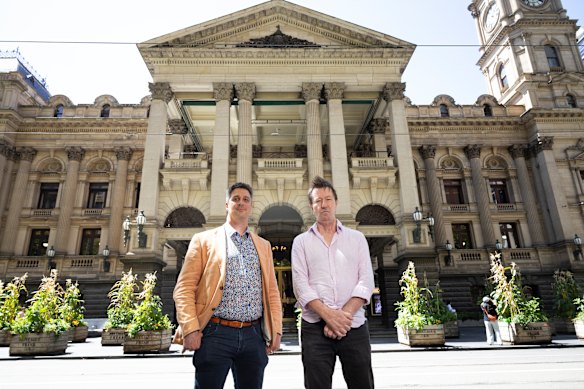

A drastic proposal to merge inner-city municipalities into a single mega-council has been floated as a “last resort” option as mayors entertain redrawing boundaries to cope with crushing financial pressures.
In a move that breaks a 30-year political taboo, Yarra Mayor Stephen Jolly has called for an “adult conversation” about amalgamation to prevent a bankruptcy-level crisis of shuttered services and mass sackings.
Jolly told The Age that Yarra has identified close to $10.5 million a year in “cost shifting” – essential services like libraries and school crossings once co-funded by state and local government but now largely bankrolled by ratepayers. After a decade of state-mandated rate capping, Jolly said the business model was “untenable”.
“[Amalgamation] is not my number one. This is not what I want,” he said. “I want the government to cough up the money … but we can’t just keep patching things up.” He added that as a trade unionist, he would rather see his own council merged than be forced to “become the Maggie Thatcher of Victoria” and sack staff.
The mayors of Melbourne and Port Phillip have both signalled they were prepared to entertain the prospect of redrawing boundaries. Lord Mayor Nick Reece – while noting it wasn’t the formal position of the council – called the pitch a “bold idea” and questioned if current inner-city lines were still “fit for purpose”.
Reece pointed to a recent viral photograph of Victoria Parade, where one side is lush and mowed by the City of Melbourne while the Yarra side is overgrown. “I’m sure the residents of Fitzroy look over the road at East Melbourne and wish they could get services at the same level,” Reece said. “That’s not the City of Yarra’s fault. It’s a product of a local government sector that is being starved of funds.”
The City of Melbourne is essentially bankrolled by its skyscrapers, with its $390.3 million rate base including more than $183 million in commercial rates. The City of Yarra relies more on households, with an entire rate base of $140 million. A hypothetical merger would have political implications, as Yarra has historically been a left-leaning council compared to the more conservative City of Melbourne, where businesses get two votes.
Port Phillip Mayor Alex Makin noted that councils were again facing the financial pressures seen in the early 1990s before then Liberal premier Jeff Kennett slashed the number of Victorian councils from nearly 300 to 78. Both Yarra and Port Phillip were products of those 1994 mergers.
Kennett told The Age he agreed with Jolly – despite being far from him on the political spectrum. He said that with today’s technology, he would merge Melbourne’s 31 councils into just five, creating a “Greater City of Melbourne”.
“Ratepayers would be a lot better off in terms of cost and speed of delivery,” Kennett said.
Other groups have also floated amalgamations, including pro-density advocacy group YIMBY Melbourne which recently proposed amalgamating all metropolitan councils into a single authority – as happened in Brisbane 100 years ago and Auckland in 2010.
“The borders between councils are … arbitrary lines on a map,” the group stated in a submission to a 2024 parliamentary inquiry into council finances, arguing a single council would enable more coherent delivery of things like bike lanes, which currently stop at municipal boundaries.
However, Marcus Spiller, principal at SGS Economics and the author of a book on modernising local governments, offered a word of caution on simple mergers. While acknowledging that councils are being “drained” by rate capping, he warned that making them bigger wouldn’t always make them better.
“You might save on overheads, but you might lose in terms of the accessibility … and the relevance of local governments to local communities,” Spiller said. He instead advocates for a metropolitan authority to sit above councils and below state – to handle the public transport network and strategic planning – much like the former Melbourne and Metropolitan Board of Works, in a model similar to London.
Port Phillip Mayor Makin said the biggest issue was desperately needed clarity on which levels of government control what and how they are funded.
“That’s fundamentally the issue,” he said. “Whether we amalgamate or we don’t, those fundamental problems still remain.”
The peak body for councils, the Municipal Association of Victoria, has proposed councils share back-end systems and staff to reduce duplication, but would not comment on the idea of mergers when approached by The Age. President Jennifer Anderson said only that councils were “under unprecedented strain, asked to do more by other levels of government and communities, with less certainty and mounting financial pressure”.
To merge Yarra and Melbourne would require an act of state. A Victorian government spokesperson said they are “not currently considering” any amalgamations and highlighted that Victoria’s 79 councils generated a collective operating surplus of $1.75 billion last year.
Opposition local government spokesperson Bev McArthur, a former councillor herself, said some councils were open to the idea of shared services but that she had “received no feedback from the sector on council mergers”. She said if the Coalition won the November election it would “review and clarify the roles and responsibilities of each level of government, and ensure that where responsibilities are shared, funding is fair and sustainable”.
“Our focus is on fixing the current funding model and enabling councils to focus on their core responsibilities.”
Start the day with a summary of the day’s most important and interesting stories, analysis and insights. Sign up for our Morning Edition newsletter.
 Rachael Dexter is a journalist in the City team at The Age. Contact her at rachael.dexter@theage.com.au, rachaeldexter@protonmail.com, or via Signal at @rachaeldexter.58Connect via Facebook or email.
From our partners
Disclaimer : This story is auto aggregated by a computer programme and has not been created or edited by DOWNTHENEWS. Publisher: www.smh.com.au