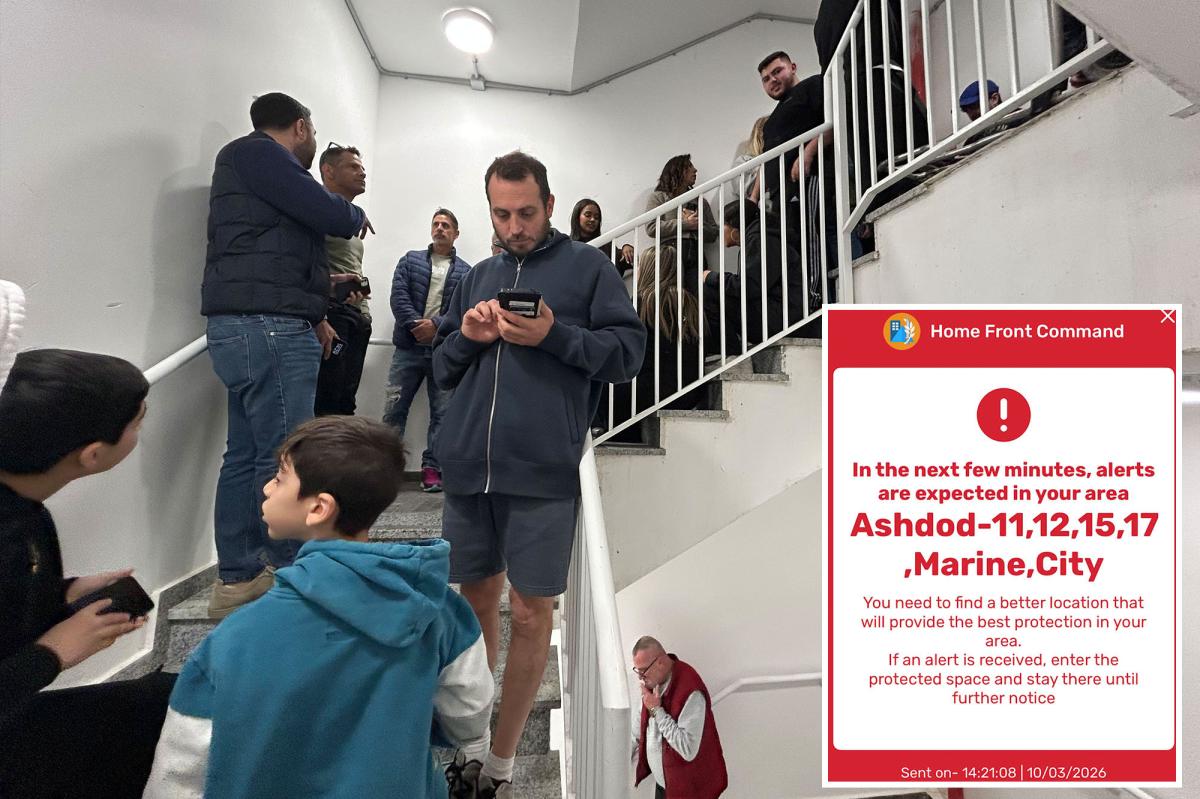
ASHDOD, Israel — The US assault on Iran has meant a return to life underground here for Israeli hotel worker Daniella Aharoni.
In the 10 days since US and Israeli forces took out the supreme leader, Ali Khamenei, Iran has launched a barrage of attacks on Israel and its Gulf neighbors.
The incoming drone and missile strikes have put Israel’s Iron Dome defense system to the test, but also put locals here in a constant state of high alert.
Alarms sound over loud speakers and warning messages are pushed out to cell phones like Amber Alerts when Israel detects an incoming missile. Since Feb. 28, it has happened every day — sometimes multiple times a day — as Iran targets Israel in its retaliation campaign for the US-Israel strikes on Tehnran.
In many parts of Israel, residents have just 30 to 45 seconds to reach a shelter once an alert is issued, and most heed that advice, locals told The Post from a bomb shelter on Tuesday.
“When there is an alert, we have to go to a safe place. But it’s a very difficult life,” said Aharoni, working at a hotel that welcomes mostly native Israelis now that vacationers have largely fled the country. “But we will go through that; we’re used to it here in Israel.”
Bomb shelters take many forms in Israel, from fully furnished basement rooms to parking garage stairwells. The shelter at Aharoni’s hotel, the Leonardo Plaza Ashdad, is comfortable with tables and chairs set up — with even a television on the wall. It is located on the lowest floor of the building, in the basement.
On Tuesday, guests and employees rushed there after an alarm rang out, and inside, all the Israelis were calm, with some comforting concerned foreigners unused to the lifestyle of incessant war. The alert lasted about 10 minutes before the all-clear was announced after the IDF intercepted the missile above the city.
Secretary of War Pete Hegseth warned Tuesday morning “today will be yet again our most intense day of strikes inside of Iran.” Their targets have degraded Iran’s ability to threaten Israel and US forces stationed in the Middle East.
Gen. Dan Caine, chairman of the Joint Chiefs of Staff, said Iran’s missile attacks have fallen 90% and one-way attack drones have decreased 83% since the war began on Feb. 28.
In that time, there have been about 13,443 rocket alerts issued to various regions of Israel, according to Rocket Alert, a company that issues and tracks the IDF’s warnings via a cell phone app. The vast majority of those alerts — roughly 11,350 — occurred on the first day of the war.
While the numbers are still high, they are considerably lower than the more than 20,000 that took place during the 12-day war between Israel and Iran last June.
During times of peace, air alerts are relatively rare — generally with just a few issued per week as Hamas or other regional terrorist organizations lob a rocket toward the Jewish state.
As the target of Tehran’s hate for decades, war is a way of life here — but that doesn’t mean Israelis shrug off air raid alarms out of complacency.
The government regularly reminds the public of the importance of adhering to that guidance — and it’s proven advice. During last year’s 12-day Israel-Iran war, most of the 32 Israelis killed in Iran’s bombing campaign had not been in a shelter when they were hit.
So far in the latest US-Israeli assault on Iran, there have been 12 fatalities of Israelis and approximately 200 injuries, including seven in serious condition from various missile attacks, an Israeli military official told The Post.
On the US side, seven US service members have died in combat and an eighth died from a medical episode.
Shelter or risk death
The Israel Defense Forces’ Home Front Command pushes alerts to cell phones ahead of alarms, warning that an incoming projectile has been launched before it comes to Israeli airspace. Minutes later, it will update if the object was not shot down and poses a threat to civilians who should take shelter.
“If everyone is outside and missiles are going, there will be a lot of deaths and injuries,” Aharoni, an Ashdod resident, said as sirens rang.
“So it’s difficult also for the government, so people here are very respectful [of that guidance.]”
Still, some choose to stay above ground — or even watch the missile interceptions like fireworks on the Fourth of July.
But even if a missile is intercepted and doesn’t strike your location, you can still be at risk of death as the shrapnel falls from the sky, US Ambassador to Israel Mike Huckabee recently cautioned in a post to X.
“An intercepted missile spreads shrapnel over a 2-3 mile area with some pieces being the size of a Buick. They come in at Mach 5,” he said, referring to the shrapnel flying at five times the speed of sound. “It’s why it’s not smart to stay outside & ‘watch.’ A missile is [the size] of [an] 18 wheel truck.”
But even for those who are committed to seeking shelter and have spent their entire lives in Israel, the difficult life of always being under threat can be exhausting.
“It’s disturbing, you know, because the Iranians are they’re sending only one missile, but they’re putting 9 million people in the shelters,” Aharoni said. “But yesterday, someone didn’t go to the shelter and he got killed.”
She was referring to the death of a man in central Israel on Monday who was at a construction site when Iranian cluster munitions struck and mortally wounded him, according to local officials.
It’s even more difficult on children, who are frightened by the sudden alarms and rushes to shelters.
“I grew up like that — I’m 26 years old. Eight months there was another war,” Ashdod resident Valerie Lugassy said, referring to the 12-day war. “So we just learn how to live with that and understand why it’s important.”
Having grown up in that environment, she said she gets confused when she sees people — usually foreigners unaccustomed to the threat — stay above ground during alerts.
“I saw some Americans earlier as we were running to the shelters,” Lugassy said. “We told them to come with us, and they said ‘no, no, it’s OK.’”
That’s what life under constant attack teaches you, she said — to take every threat seriously.
Lugassy said she looked forward to a future where that constant threat could be eliminated, and said the current war on Iran waged by the US and Israel gives her hope that day may be around the corner.
Disclaimer : This story is auto aggregated by a computer programme and has not been created or edited by DOWNTHENEWS. Publisher: nypost.com