Call it subtlety or caution, but the Reserve Bank – and especially governor Michele Bullock – is rarely very blunt (even if interest rates are).
On Tuesday, there was a change: not in interest rates – which stayed on hold – but in the way the bank was getting its message across.
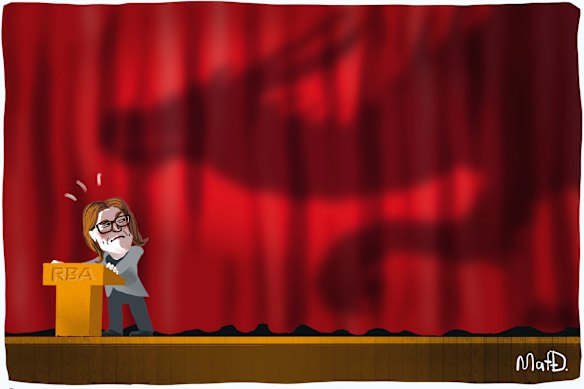
It’s much easier for the bank to send a clearer message when it has a clearer idea about where the biggest risks are.Credit: Matt Davidson
For a start, its monetary policy statement – which lays out the bank’s thinking and the reasons for its latest decision – was short (I took a leaf out of my colleague Shane Wright’s book and count: it was 502 words, to be exact).
That wouldn’t have been unusual a decade or two ago, but it’s the shortest statement in at least three years. The average length of its statements over that time has been closer to 700 words.
That in itself doesn’t tell us a lot: it might simply mean there was little to add to what we already know. But it also suggests the bank is not as worried (it’s a little too soon for Bullock and her board to completely forget about the fate of her predecessor) about cushioning its statements with caveats as it has been over the past few years.
Sure, the bank still sprinkles a dose of caution through its statement, saying it will “be attentive to the data” and “pay close attention” to developments. But if there is one thing the Reserve Bank has been consistent with, especially under Bullock, it’s treading very carefully in their language. If these phrases ever disappeared completely from their statements, there would be a solid case for barging into the RBA’s offices to see who had taken the board hostage.
But there were some far clearer views expressed by the bank than usual.
First, there’s no longer any concern about people losing their jobs or struggling to find one. The unemployment rate has “risen gradually” and employment growth has “slowed”, the bank notes. But the high number of unfilled jobs and businesses struggling to find workers is what is worrying the bank more because that suggests there’s not enough people to meet the country’s demand, which could push up prices.
The RBA appears less concerned about the risk of unemployment.Credit: Louie Douvis
Likewise, when it comes to economic growth, the worry is more about what a pick-up in demand (more spending) from households and businesses could mean for prices across the economy. That improvement in demand “might not persist”, the bank admits. But fear of a recession is nowhere to be found.
The strongest tone of caution came through in the bank’s description of inflation. While monitoring price changes has been made tricky thanks to temporary factors such as energy rebates, the board noted signs of a pick-up in prices across a broad range of things. These price pressures, which might not be temporary, it said, “will bear close monitoring”.
If the board’s ballooning focus on inflation wasn’t abundantly clear from the bank’s statement, Bullock made the message pop in her press conference. “They are uncomfortable with where [inflation] is,” she said, and are ready to do what it takes to bring it firmly back within the bank’s 2 to 3 per cent target range.
Asked whether the board had considered an interest rate cut at its last meeting, Bullock said no one had suggested it and it was certainly not on the table. What the board did discuss “quite a lot”, meanwhile, was the circumstances in which the bank might have to lift rates.
While Bullock rarely gets drawn into giving “forward guidance” (signalling the future path of interest rates) – and often playfully raps journalists over the knuckles for trying – she all but shut down the possibility of an interest rate cut. “From what we know at the moment, I don’t think there are interest rate cuts on the horizon for the foreseeable future,” she said, even going as far as to say that the view in financial markets that there may be some interest rate hikes to come is “right”.
Journalists and watchers of the Reserve Bank generally have to read through the lines and make guesses about the bank’s intentions and what it is trying to say. But on Tuesday, Bullock cut out the middle man: “the board is wanting to give the signal that the risks have tilted to the upside,” she said, referring to worries that the economy might be running too hot and inflation could be taking hold again.
While six or seven months ago, the bank was more worried about the “downside risks”: a slowing economy and rising unemployment, Bullock said the past few months had seen the risks become (neither bullish nor bearish but…) “balanced-ish”.
Now, she said the “upside risks”, and especially the possibility of inflation rising and staying high, had become front of mind for the board. In particular, she said the bank was concerned about price rises in durable goods (items that last a while such as televisions, fridges or washing machines), market services (like hospitality or tourism services) and new dwellings.
But why is the Reserve Bank being so much more blunt than it usually is?
Well, for one thing, it’s easier to have a clearer message when you’re more sure about your views. Even the bank, with its hundreds of economists, cannot always read the tea leaves right when it comes to the economy – and it’s much harder when there are mixed signals.
While there’s still plenty of uncertainty, and things can change quite suddenly (especially with volatile figures such as Donald Trump steering the largest economic ship in the world), the Reserve Bank is seeing more numbers that confirm its view that the Australian economy is okay on the growth and employment front, but feeling the squeeze when it comes to keeping up with demand.
As Bullock herself noted on Tuesday, it’s much easier for the bank to send a clearer message when it has a clearer idea about where the biggest risks are: right now, that’s the possibility of inflation once again rearing its head.
But it’s also very likely that Bullock is being intentionally explicit. She isn’t resorting to swearing, of course, but she is sending the clearest signal yet in her time as the Reserve Bank boss about where her head is at … or perhaps where she would like people to think her head is at.
Because while interest rates are generally the first and only thing people think about when they think about the tools the bank has to steer the economy, there’s also the more subtle art of communication.
As we know, inflation is shaped not just by our behaviour, but what we think: specifically, our expectations for what might happen in the future. If we think inflation is spiralling out of control, we might be more tempted to splurge and buy things before they skyrocket in price.
But if we think interest rates will rise and dampen inflation in the near future, we’re less likely to be worried about inflation even if it is hovering (as it is) above the target range of 2 to 3 per cent, and less likely to spend up in a panic.
The RBA can shape these expectations by what it says, and Bullock is doing that (with much more gusto than usual). It’s called “jawboning”, or communicating and signalling in a way that manages expectations and influences behaviour like spending and saving without actually having to move rates.
If that tactic works as Bullock would like it to, she may not have to lift a finger – or spike interest rates – to poke the inflation dragon back into its cave.
Ross Gittins unpacks the economy in an exclusive subscriber-only newsletter. Sign up to receive it every Tuesday evening.
Most Viewed in Business
Disclaimer : This story is auto aggregated by a computer programme and has not been created or edited by DOWNTHENEWS. Publisher: www.smh.com.au