MILAN — Leaders of the International Olympic Committee appear ready to lift suspensions of Russia and Belarus, clearing the way for athletes from those countries to return to major international competitions perhaps as early as the 2028 Los Angeles Olympics.
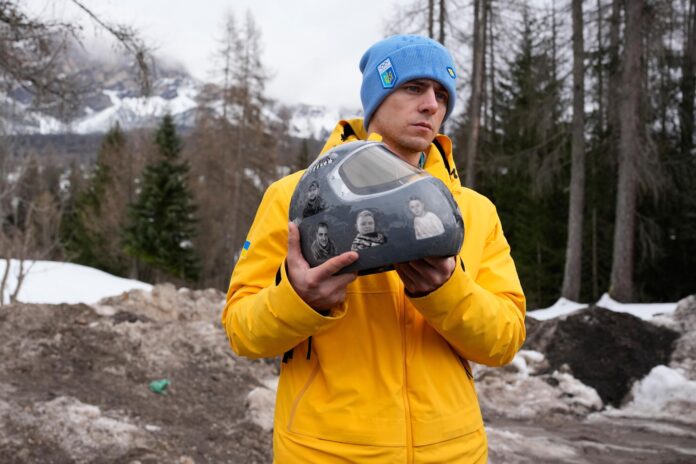
But those plans may have hit a snag last week with the international show of support for Ukrainian skeleton slider Vladyslav Heraskevych, who was disqualified from the Milan-Cortina Games for refusing to compete without a helmet featuring images of people killed following the Russian invasion of his country.
IOC President Kirsty Coventry, in an address to the IOC Congress in Milan this month, signaled a more neutral approach toward Russia without ever mentioning the country.
“We are a sports organization. We understand politics and we know we don’t operate in a vacuum,” she said. “But our game is sport. That means keeping sport a neutral ground. A place where every athlete can compete freely, without being held back by the politics or divisions of their governments.”
Vladyslav Heraskevych holds his skeleton helmet honoring Ukranians killed during a war with Russia. Heraskevych was suspended from Olympic competition after he was told the helmet violated political speech restrictions.
(Alessandra Tarantino / Associated Press)
In a meeting with the media, she demurred when asked when Russians would be welcomed back.
“There’s no timeline,” she said.
A massive international outcry following Russia’s full-scale invasion of Ukraine, a war that will enter its fifth year two days after the closing ceremony of the Milan-Cortina Games, forced most major international sports bodies to ban all Russian athletes from competition. The IOC has allowed athletes from Russia and Belarus to compete in Italy as individual neutral athletes, which means they cannot compete on teams nor wear their national team colors or flag.
The conditions that led to those suspensions haven’t changed; Russia, with help from Belarus, continues to wage war against its neighbor, with a report from the Center for Strategic and International Studies estimating the number of casualties on both sides at more than 1.8 million. That doesn’t including civilians, making it the most costly European conflict since World War II.
Coventry appears to believe politics should have no role to play in the sports arena, though athletes march behind their national flag in the opening ceremony and have their national anthem played when they win a gold medal.
Last December, the IOC called for Russian and Belarusian youth athletes to be allowed to compete in international competitions under their national flag and as teams, paving the way for them to compete at the Youth Olympic Games this summer in Senegal.
“The fact that … higher-ups in the IOC are sort of floating this out there, it seems like a bit of a trial balloon situation to sort of see what the reaction is,” said Jules Boykoff, a professor of politics and government at Pacific University.
The response during the Milan-Cortina Games has not been supportive of a change. Ukraine’s 46-member team got a huge ovation during the opening ceremony, proving that international solidarity for the embattled country has not waned. Then a week later, Heraskevych received a wave of sympathetic support when he was forced out of the skeleton for refusing to compete without a helmet adorned with more than 20 elite Ukrainian athletes and coaches who have been killed in the war.
Coventry met with Heraskevych and tried to reach a compromise, allowing him to wear the helmet in training and display it off the ice. She also offered to let him wear a black armband while competing. When Heraskevych refused to budge, the IOC banned him for violating Rule 50.2 of the Olympic Charter, which says “no kind of demonstration or political, religious or racial propaganda is permitted in any Olympic sites, venues or other areas.”
Heraskevych appealed his disqualification to the Court of Arbitration for Sport, which ruled against him. After their competitions, the Ukrainian and Latvian bobsled teams lifted their helmets in tribute to Heraskevych.

Ukraine’s Vladyslav Heraskevych starts a men’s skeleton training session at the Winter Olympics on Feb. 9.
(Alessandra Tarantino / Associated Press)
The IOC policy banning political statements on the field of play is long-standing and allowing the Ukrainian display would open the door for all other athletes to push to make their own statements in support of any country or against any issue they find oppressive or important.
“The fact that it seems like a lot of people were actually supportive of the Ukrainian athlete wearing the helmet really speaks to the support that Ukraine still has around the world,” said Andrew Bertoli, an assistant professor at IE University in Segovia, Spain, and author of “Beyond the Stadium. How Sports Change the World.”
“With that as a backdrop, to allow Russia back in would be tough,” added Boykoff. “Even to continue those conversations right now in Milan would be tough. But Los Angeles could be a totally different story.”
The IOC has plenty of time to try to find a path for Russian athletes to compete under their flag in the 2028 Olympics for the first time since 2017, when they were banned because of a state-sponsored doping scandal.
Lifting sanctions on Russia and Belarus in time for the L.A. Games would be complex, and cannot be done unilaterally. The IOC would need to lift its suspension of Russia’s national Olympic committee, which was imposed in 2023 not only because of the invasion but because Russia absorbed the sports organizations in occupied areas of Ukraine.
Then the governing federations for each individual Olympic sport would need to vote to end their bans. If some federations kept sanctions in place, it could lead to a fractured Olympics, with Russians and Belarusians competing in sports such as judo and boxing but not in track and field, whose governing body currently opposes their reintegration.
Even some of those federation leaders aren’t sure of the rules. The New York Times reported that at the IOC meeting in Milan, Johan Eliasch, head of the International Ski Federation, sought clearer guidelines to ensure that Russia was not being singled out unfairly, given the many other conflicts around the world such as the U.S. incursion into Venezuela last month or Israel’s war in Gaza.
“I would not be surprised to see the Russians back for 2028 in L.A.,” said Mark Dyreson, the director of reach and educational programs for the Penn State Center for the Study of Sports in Society. “Between then and now, it’s looking like the IOC is going to make a shift, even if there’s no resolution or peace to the war.”
Bertoli, however, says he wouldn’t bet on Russia or Belarus competing in L.A. if the war is ongoing.
“I really doubt it,” he said. “I imagine the IOC would welcome it, but I think that the international public opinion is too much against it, and it would be highly controversial if Russia was back at the Olympics.
“I think most people don’t want them in there if they’re going to be engaged in a war like this in Ukraine.”
More to Read
Disclaimer : This story is auto aggregated by a computer programme and has not been created or edited by DOWNTHENEWS. Publisher: latimes.com