NEWYou can now listen to Fox News articles!
Iran’s instability is unlikely to trigger a Syrian- or Afghanistan-style refugee crisis, a top immigration expert told Fox News Digital, even as questions mount over what comes next for the Iranian people once the fighting subsides.
With Ayatollah Ali Khamenei killed in an airstrike, several top officials dead and competing factions vying for control, questions are mounting over whether Iran’s turmoil could trigger a refugee crisis.
However, given the geography and environment in Iran, a mass refugee exodus appears unlikely, according to Andrew “Art” Arthur – a nationally-recognized national security and immigration expert at the Center for Immigration Studies.
NEXT MOVE ON IRAN: SEIZE KHARG ISLAND, SECURE URANIUM OR RISK GROUND WAR ESCALATION
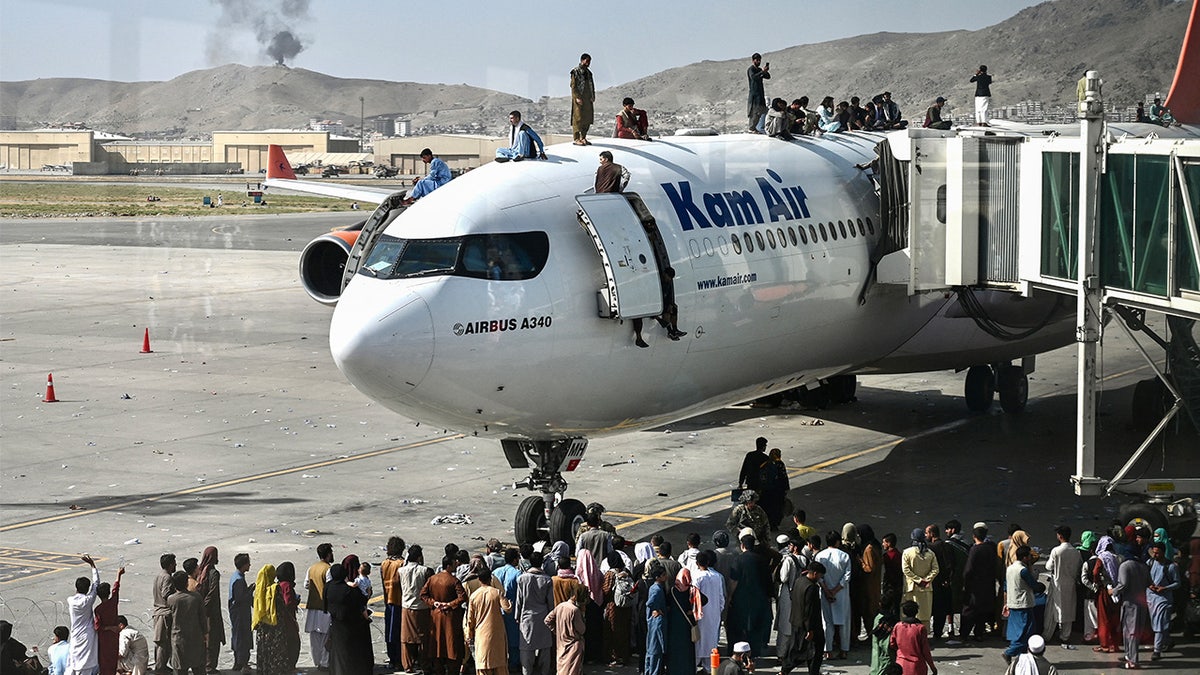
Afghan people climb atop a plane at Kabul airport in Kabul on Aug. 16, 2021, amid a mass exodus following the end of Afghanistan’s 20-year war. (Wakil Kohsar/AFP/Getty Images)
“It’s actually an interesting question, and there are a couple of things to keep in mind,” Arthur said in a recent interview.
“One is Iran is about twice the size of Texas. It’s, I think, roughly the size as Alaska. It is a huge country, and I think there are 93 million people there, but it’s still a big country and most of it is untouched by the conflict, so it’s not like individuals couldn’t relocate in-country and be perfectly safe.”
Unlike Afghanistan, he added, the U.S. and the West don’t have a previous footprint on the ground and don’t have people inside the country offering assistance.
AS AIRSTRIKES RAIN DOWN ON THE IRANIAN REGIME, CAN A FRACTURED OPPOSITION UNITE TO LEAD IF IT FALLS?
“[W]e don’t have the ability to do something like President Biden did where we load up C-130s with everybody we can get our hands on and fly them to the United States. So, that’s a huge distinction.”
During the 2021 Afghanistan withdrawal, chaos reigned at Hamid Karzai International Airport as U.S. military planes with refugees hanging off of them flew in and out of Kabul while Taliban forces created deadly roadblocks and uncertainty for those trying to flee.
The operation led to a huge influx of largely unvetted Afghan nationals into the U.S., which many immigration hawks blame for some of the migrant violence seen domestically.
WINNING THE BATTLES, LOSING THE WAR? AMERICA MUST DEFINE THE ENDGAME IN IRAN
Arthur said that exemplar is rare, in that most refugees don’t or aren’t able to fly “halfway around the world” to escape unrest.
“The Afghanistan evacuation operation, Allies Refuge and Allies Welcome, was completely without precedent in U.S. history, because, generally, refugees resettle in an adjacent country assuming that they can resettle in-country,” he said.
Such was true during the other major refugee flow this century, the Syrian crisis during the 2011 “Arab Spring.”
AUSTRALIA GRANTS ASYLUM TO 5 IRANIAN WOMEN’S SOCCER PLAYERS AMID IRAN CONFLICT
Then-Syrian President Bashar al-Assad responded to peaceful civilian protests with military force, spurring years of outflows of about 11 million Syrian nationals around Europe with a smaller proportion ultimately making their way to the U.S.
The Obama administration set a goal of 10,000 admissions of Syrians through refugee resettlement, while nearly 5 million were registered globally as refugees as of 2017, according to the Migration Policy Institute.
A good proportion of the U.S.’ Syrian population also predates the refugee crisis, some by more than 100 years, like the estimated 5,000 in Allentown, Pennsylvania.
TOP COUNTERTERRORISM OFFICIAL RESIGNS IN PROTEST OF US WAR AGAINST IRAN
Addressing the potential for any Iranian refugee crisis, Arthur said that, in practice, the U.S. could offer resources to neighboring countries but would not be obligated to take in refugees.
“That’s not the way that this works,” he said, pointing out that during the 1980s Afghan-Soviet conflict, Afghans relocated to Pakistan and the U.S. helped them from afar.
“We didn’t bring them to the United States,” he said, adding that the U.S. helped enforce a no-fly zone to assist aligned factions, such as the Kurds, maintain safer territory.
Fox News Digital also asked the White House for its thoughts on the prospect of another refugee crisis amid another bout of instability in a Mideast country.
The White House directed Fox News Digital to recent comments by Secretary of War Pete Hegseth on the matter, when he was questioned about the proclivity for such conflicts as Iran to force thousands to flee from the conflict zone and into the U.S. – and whether there are any “safeguards” in place to prevent such.
“I think it’s safe to say there’s no plan for a wave of new Middle Eastern refugees to the United States of America,” Hegseth said.
“I think, as the president has pointed out for a long time, there are a lot of countries in the region who would be capable of providing that kind of support if need be.”
CLICK HERE TO DOWNLOAD THE FOX NEWS APP
“But that’s certainly not something we’re planning on,” he said.
<!–>
–>
Disclaimer : This story is auto aggregated by a computer programme and has not been created or edited by DOWNTHENEWS. Publisher: moxie.foxnews.com