
Iranian university students have resumed protesting against the regime on the first day of a new semester, as US President Donald Trump considers limited military strikes to pressure the Islamic republic into signing a new nuclear deal.
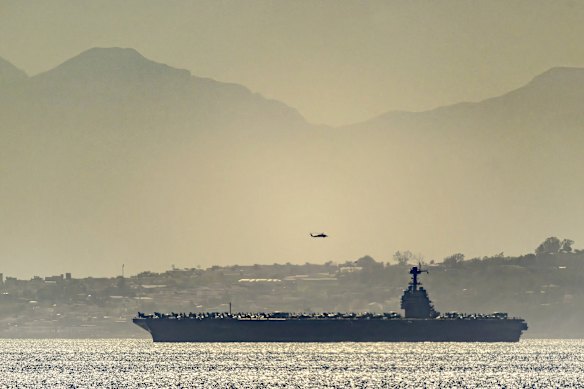
The Pentagon has orchestrated a massive deployment to the region that includes two aircraft carriers, fighter jets and refuelling planes, giving Trump the option to launch limited, or extended, operations against Iran.
Trump has also reportedly been briefed on options to assassinate the son of Ayatollah Ali Khamenei and various mullahs.
The campus demonstrations came a month after a deadly government crackdown that killed thousands of people. While the government has not acknowledged the latest protests, state-affiliated news media reported on the tension on university campuses.
A video purportedly showed rows of marchers at Tehran’s Sharif University of Technology condemning Supreme Leader Ayatollah Ali Khamenei as a “murderous leader”, and calling for Reza Pahlavi, the exiled son of Iran’s toppled shah, to be a new monarch.
State-affiliated news agencies such as SNN carried videos of clashes, with protesters allegedly injuring volunteer student Basij militia by throwing rocks at Iran’s top engineering university. Pro-government Basij members often assist security forces in quelling protests.
Protests were also held in Beheshti and Amir Kabir universities in the capital Tehran and Mashhad University in the northeast, according to unverified videos published by rights group HAALVSH.
In the western town of Abdanan, a hotspot for protests, demonstrators chanted “Death to Khamenei” and “Death to the dictator” after the arrest of an activist teacher, according to rights group Hengaw and social media posts.
The protests coincided with ceremonies traditionally held after 40 days to mourn those killed by security forces during last month’s anti-government demonstrations, which saw thousands lose their lives in the worst domestic unrest since Iran’s 1979 Islamic Revolution.
Activism by students and Tehran shopkeepers grew into a nationwide protest movement that appeared to threaten the regime before it was violently suppressed.
The Iran government acknowledges more than 3000 people were killed in January, but rights groups such as the US-based Human Rights Activists News Agency say at least 7000 were killed, with more to come as numbers are verified.
Iran experts argue that bombing the country in the middle of negotiations might derail a deal, and could prompt a deadly cycle of retaliation.
Tehran would likely suspend participation in talks if the US launched a strike, according to a senior government official in the region, who asked not to be identified discussing private deliberations.
“He’s not going to get a diplomatic agreement out of the Iranians if he attacks them again,” said Barbara Slavin, a fellow at the Stimson Centre in Washington. The military threats alone — even if the US doesn’t ultimately act on them – “is going to make them less willing to make a deal.”
While Trump has given a deadline of between 10 and 15 days, it also remains unclear what a new round of airstrikes – limited or otherwise – would actually achieve.
Israel and the US bombed the country’s nuclear sites and air defences extensively last June, with the president saying at the time that “key nuclear enrichment facilities have been completely and totally obliterated”.
The US and Israel could target Iran’s ballistic missiles, but the danger there is Tehran could be spurred to fire them off at US or allied targets before it loses them, according to Slavin.
Asked during a Friday news conference about what his message would be to the Iranian people, Trump said: “They better negotiate a fair deal. They better negotiate.”
Speaking on Fox News Saturday, Middle East envoy Steve Witkoff said “zero enrichment” is non-negotiable for any deal with Iran. “And we have to have the material back.”
“They’re probably a week away from having industrial-grade bomb-making material and that’s really dangerous, so you can’t have that,” he said. “This is something they have to stick with until they prove to us that they can behave.”
He added that Trump is “curious” why Iran hasn’t capitulated to the demands in the face of US military power.
The shifting US rationale for talks – and strikes – makes deciphering US intent even more difficult. Trump’s initial threat of airstrikes was in support of the protests in Iran in December and January rather than a nuclear deal.
Reuters, Bloomberg
Get a note directly from our foreign correspondents on what’s making headlines around the world. Sign up for our weekly What in the World newsletter.
From our partners
Disclaimer : This story is auto aggregated by a computer programme and has not been created or edited by DOWNTHENEWS. Publisher: www.smh.com.au


