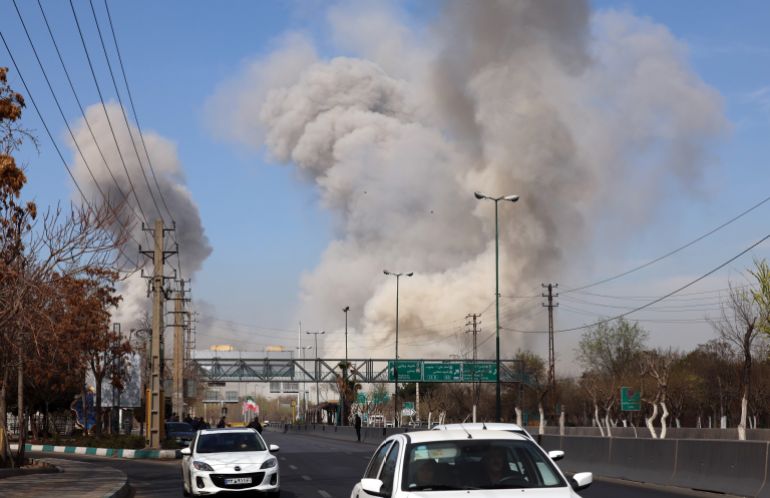
Tehran, Iran – “The war might last weeks, so my family and I will only leave if it gets too bad. For now, life goes on,” says Sepehr, a resident of eastern Tehran.
The booming sound of explosions has been a daily reality this week where he lives, at times leaving thick smoke billowing to the horizon and shaking windows, he told Al Jazeera, asking to remain anonymous due to security reasons.
Recommended Stories
list of 3 itemsend of list
The scenes are similar across Tehran, a sprawling city of nearly 10 million people, with United States and Israeli missiles raining down in quick succession during waves of attacks that have taken place at all hours of the day since the start of the war on Saturday morning, which has killed more than 1,000 people.
Iranian officials said on Thursday that some water and electricity facilities were damaged by projectiles and asked people to conserve resources, but no widespread outages have been reported so far.
The streets of the capital are noticeably quieter and less congested than usual, and many businesses are closed. However, the basic necessities remain largely available, both in person and through online orders.
“When the bombing runs seem finished for a while, I go for a short walk once during the day to get some essentials from the local shops. There are usually queues for bread, which are not too long, and there are queues at some petrol stations,” said Marjan, who lives in a western neighbourhood.
Advertisement
“Except for a few items that might be in shorter supply, the shops mostly have everything you want for now, but who knows what could happen later. Either way, the prices are breaking people’s backs,” she said.
Two days before the start of the war, the Statistical Centre of Iran (SCI) and the Central Bank of Iran released separate reports that painted a grim picture of how the daily livelihoods of 90 million people had been affected by runaway prices.
The SCI put annual inflation in the Iranian month of Bahman, which ended on February 19, at 68.1 percent, while the Central Bank put it at 62.2 percent. These were some of the highest inflation rates recorded since the pre-Islamic revolution of 1979 that birthed the incumbent theocratic establishment, stoking further concern of potentially looming hyperinflation.

Iran has one of the highest food inflation rates in the world, which stood at a whopping 105 percent by the end of last month, according to the SCI.
That included a 207 percent inflation rate for cooking oil, 117 percent for red meat, 108 percent for eggs and dairy products, 113 percent for fruits and 142 percent for bread and corn.
First Vice President Mohammad Reza Aref told state media on Wednesday that the government had concerns about providing sufficient medicine and medical equipment, “but fortunately today conditions are good”.
This comes as Iran’s medicine market has been in heavy turmoil over recent weeks, with prices skyrocketing and some drugs like antidepressants facing shortages in Tehran and other cities. In some cases, only Iranian-made versions of medicine can be found in the market, with foreign-made counterparts becoming rare.
The government continues to offer a meagre cash subsidy to people to buy essential goods, and recently expanded items purchasable through the scheme to include baby diapers, another item that has more than doubled in price over recent months.
Government officials also continue to emphasise that provincial governors and ministers have been empowered to import essential goods in large quantities with reduced red tape to ensure continuity in case of a lingering war.
The Iranian economy, bruised and isolated after decades of corruption and mismanagement paired with US and United Nations sanctions, is again on pause as its forces launch ballistic missiles and drones across the region amid the war.
The Iranian rial stood at about 1.66 million per US dollar before the war, near an all-time low. The stock market was a sea of red as investors baulked at prospects of an increasingly uncertain future, while traditional assets like gold soared.
‘Orwellian’ comms blackout
Iranian authorities are blocking access to the global internet for a sixth day as the bombs fall, trying to limit information avenues to state-run news and messaging services.
Advertisement
Those channels largely cover official statements and news of successful attacks by the Islamic Revolutionary Guard Corps (IRGC) across the region.
They also mostly limit local coverage of strikes to civilian areas damaged by US and Israeli munitions, and refrain from discussing the impact of strikes on a large number of police stations or paramilitary Basij bases hit.
“This tweet is going out after six hours of trying and testing more than 59 configurations” of virtual private networks (VPNs) and proxy connections, wrote journalist Milad Alavi in a post on X on Wednesday.
“The internet in Iran, both fixed and mobile, is disconnected. We are left without news while in state television, Iran is on the verge of taking over Tel Aviv and Washington!”
Internet connectivity nosedived in Tehran and across the country minutes after warplanes bombed the downtown area of the capital on Saturday morning, killing Supreme Leader Ayatollah Ali Khamenei, several members of his family, and many top military commanders.
After a few hours, connectivity was at below 1 percent of previous levels, which were already severely limited, and has remained at that level, according to data shared by international observers, such as CloudFlare and NetBlocks.
NetBlocks said on Thursday that “an increasingly Orwellian environment is emerging as telcos threaten users who try to connect to the global internet with legal action”, in reference to users reporting that they have received threatening text messages from telecommunications authorities after trying or sharing VPNs.
With only an intranet set up by authorities connected to accommodate local websites and services, the comment sections of a few leading news sites have turned into the only place some Iranians can express themselves online at the moment.
After many of the sentiments were critical of state authorities, the judiciary ordered the comment section of the popular technology-focused site Zoomit closed.
Political, military and intelligence authorities are also repeatedly urging citizens to report any suspicious activity, or even sightings of US and Israeli warplanes, by calling security services.
As with the 12-day war with Israel and the US last June and the 20-day total internet shutdown during the nationwide protests in January, a black market has also taken form for any connection managing to tunnel out to the global internet.
Al Jazeera spoke with two people who said they managed to buy proxy connections capped at a few gigabytes of data from vendors inside Iran, which were slow and extremely expensive, but did not discuss details due to security reasons.
As US and Israeli officials tell Iranian citizens to stay vigilant so they can rise up and overthrow the establishment at a later date, Iranian authorities have not set an expiration date for the internet restrictions.
Disclaimer : This story is auto aggregated by a computer programme and has not been created or edited by DOWNTHENEWS. Publisher: aljazeera.com