As the U.S. and Israel continue their bombardment of Iran, Iranian-Angelenos are turning to a patchwork of communication apps, social media and cable news for updates on their loved ones some 7,500 miles away.
The Times spoke with several people in the ‘Tehrangeles’ area of Westwood this week — the epicenter of L.A.’s sprawling Iranian diaspora — where they continued to express a mixture of anxiety and elation following the death of Supreme Leader Ayatollah Ali Khamenei. Many said they are relying on apps such as Telegram and WhatsApp to get messages from their family and friends in Tehran and other parts of the country, while a large number said they’re turning to Fox News for the latest updates.
Internet access in Iran is tightly controlled by the government, which operates one of the most restrictive systems of online censorship in the world. Internet traffic is routed through state-controlled infrastructure that allows authorities to monitor usage and block thousands of websites, including social media platforms, international news sources and messaging apps.
But people are finding ways through.
Many are using some form of “filter shekan” — an Iranian term for virtual private networks, circumvention apps and other tools that can bypass internet filters and access websites blocked by the government. Some use an an Android app that lets users outside the country act as a relay, allowing people inside Iran to route calls and messages through the outside internet connection and bypass government filtering. Others still use landlines, which can function when the internet is shut off, but which are widely believed to be monitored by authorities.
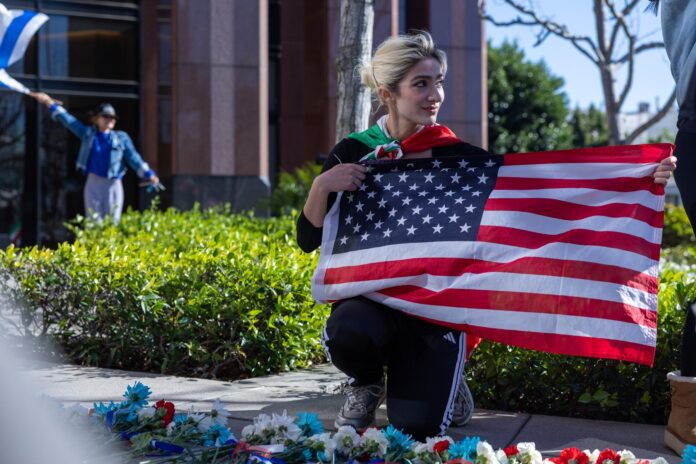
Charlene Laurent, an Iranian social media influencer in Los Angeles, noted that most filter-breaking tools cost money, which means some people can’t access them. She spoke from a gathering of about 100 Iranians outside the Israeli consulate on Wilshire Boulevard Thursday, where she had come to express gratitude to President Trump and Israeli Prime Minister Benjamin Netanyahu for their military action.
When the internet in Iran is stable, Laurent said her cousins in Tehran sometimes call her through WhatsApp, although they prefer Telegram because its encrypted messages can be easily deleted. She said constant deletions are necessary, as authorities recently broke into a home in her cousin’s neighborhood, confiscated the man’s phone and accused him of being an American spy.
“People tell me that I’m so brave for speaking against this, because I get a lot of death threats, but it’s nothing compared to what they’re doing in Iran,” Laurent said.
Iran scholar Mehrzad Boroujerdi said it’s a risk many people are willing to take.
“There is always that fear, but the need for communication is so great that people are utilizing these apps to make contact with one another,” said Boroujerdi, co-founder of the Iran Data Portal at Syracuse University and dean of the College of Arts, Sciences and Education at Missouri University of Science and Technology, in a phone call.
“Of course the government is very opposed — that’s why they want to shut down the internet so that they can prevent any mobilization, or people for example sending video clips that the government does not consider favorable to expatriot TV stations that are broadcasting into Iran,” he said. “That’s part of the censorship war that is going on.”
As for her family in Los Angeles, Laurent said they tend to turn to Fox News because “CNN is, sorry to put it, fake news.” That’s because she does not think the footage on CNN lines up with videos she is seeing directly from people in Iran.
She’s far from the only one person who said they turn to Fox, the conservative cable news network, for the latest updates.
“I’m hooked to Fox 24/7,” said Shahram Elyaszadeh, 66, an Iranian who has lived in the U.S. since 1979 and runs a mortgage banking office on Wilshire Blvd.
“Fox is the most trustworthy,” said Ryan Ghasemi, 56, who recently moved here from Canada. “The leftist media like CNN, BBC, we don’t trust them — in Iran actually they call the BBC the ‘Ayatollah BBC’” because they feel it is sympathetic to the government.
Social media influencer Charlene Laurent waves a flag in front of the Consulate General Israel on March, 5. 2026 in Los Angeles, CA.
(Ronaldo Bolanos/Los Angeles Times)
Ghasemi said he has been speaking with his brother in Iran nearly every day through WhatsApp, which his brother accesses through paid software to bypass the government filters. “It’s not easy, it’s not fast, but at least we can talk and receive the messages,” he said.
David Taheri, 53, said he has family in Tehran and Ahvaz, including his mother and siblings. He has not been able to reach any of them directly in several days, but has been able to get word from a friend who asked her family to contact his family and confirm their safety, like a game of telephone. Most of those updates come through WhatsApp, but sometimes Telegram, he said.
He added that he, too, prefers Fox News “because they are against the Islamic Republic.”
Boroujerdi, the Iran scholar, said the preference for Fox aligns with broader trends.
“A big percentage of the Iranian expatriate community, particularly in places like L.A., consider themselves as monarchists — they are opposed to the Islamic republic, favor the son of the exiled shah [Reza Pahlavi], and therefore they consider CNN, BCC, etc, as TV stations that are not necessarily sympathetic to their cause,” he said. “And therefore they have gravitated toward Fox News in terms of American media stations.”
Some people also turn to expatriot news channels such as London-based Iran International, which is broadcast in the U.S. and Iran via satellite, online streaming and social media, he said. Others are “addicted” to social media apps such as TikTok and Instagram “because everybody is in hunger to find stories about what’s happening to their family and relatives inside the country, and also to follow the course of events.”
After the bombing began, Mehrnoosh Arabestani, 42, said she wasn’t able to reach her cousins in the Iranian city of Qom for five days because communications were shut down. She was relieved when a call finally came through and they said they are safe, and in fact happy because the regime is gone.
Ali Javahery, who helped organize the event at the consulate Thursday with the group Hambastegi, wore a “Make Iran Great Again” hat and said communication is one of the problems he hopes the war will address.

An sign shows President Trump and Israeli President Benjamin Netanyahu during a public show of support for the war in Iran at the Israeli Consulate, March 5, 2026 in Los Angeles.
(Ronaldo Bolanos/Los Angeles Times)
“We want the United States and Israel to help us communicate with our loved ones,” he said. “They don’t have internet over there. They want to communicate with us. We are at the mercy of whatever’s available. We need the United States to open the airwaves to them.”
But while he celebrated on Wilshire Boulevard, others in the neighborhood said the war weighs heavily on them. Mohammad Ghafarian, owner of the Shater Abbass Bakery & Market on Westwood Blvd., said he hasn’t been able to reach his family in Tehran or Mashhad at all.
“I’m happy because the Ayatollah was overthrown, and for the freedom,” he said. “But still there is war, and I am worried for my family and hoping the U.S. doesn’t bomb the civilians, and I hope this ends as soon as possible.”
Before the bombing started, Ghafarian typically spoke to his family on the phone every one or two weeks, and his friend there every couple of days, he said. Now, he said he primarily follows Instagram and watches every news channel for updates, including CNN, CNBC and Fox.
“I watch all of it,” he said.
More to Read
Disclaimer : This story is auto aggregated by a computer programme and has not been created or edited by DOWNTHENEWS. Publisher: latimes.com