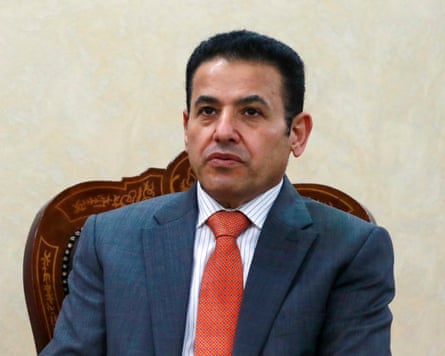
A senior Iraqi government official has implored Australia to repatriate a group of suspected Islamic State fighters, raising the issue with Canberra’s top diplomat in Baghdad just weeks after the detainees were transferred out of Syria.
In a post on X, Iraq’s national security adviser, Qassim al-Araji, said he met with ambassador Glenn Miles last week, and told him that foreign detainees should be returned to their home countries. This is despite such a task being made more difficult by growing instability in the region, caused by the war in Iran.
The comments are the latest in a series of efforts to force countries to repatriate their citizens, after more than 5,700 suspected IS members were recently transferred from Syria to Iraq in a US-backed military mission. About 13 Australian men are among them, including one who was only a child when trafficked into IS territory.
The Australian government has recently resisted such calls, although some alleged fighters who travelled to Syria have previously been returned.
Al-Araji, a former interior minister, posted a photo with Miles last Wednesday, shortly after the pair met, and said they discussed the group of suspected IS fighters.
“We affirmed … the importance of intensifying international efforts to halt the war and prevent its further expansion, in a manner that safeguards the security of the peoples of the region and spares them further suffering,” he said in the post.
“We also explained that the Iraqi government continues its coordination and diplomatic engagements with friendly and brotherly countries to reduce tensions and move toward de-escalation through constructive dialogue and the rebuilding of trust, in a way that contributes to ending the conflict.
“Furthermore, we renewed Iraq’s call on the international community to receive its nationals among the detainees who were recently transferred from Syria to Iraqi prisons.”
Miles made no mention of the meeting on his X account, on which he frequently posts.
It is understood the meeting was a regular appointment, and its primary purpose was to discuss the conflict in Iran and broader turmoil in the Middle East.
But a spokesperson for the Department of Foreign Affairs and Trade told the Guardian that “Australia is not repatriating or assisting ISIS-linked individuals in Iraq and Syria”.
Over the past decade, several men accused of fighting in Syria have been returned to Australia on an individual basis – and were subsequently jailed.
Thousands of alleged fighters in Iraq
Last month, Iraq’s National Center for International Judicial Cooperation confirmed it had taken custody of 5,704 alleged former fighters from 61 countries, including citizens of Australia, New Zealand, the UK and the US.
The country’s government has made clear it wanted foreign nationals to be returned to their home countries as soon as possible, but would prosecute any who allegedly committed crimes against Iraqis.
“We are in contact with their countries to repatriate them according to their nationalities once investigations are completed, provided they are not among those who fought Iraq, killed Iraqis, or participated in terrorist activities inside Iraq,” the justice minister, Khalid Shwani, told news outlet Asharq Al-Awsat last month.
It was unclear whether the Australians transferred from Syria could face charges in Iraq.
At least one Australian has previously been sentenced to death in Iraq, after a court found him guilty of being a member of Islamic State.
Iraq has consistently executed people convicted of terrorism offences by hanging. It was the fourth-highest executioner in the world in 2024, with 63 documented executions, most for terrorism offences.
The men could also face terror or foreign incursion offences in Australia, a prospect that could make them reluctant to return.
The group include husbands and fathers of the group of 34 Australian women and children that remain marooned in Syria.
Guardian Australia attempted to contact the Australian-based families and lawyers of several of the men.
One lawyer who represents several of the prisoners told Guardian Australia last month that neither he nor his clients’ families had heard from the Australian or Iraqi governments since the transfer from Syria.
It came after the federal government adopted a hardline approach to women and children trapped in al-Roj camp in Syria, who have been trying to return to Australia, including via a failed attempt to leave last month
Disclaimer : This story is auto aggregated by a computer programme and has not been created or edited by DOWNTHENEWS. Publisher: theguardian.com