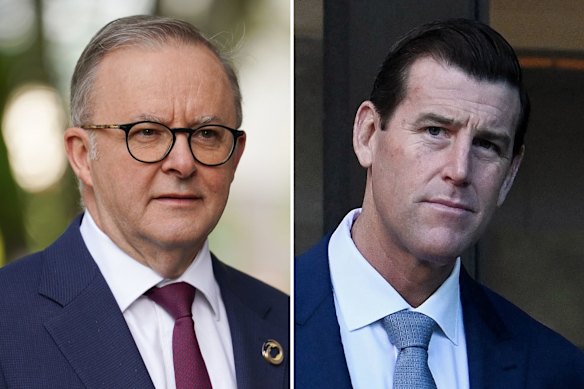
The prosecution of Ben Roberts-Smith demonstrates that Australia is not the US. Prime Minister Anthony Albanese should be shining a spotlight on this instead of dodging questions asking him to comment on Roberts-Smith’s arrest. Doing so would make it plain that, unlike our closest allies, Australia understands the value of international law.
Hypocrisy and double standards are cancerous twin evils that are eating away at the international order. Examples are plentiful, but none are more compelling than the West’s expression of outrage over Russia’s invasion of Ukraine and its insistence that Russian perpetrators of serious international crimes be held to account, contrasted with its near silence, even obfuscation, in the face of Israel’s massive violations of international law in Gaza. This was a tipping point: it was the moment the West’s rhetoric about the importance of international law lost all credibility in the eyes of the developing nations that make up the “Global South”.
The fracturing of the international order has, of course, accelerated under the second Trump administration as a result of the US’ multiple and egregious violations of international law. Not only is the post-war standard-bearer of the international order turning its back on, and thereby completely undermining, the rules that have served its interests so well, it is also creating an ever-widening space for un-like-minded states, led by Russia and China, to do as they like.
Both in launching their attack on Iran, and in the way the war is being fought, the US and Israel are, once again, violating international law with disastrous security and economic consequences. In the past few weeks, President Donald Trump has repeatedly stated his intention to commit war crimes by threatening to destroy critical civilian infrastructure. His latest declaration that a whole civilisation would die if Iran did not open the Strait of Hormuz may have resulted in the announcement of a temporary ceasefire, but we must not lose sight of the fact that it amounted to a threat to commit genocide. If one is tempted to dismiss Trump’s pronouncements as the ranting of a narcissist, or even just hyperbole, don’t forget that US Secretary of War Pete Hegseth has repeatedly advised that the US will no longer fight within the bounds of “stupid rules of engagement”, and has been busy cleaning out members of the US military hierarchy who have not shared his vision.
In January this year, Canadian Prime Minister Mark Carney issued a call to arms. He called out the implications of the great powers’ violations of international law, and he called on middle powers like Australia to act consistently in applying the same standards to allies and rivals, and to work together to build a new, more inclusive, values-based international order, rather than waiting for the old order to be restored. Carney’s speech resonated in Australian halls of power because it is widely recognised that we depend on agreed international rules for both our national security and our economic prosperity. To stand by and let the US burn the international rule book without working on a plan for its replacement would be entirely self-destructive.
Building this new international order will require Western middle powers like Canada and Australia to prove that we are not the US’ lackeys. This will be a formidable task. But every time we call out an ally’s violation of the law, every time we demonstrate our own fidelity to the law, we will be a step closer to regaining the trust of the Global South.
The prosecution of Australia’s most decorated living solider for war crimes is a small but significant example that Australia walks the walk, as well as talking the talk, when it comes to the importance of international law.
The prime minister is obviously correct to avoid making any comment that could prejudice the case against Roberts-Smith. But this does not require the prime minister to avoid all comment on the matter. Albanese could and should have used the opportunity to underline the fact that he was proud to be the prime minster of a country that is committed to meeting its international obligations in full. At this precise moment, this would have drawn a clear distinction between Australia’s commitment to international humanitarian law and the US and Israel’s flagrant disregard of the laws of war, without Albanese even needing to directly criticise our allies.
In refusing to comment on the Ben Roberts-Smith case on Tuesday, Albanese seemed, once again, to be unable to see past his own desire to avoid controversy. He lost the opportunity to show the world that Australia is leading by example. It won’t be the last time the case draws international media attention. Let’s hope that the next time, the prime minister can take advantage of the opportunity presented to him on a platter.
Dr Carrie McDougall is an associate professor at Melbourne Law School. She has previously advised the Australian government on its operations in Syria, Iraq and Afghanistan.
The Opinion newsletter is a weekly wrap of views that will challenge, champion and inform your own. Sign up here.
 Dr Carrie McDougall is an associate professor at Melbourne Law School. She rejoined Melbourne Law School in 2018 after nearly a decade working for the Australian Department of Foreign Affairs and Trade.
From our partners
Disclaimer : This story is auto aggregated by a computer programme and has not been created or edited by DOWNTHENEWS. Publisher: www.smh.com.au