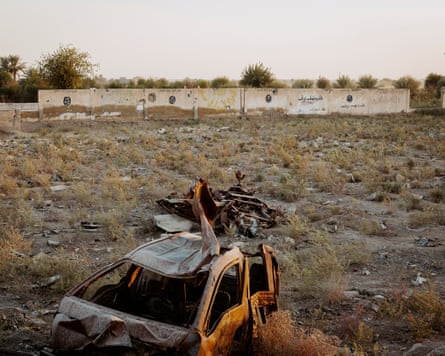
On the surface, all that remains of Islamic State in the Syrian town of Baghuz are discarded tubs of whitening cream, spent RPG motors and children’s backpacks, with an old grenade nestled in the frayed pink nylon.
It was here nearly seven years ago that IS made its last stand. Its most zealous followers were obliterated along with the blood-soaked caliphate they fought to defend. Their bodies were collected and buried next to the town graveyard, while bulldozers came and sealed the entire area under a layer of heavy yellow earth.
Today, nothing grows on the former battlefield. The ground remains barren despite the heavy winter rains that have sent green shoots sprouting in the furrowed fields just metres away.
Yet while the graveyard lies undisturbed, residents say the town is deeply uneasy once more. IS is stirring again, its members living among the people of Syria.
“They are our neighbours. It’s known who in the village is with IS. They feel nostalgic for the days of the caliphate, and for sure they would readily join IS if it came back,” said an activist in Baghuz, asking to remain anonymous out of fears for his security.
The sense of unease is shared across Deir ez-Zor, a long neglected rural province of Syria that was a stronghold of IS during the height of its control of Syria. “You can see them in the streets. It’s clear who is sympathetic to them from their dress and habits,” said Deeban Harwil, a civil society activist in Deir ez-Zor.
This week, the group lurched back into the open. Its spokesperson Abu Hudhayfah al-Ansari released a speech more than 30 minutes long – the first time in two years that IS has put out such a public display to its followers.
In the speech, the spokesperson took aim at the new Syrian government, decrying President Ahmed al-Sharaa as an apostate and a puppet for the west. Fighting Syria’s new government, al-Ansari claimed, was a duty for followers of IS.
Its followers quickly answered the call. At least nine attacks were launched against government checkpoints across the north-east of the country this week, including one gun battle in Raqqa that killed four members of the Syrian security forces. Unknown gunmen opened fire on a checkpoint in Baghuz on Tuesday.
The attacks were unprecedented, the most serious activity seen in Syria since the fall of Bashar al-Assad just over a year ago.
It is part of what analysts say is a strategic “rebrand” for the radical group in an attempt to recruit a new generation of followers and reconstitute itself.
“They want to change the perception of the group in order to revive it. They want to cancel the mistakes they committed in 2014, when you would see mass killings and walk through the countryside and see beheaded people,” said Bashar Hassan, an IS analyst from Deir ez-Zor who was imprisoned by the group.
When the group controlled vast parts of Iraq and Syria, its rule was marked by brutality. The group kept sex slaves and published videos of its members burning enemies alive. Residents of Raqqa, once the capital of the group’s so-called caliphate, still shudder when they walk by the clock tower square, where severed heads were mounted on stakes after public executions.
IS has since calculated that the shocking violence it became known for led people to reject it. The group has instead decided to focus more on winning hearts and minds at the local level in Syria.
To do that, Hassan said, the group is trying to exploit more radical elements in Syrian society who are disappointed by the new government in Damascus, which, despite its Islamist background, has not imposed strict Islamist law on the country.

Al-Sharaa, once an al-Qaida commander, has largely moved the country into the west’s orbit since becoming president. He has made Syria a member of the global coalition to defeat IS and has pushed mostly liberal economic reforms in the country – a far cry from the demands of the more extremist members of his base.
IS has sought to recruit those alienated by this western turn. In a press release claiming responsibility for the attack in Raqqa this week, they included a picture of al-Sharaa meeting Brad Cooper, the head of US Central Command.
The Syrian government has vowed to defeat the group in Syria, but experts warn that the same factors which allowed for IS’s initial rise are still present. Most Syrians are impoverished and the streets of Deir ez-Zor are still covered in rubble. Cars queue for an hour at a time to cross the town’s only bridge, as the others lie collapsed in the Euphrates.
“Education could get young people out of this ideology, but no one is implementing this. The group is not showing its dangerous side yet, and those at a formative age are being radicalised,” said Harwil.
For some disaffected young men, the group’s new branding might hold some allure – or at least some sense of purpose.
But in Baghuz, where residents are still careful not to stir the town’s soil in fear of what they might find, memories of IS offer nothing but fear.
“We have a saying here,” the activist in Baghuz said. “Nothing can be worse than what has already happened.”
Disclaimer : This story is auto aggregated by a computer programme and has not been created or edited by DOWNTHENEWS. Publisher: theguardian.com