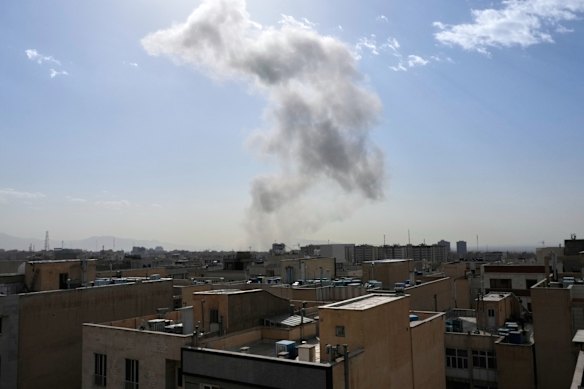
The apparent strike happened near the offices of Supreme Leader Ayatollah Ali Khamenei.
It wasn’t immediately clear whether the 86-year-old Khamenei had been in his offices at the time.
He hasn’t been seen publicly in days as tensions with the United States have grown. But the attack comes as the United States has assembled a vast fleet of fighter jets and warships in the region to try to pressure Iran into a deal over its nuclear program.
Reuters reports, citing a source, that Ali Khamenei is not in Tehran and has been transferred to a secure location.
AP, Reuters
Iran has nowhere near the same military capabilities as the US, and is even more vulnerable after last year’s war launched by Israel and recent anti-government protests.
But it could still inflict pain on American forces and allies, and may feel it has to if the Islamic Republic’s survival is at stake.
While Iran suffered major losses last June, it still has hundreds of missiles capable of hitting Israel, according to Israel’s estimates. Iran boasts a much larger arsenal of shorter-range missiles capable of hitting US bases in Gulf countries and offshore American forces, soon to be joined by a second aircraft carrier.
Iran has previously threatened to close the Strait of Hormuz, a vital waterway for the global oil trade, and claimed to have done so partially during military drills earlier this month.
Israel carried out heavy strikes on Iran’s longer-range missile arsenals – as well as its military leadership and nuclear program – during the 12-day war in June.
The US struck Iran’s main nuclear sites, and US President Donald Trump said at the time that they had been “obliterated.”
But the extent of the damage – and how much has been rebuilt – is still unknown. Iran continued to strike Israel with missiles and drones until the fighting stopped, at times eluding its vaunted air defences.
Iran’s shorter-range missile arsenal was largely untouched, said Danny Citrinowicz, an Iran expert at Israel’s Institute for National Security Studies. That could make Iran more inclined to retaliate against tens of thousands of US forces based in Qatar, Saudi Arabia, Jordan, the United Arab Emirates and elsewhere.
“Iran may be weak. But it still has ways to inflict real pain on the United States – and much more incentive to try than it did before,” Nate Swanson, head of the Atlantic Council’s Iran Strategy Project, wrote in Foreign Affairs.
“Iranian officials feel they need to give Trump a bloody nose or they will perpetually be at risk.”
Iran has also held quiet talks with China about purchasing anti-ship missiles that could significantly boost its ability to strike warships and choke sea routes, officials with knowledge of the discussions told the Associated Press.
The Iranians have had eight months to learn from their mistakes and firm up internal security.
Citrinowicz said there are likely contingency plans if the 86-year-old Khamenei were to be killed.
Rather than naming a single successor, power would probably shift to a small committee until hostilities subsided.
Experts say the death of the 86-year-old Khamenei, who has ruled Iran for over three decades, would not in itself spell the end of the Islamic Republic. Power might eventually pass to a member of his inner circle, as it did in Venezuela, or to Iran’s Revolutionary Guard.
Iran’s allies in the region include Houthi rebels in Yemen, armed groups in Iraq, Hezbollah in Lebanon and Hamas in the Palestinian territories.
However, its self-described Axis of Resistance suffered major losses in the fighting that rippled across the region after Hamas’ October 2023 attack on Israel.
Iran or its proxies could also carry out attacks farther afield. The country has been accused of using criminal gangs and armed groups to plan or carry out attacks around the world, including on dissidents, Israelis and Jewish targets.
AP
The United States is participating in the Israeli strikes against Iran, according to a US official and a person familiar with the operation, who spoke on condition of anonymity to detail sensitive military operations.
Israel launched a daylight attack Saturday on Iran’s capital, with a cloud of smoke rising from the city’s downtown. The apparent strike happened near the offices of Supreme Leader Ayatollah Ali Khamenei.
It wasn’t immediately clear whether the 86-year-old Khamenei had been in his offices at the time. He hasn’t been seen in public in days as tensions with the United States have grown. But the attack comes as the United States has assembled a vast fleet of fighter jets and warships in the region to try to pressure Iran into a deal over its nuclear program.
Trump had wanted a deal to constrain Iran’s nuclear program, and he sees an opportunity while the country is struggling at home with growing dissent following nationwide protests. Iran had hoped to avert a war, but maintains it has the right to enrich uranium and does not want to discuss other issues, like its long-range missile program or support for armed groups like Hamas and Hezbollah.
It wasn’t immediately clear if Iran would immediately strike back, but it had warned that American military personnel and bases spread across the region would be targets for any retaliation.
Israeli Defence Minister Israel Katz described the attack as being done “to remove threats.” He did not immediately elaborate.
In Tehran, witnesses heard the first blast by Khamenei’s office. Iranian state television later reported on the explosion, without offering a cause.
Sirens sounded across Israel at the same time. The Israeli military said that it had issued a “proactive alert to prepare the public for the possibility of missiles being launched toward the state of Israel.”
More explosions struck Iran’s capital after Israel said it was attacking the country. Authorities have offered no casualty information from the strikes.
Meanwhile, Iran shut down its airspace after Israel launched an attack targeting the country.
The warning to pilots came out as explosions rang out across Tehran, the Iranian capital.
The US military has declined to comment on the attack.
AP
Israel has launched an attack on Iran, with the country’s defence minister declaring a state of emergency across the country.
Israel Katz made the announcement as thick smoke rose from an explosion in downtown Tehran, Iran’s capital.
Iranian state television acknowledged the blast, without providing more details.
Sirens sounded across Israel at the same time. The Israeli military said that the “proactive alert to prepare the public for the possibility of missiles being launched toward the state of Israel”.
The attack comes as tensions are high between Iran and the United States over Tehran’s nuclear program.
Reuters
Disclaimer : This story is auto aggregated by a computer programme and has not been created or edited by DOWNTHENEWS. Publisher: www.smh.com.au