

Israel said on Tuesday it would seize parts of southern Lebanon to create what it called a “defensive buffer”, while Benjamin Netanyahu vowed to continue striking Iran, dimming hopes of de-escalation even as Donald Trump talked up the prospects of a deal to end the conflict.
During a meeting with the military chief of staff, Israel defence minister Israel Katz said Israeli forces would “control the remaining bridges and the security zone up to the Litani”, a river in Lebanon that meets the Mediterranean about 30km (20 miles) north of Israel’s border.
Katz’s remarks appeared to suggest the presence of Israeli troops could become prolonged, with Hezbollah, the powerful Iran-backed armed group, calling the move an “existential threat” to the Lebanese state.
Katz added all bridges over the Litani river, which he said had been used by Hezbollah to move operatives and weapons into southern Lebanon, “have been blown up and the IDF will control the remaining bridges”.
The previous day, Bezalel Smotrich, Israel’s far-right finance minister, said Israel should and “apply sovereignity” areas in southern Lebanon, signalling an expansionist vision that has alarmed critics at home and abroad.
The news of Israel taking control of areas in southern Lebanon comes as tensions between the Lebanese government and Hezbollah escalated on Tuesday after the government expelled Iran’s ambassador, Mohammad Reza Shibani, declaring him persona non grata and ordering him to leave by Sunday.
The unprecedented move reflects a break from decades of Iranian influence. Prime minister Nawaf Salam urged Hezbollah to halt attacks on Israel, saying avenging Iran’s leadership “has nothing to do with us”. Hezbollah condemned the decision as serving Israel and deepening divisions, as fears grow of renewed internal conflict in the country amid escalating regional war.
Lebanon has found itself pulled further into the regional conflict with Iran as Israel bombs the country and fights Hezbollah in the south. On Tuesday afternoon, residents of the northern city of Jounieh emerged from their homes confused as explosions rang out along the coastal area.
An Iranian missile heading towards Cyprus had been intercepted by a “foreign naval boat” over north Lebanon, according to Reuters, littering the Lebanese coast with debris and damaging streets.
Meanwhile, a fresh wave of Israeli airstrikes battered Iran on Tuesday, after Netanyahu vowed to press ahead with military action against Tehran.
“There’s more to come,” Netanyahu said in remarks that appeared to corroborate those of three Israeli officials who told Reuters they thought it was improbable that Iran would accept US demands in any new round of negotiations.
In a statement released on Tuesday, Iran’s Islamic Revolutionary Guard Corps said it would launch heavy missile and drone attacks at Israeli troops in northern Israel and the area near Gaza “without restraint” unless Israel ceased attacks in Lebanon and Palestine.
Israel said it carried out an extensive series of strikes on Iranian “production sites”, without providing more information. In Tehran, a massive blast was heard in northern neighbourhoods and another in the city centre.
Iran also fired at least 10 waves of missiles at Israel.
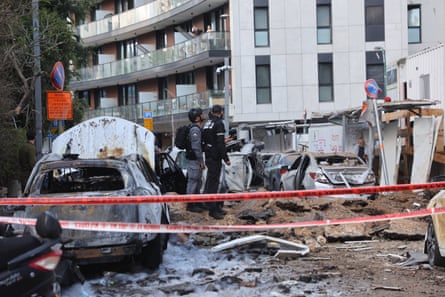
A thick plume of smoke rising over Tel Aviv’s skyline on Tuesday morning reinforced a sense that the end of the war remained distant.
Police said an Iranian munition carrying a substantial explosive payload struck the central city, causing widespread damage to buildings and vehicles. At least six people were lightly injured. Several buildings were damaged across Tel Aviv, with emergency services reporting casualties at one of the impact sites. One building and the adjacent road were heavily affected, with cars set ablaze. Fragments from intercepted missiles also fell in Rosh Ha’ayin, causing minor damage but no reported injuries.
The strikes were the latest in a cycle of retaliation after Israeli operations announced on Monday. About 40 minutes after Trump said he would delay action against Iran’s power infrastructure, Israel said on X that it had “just begun another wave of strikes targeting infrastructure of the Iranian terror regime across Tehran”.
The Israel Defense Forces said energy facilities would be spared, suggesting that Israel may be aligning with Washington in suspending attacks on Iranian power plants and related sites.
Since US-Israeli bombs started falling on Iran, estimates of total deaths (military and civilian) in the country have exceeded 1,500, with some rights groups reporting figures as high as 3,230 as of 21 March.
In recent weeks, Israel’s military claims to have eliminated more than 70% of Iran’s ballistic missile launchers, and says it has come close to establishing near-total control of Iranian airspace. Even so, Tehran has continued to penetrate Israel’s defences.
Disclaimer : This story is auto aggregated by a computer programme and has not been created or edited by DOWNTHENEWS. Publisher: theguardian.com



