Full marks to RSL Australia president Peter Tinley for expressing concern not only about the wanton destruction of Australian war graves in Gaza, but also for “the welfare of the cemetery’s gardeners and caretakers” (“Anzac war graves in Gaza to be restored,” February 6). It’s inspiring to learn that the head gardener’s family have served in that role for more than 100 years. The dedicated caretaking team deserves Australia’s gratitude and material support. Much more than that, the cemetery damage is a microcosm of the devastation wrought on Gaza’s buildings by Israeli forces. They have made the entire territory a cemetery of unmarked graves. Prime Minister Anthony Albanese may well voice concern to President Isaac Herzog over Australia’s war dead in Gaza, but will he have the integrity to convey Australia’s abhorrence of the ongoing carnage in Gaza? Tom Knowles, Parkville (Vic)
If Israel bulldozed and destroyed graves in the Gaza war cemetery, some dating back to the light horsemen of World War I, and the cost to remedy them exceeds $11 million, then why don’t they send the bill to Israel? Why should the Commonwealth War Graves Commission have to pay for this appalling and needless destruction? How would Israel feel if the boot were on the other foot and the graves of their soldiers were wantonly destroyed? Wendy Jane Whalley, North Ryde
As the granddaughter of a medic who served with the First Light Horse in Palestine in World War I, I am appalled to read that the war cemetery in Gaza containing the bodies of Australian and British servicemen was bulldozed by the Israeli Defence Forces. Hopefully, this atrocity, as well as the deaths of tens of thousands of men, women and children in Gaza, will be raised by Prime Minister Anthony Albanese when he meets with President Herzog. Christine Tiley, Albany Creek (Qld)
Herzog visit troubling
Amber Schultz’s article raises troubling questions about Israeli President Isaac Herzog’s visit (“NSW Police deploy thousands of officers for Herzog’s visit, protesters put on notice”, February 6). The victims of the Bondi terrorist attack were Australian citizens, not Israelis. Why has the president of a foreign nation been invited to commemorate Australian lives lost on Australian soil? Wouldn’t our own head of state have been more appropriate? This invitation risks portraying Australia’s Jewish community as primarily Israel-aligned, rather than Australian. It unfairly conflates a diverse local community with a foreign government’s actions, potentially exposing Jewish Australians to increased antisemitism. The massive police deployment of 3000 additional shifts demonstrates how divisive this visit is. Rather than promoting healing after tragedy, we’re creating conditions for conflict. Our Jewish community deserves better than being painted with the brush of another nation’s controversial actions. They are Australians first, and this visit undermines that reality. Shameel Durham, Paddington
Instead of continuing to chip away at any broad support that remains for their cause, perhaps the Palestine Action Group would agree not to march on our streets if the money saved from the cost of policing their rallies was instead donated by the NSW government to support the people of Gaza. With more than $11 million spent overseeing protests since Hamas attacked Israel on October 7, 2023, that represents a lot of humanitarian aid. Or does the group’s organiser, Josh Lees, prefer to continue his performative anti-Israel protests even at the expense of public support for the cause, rather than providing genuine and practical help to Palestinians? Rob Fraser, Balmain

Calls to cancel the visit of President Isaac Herzog are misguided. NSW Police have acted commendably, but their security concerns, especially regarding proposed illegal marches, have evoked further consternation. At the invitation of Prime Minister Anthony Albanese, Herzog is coming for talks with our federal government, as well as to offer support to the survivors and families of the victims of the Bondi Beach attack. Those opposing his visit and accusing Israel of genocide demonstrate a disappointing and sad nexus with Hamas and the Bondi Beach killers, as they feign ignorance of the Gaza conflict’s origins. Stuart Fox, Bondi Beach
Cancel US subs deal
I’m gobsmacked and baffled. Regarding one of the largest outlays of all time by Defence in this country, we rarely see any argument, debate or voluble opposition to the nefarious, secretive and outrageous AUKUS deal. The USA must be laughing hysterically about how stupid and naïve both the (old) Coalition and Labor governments are. We see very little analysis or opinion on the subject in the media. All that gets through is the occasional letter to the Herald. We must be allowed to debate this as a nation. Imagine how many schools, hospitals, trains, houses, national parks, mardi gras could be funded with $368 billion. Plus we could save our historic Defence sites (“Selling our barracks is not a defence strategy – it’s surrender”, February 6). Diane Prior, Northbridge
So the Albanese government plans to flog off the Victoria Barracks in Sydney, Melbourne and Brisbane to raise $1.8 billion to $3 billion for “defence capability.” Let me do the maths. The AUKUS submarine deal costs $368 billion. This sale of the barracks will buy us approximately 0.8 per cent of the program. We’re literally selling the crown jewels to make a down payment on American submarines. Marie Antoinette would be proud. Yours in fiscal bewilderment. Raj Kamath, Castle Hill
Given the number of letters appearing daily that call for the abandonment of the AUKUS submarine deal, perhaps it is time for the people to have a real say on this expensive and contentious arrangement. The plebiscite on same-sex marriage showed that it can be an effective way of clarifying and communicating the people’s view to an often out-of-touch federal parliament. Is it time for a national plebiscite on the AUKUS deal? Brian Kidd, Mt Waverley (Vic)
Correspondent Brian Everingham makes the very valid point that if we ever do obtain American nuclear subs, our incorporation into the American empire will be complete (Letters, February 6). The UK is in the same subservient position, as its Vanguard-class nuclear subs have to regularly visit the US to have their onboard Trident nuclear missiles serviced as there are no such facilities in the UK. Lance Dover. Pretty Beach
It is obvious to any thinking person that the chances of ever seeing nuclear submarines delivered are negligible. That is not a bad thing. By the time they are scheduled to be delivered they would be an expensive anachronism. We need to get out of this deal before paying over more money. We can then use it on more sensible acquisitions. It is therefore heartening to read that there are US politicians who are brave enough to face the fact that they lack the capacity to supply these vessels. We should accept we are not going to have them delivered and any that are built will be American operated. We should just charge them rent to use our bases and avoid involvement in a futile war over Taiwan. Problem solved. Peter Wilson, Murray’s Beach
Nuclear treaty
The last nuclear treaty between the United States and the Russian Federation expired this week. It is the first time in 64 years that there will be no limits on each side’s nuclear forces. The New Start Treaty had been limiting the number of deployed strategic nuclear weapons and weapon carriers. Other nuclear related treaties like the Anti-Ballistic Missile Treaty, the Intermediate Range Nuclear Forces Treaty and the Open Skies Treaty have previously been ended by various US presidents. Russia had offered and asked for prolonging New Start but the Trump administration has not responded. Norman Broomhall, Port Macquarie
Double standards
One Nation leader Pauline Hanson says our two-party system puts vested interests before Australians (“Coalition peace talks on brink of collapse as Hanson boasts of One Nation’s future”, February 6). This, from a politician who flew as Gina Rinehart’s guest in a private jet to party with the rich and powerful at Donald Trump’s Mar-a-Lago. Hanson may not put vested interests before her, but she seems to enjoy sitting beside them. Peter Campbell, Potts Point
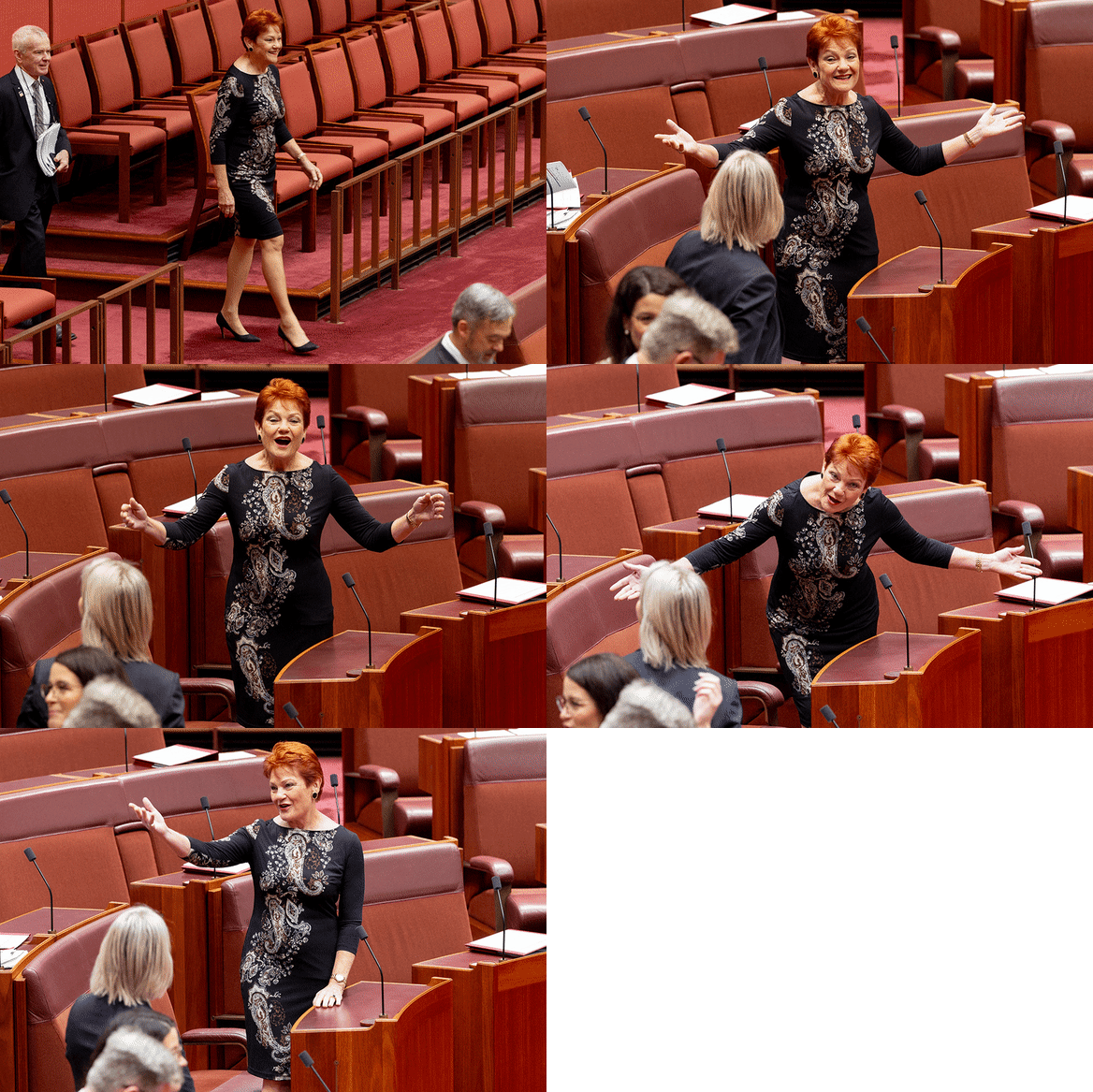
I wonder how many of Hanson’s followers have non-Anglo surnames. I noticed the One Nation official responsible for the divisive “spot the Westerner” video is called Bianca Colecchia, who migrated to Australia from Italy only 10 years ago. Does Ms Colecchia realise there was a time not that long ago when immigrants like her would have been subject to the same racist treatment she is dishing out to others? Genevieve Milton, Dulwich Hill
With Pauline and the National Party sitting there, I’m trying to work out whether it’s a crossbench or a cross bench. Neil Reckord, Gordon (ACT)
Abbott apes Trump
In criticising the judgment of Supreme Court Justice Melinda Rigg regarding the pro-Palestine march over Sydney Harbour Bridge, Tony Abbott is part of a disturbing trend in the current Australian political climate to ape the tactic of Donald Trump and his allies, who repeatedly criticise judges when they rule against his administration, accusing them of “judicial overreach” (“Abbott told off by judge for social media post”, February 6). Trump has gone so far as targeting an individual, US District Court Judge James Boasburg, calling him a “troublemaker and [an] agitator”. Abbott and his ilk should learn from Chief Justice Andrew Bell’s admonition that before posting ignorant, off-the-cuff remarks, check the statutory framework underpinning Justice Rigg’s decision instead of posting in ignorance. John Payne, Kelso
Strong woman
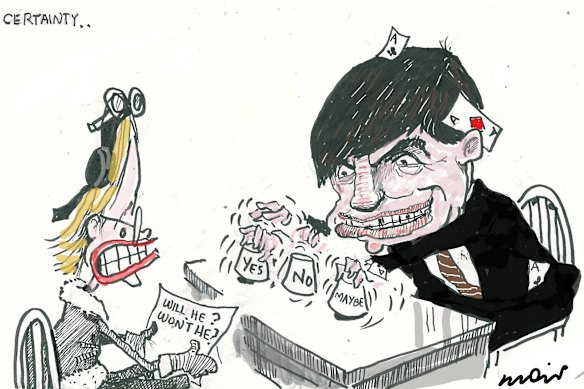
Sussan Ley is to be congratulated on proving her mettle in the Coalition split (“Littleproud rebuffs Ley’s demands as Coalition reunion deadline expires”, February 6). Littleproud wanted a blank cheque to run amok; Ley, to her credit, said no and stood by it. It will be interesting to see if she now gets the clean air necessary to develop policies appealing to middle Australia, while still having the lead of her own party’s hard right in her saddlebags. Wayne Duncombe, Lilyfield
Border skirmish
What a strange story – a mining billionaire would rather have the negative publicity of a court case with a disability pensioner rather than mend a fence (“‘Get a lawyer’ farmer suing Rinehart told”, February 6). Perhaps there is more to this than meets the eye. However, I don’t know how much a 12-kilometre fence costs in comparison to engaging a barrister, but as Robert Frost said: “Good fences make good neighbours.” Paul Doyle, Glenbrook
The IQ riddle
In addition to astute observations from correspondents (Letters, February 6), the hilarious point that’s lost on those buying polygenetic testing for high IQ in their IVF embryos is that these are embryos from their own gene pool. Thus, they are assuming that they actually carry traits for high IQ. The argument from one investing couple quoted in the original article defies any evidence of this (“Have a smarter baby”: Embryos chosen for their IQ”, February 5). Comedy aside, we are currently witnessing the unbridled power and influence of so-called global leaders whose only qualification is immense wealth, yet there’s little evidence of exceptional IQ. Those wealthy enough to buy into the myth of guaranteed high-IQ offspring merely demonstrate their ignorance of how genetics work. Robyn Dalziell, Kellyville
Bureaucracy in bloom
Correspondent Andrew Taubman writes that he “can’t think of a single major area of government spending that could be significantly cut without doing harm to the nation” (Letters, February 5). It would be interesting to see the costs of the bureaucracy in bloom, generated under decades of managerialism. Every small agency and funded service provider, up to the largest department, now has its own chief executive and hierarchy of executives and managers. In Oscar Wilde’s prophetic words, “the bureaucracy seems to be expanding to meet the needs of the bureaucracy”. And that surely doesn’t come cheaply. Barbara Chapman, South Yarra (Vic)
Time ripe for tax reform
We are at a critical moment in our history. If ever we needed both tax and housing reform, it’s now. Tackling these two matters by reducing the capital gains tax discount will go some way to addressing the widening gap between the haves and the have-nots, and the increasing disenchantment of young people locked out of the housing market (“The tax deduction that will cost Australia $250bn over the next decade”, February 6). It’s a fortuitous situation when the personal vision (others may call it ambition) of the federal treasurer, the needs of the nation and the political landscape are in sync, and Anthony Albanese needs to cast aside his usual caution and seize the moment. He should ask himself what many who voted for Labor at the last election are asking; if not now, when? It’s hard to imagine a time when the stars will align more advantageously. Many Australians may support the CGT discount as is, but few genuinely think it’s any longer fit for purpose. If the PM doesn’t allow Chalmers to reduce it, the opportunity will pass and it will continue to distort the housing market, as it has since 1999. Prue Nelson, Cremorne Point
While CGT is up for discussion, why not move the timing to two years instead of one? Capital investments would become more genuine rather than a tax dodge, since the investment would have to be held for more than 730 days, rather than 365 plus 1. Keith Masnick, Woollahra
Doctors overworked
Overworked and underpaid doctors are not a new phenomenon (Letters, February 6). Decades ago, at the original Bankstown hospital, interns and junior doctors like me were forced to do more than 40 hours overtime per week. We pleaded with the superintendent, trying to convince them that it would be much cheaper to hire an extra doctor or two to cover these hours – but to no avail. The overtime budget was well in the black and the regular hours budget was used up. The brave doctors who complained couldn’t get jobs in Sydney and had to move interstate. This kind of mentality still occurs today. Sadly, genuine care and commercial reality are like water and oil – a poor mix. Ashley Berry, Toolijooa

Mental health disservice
I wholeheartedly agree that mental health services in NSW are in need of urgent repair (“Bondi stabbing inquest reminds mental healthcare failures endanger us all”, February 6). My career in mental health spanned the change from institutional to community care. The reports of David Richmond (1983) and Brian Burdekin (1993) emphasised the need for the proper funding of community-based mental health services, but as the old institutions wound down, savings were not directed appropriately. As a corollary, it became impossible for community mental health services in NSW to provide evidence-based practice for individuals such as Joel Cauchi, even though mental health expert Dr John Hoult and his team at North Sydney had demonstrated that “assertive community treatment” of individuals with serious and enduring mental illness was superior and less costly than hospital care. In a week in which we farewelled Dame Marie Bashir, one of the pioneers of community care, and the publication of the recommendations of coroner Teresa O’Sullivan, there is no better time for the government to act. Gordon Lambert, Kiama Downs
Train-free zone
I refer to Mostafa Rachwani’s article (“Sydney’s transport deserts – and the way to fix them”, January 5). If you want to find a genuine spending desert, try catching a train on the other side of the sandstone curtain. This year’s NSW budget has allocated about $35 billion for rail and roads in Sydney. For regional roads, the figure is about $1 billion (which in previous years was mostly spent on the Coffs and Hexham bypasses). What about new rail spending in the regions this year? Precisely zero. Chris O’Rourke, Bathurst
Reporting season
Back in the days when honesty in school reports took precedence over empathy, my year 12 report said: “David is not amenable to discipline.” (Letters, February 6) A couple of years later, the army said much the same thing, but couched in somewhat more direct terms. David Calvey, Gosford
According to my year 5 report, I suffered from “verbal effervescence”, or as my dad explained it to everyone, “verbal diarrhoea”. Ian Clarke, Terrigal
Some years ago, my opening comment on a child’s primary school report read: “School is an interruption in Mike’s life.” Saw Mike’s mum the next week and as she walked across the playground she yelled out: “Loved your comment on Mike!” Comments then were real, not like so much of the computer-generated stuff that is churned out these days. Gerard Fitzpatrick, Drummoyne
Enhanced performance
I guess sports commentators will have to come up with a new phrase to replace “won by a nose” (“Ski-jumpers accused of enlarging penises to enhance performance”’, February 6). Patrick McGrath, Potts Point
- To submit a letter to the Sydney Morning Herald, email letters@smh.com.au. Click here for tips on how to submit letters.
- The Opinion newsletter is a weekly wrap of views that will challenge, champion and inform. Sign up here.
Disclaimer : This story is auto aggregated by a computer programme and has not been created or edited by DOWNTHENEWS. Publisher: www.smh.com.au