
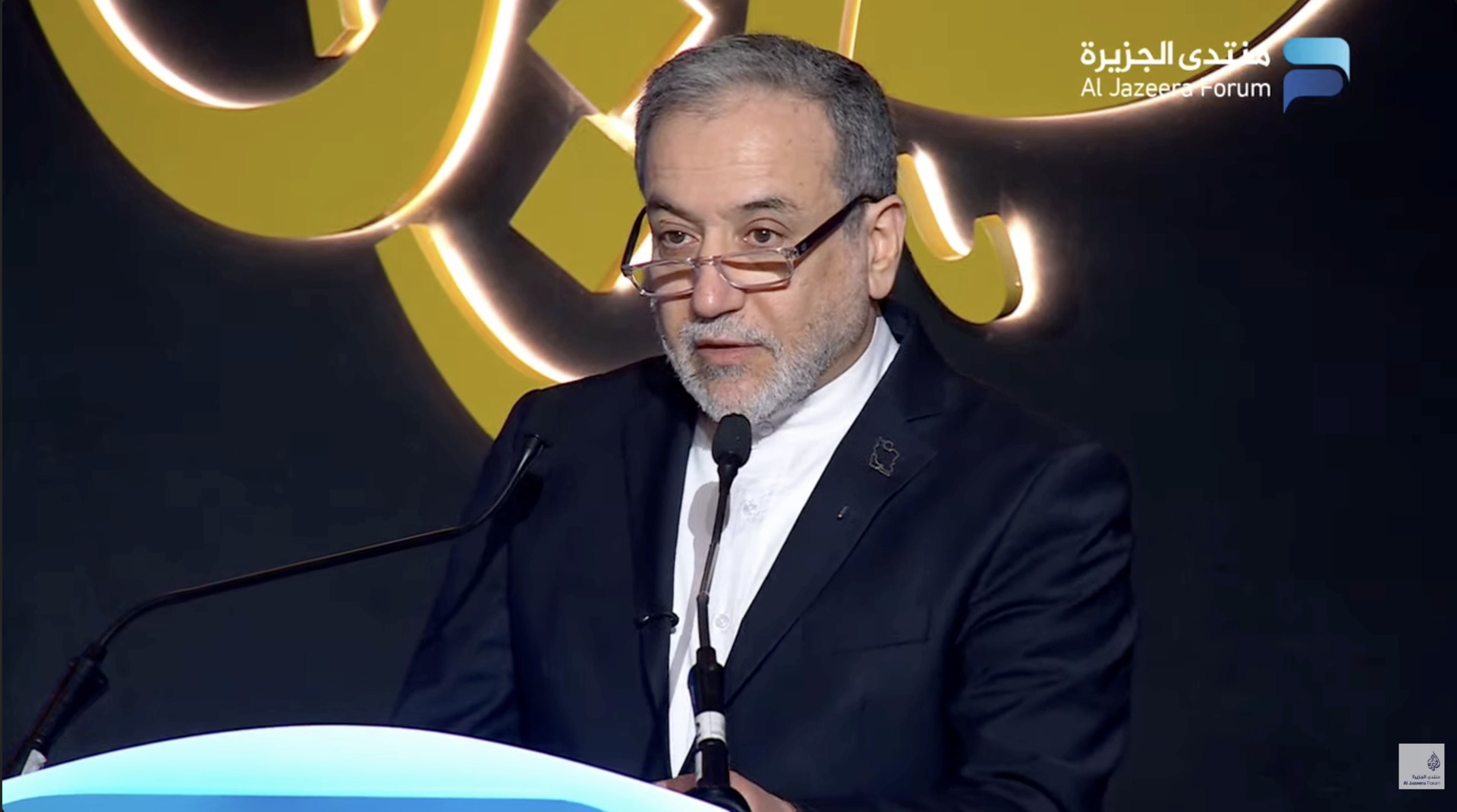
Israel’s genocide against Palestinians in Gaza and its geopolitical fallout reverberating across the Middle East and beyond have dominated the 17th Al Jazeera Forum in Doha.
Senior political figures and officials warned on Saturday that the conflict is accelerating the collapse of international norms, reshaping regional power balances, but also noted it has pushed the Palestinian cause back to the centre of global diplomacy.
Recommended Stories
list of 3 itemsend of list
Iranian Minister of Foreign Affairs Abbas Araghchi, fresh from indirect talks in Oman with the United States, described the Palestinian issue as the central strategic question shaping the future of the Middle East, warning that Israel’s military campaign in Gaza and regional posture are undermining the global legal order.
He said the Palestinian struggle is “the defining question of justice in West Asia and beyond” and “the strategic and moral compass of our region”.
Condemning the war, Araghchi stated: “What we are witnessing in Gaza is not merely war… It is the deliberate destruction of civilian life on a massive scale. It is genocide.” He added that the violence has “wounded the conscience of humanity” and exposed the inability of global powers to prevent attacks on civilians.
Araghchi warned that the consequences extend far beyond the Palestinian territories. “We are witnessing not only the tragedy of Palestine, but the transformation of the world into a place where the law is replaced by force,” he said, adding that impunity for attacks on civilians risks normalising military domination as a guiding principle of international relations.
Advertisement
He also described Israel’s policies as part of a broader Israeli regional strategy, saying the “expansionist project” aims to weaken neighbouring states and enforce “permanent inequality” across the region while allowing Israel to expand its arsenal without meaningful oversight.
Israel carried out attacks on six countries in 2025: Palestine, Lebanon, Syria, Yemen, Qatar and Iran. It also carried out strikes in Tunisian, Maltese and Greek territorial waters on aid flotillas heading for Gaza.
Calling for coordinated international action, Iran’s top diplomat urged governments to impose “comprehensive and targeted sanctions against Israel, including an immediate arms embargo,” alongside the suspension of military and intelligence cooperation, and legal accountability for violations of international law.
He stressed that the Palestinian issue is “not only a humanitarian issue … It is a strategic issue,” arguing that regional stability depends on ending occupation and building a system grounded in sovereignty and equality.
Israel seeks to ‘prevent the establishment of a Palestinian state’
Sheikh Hamad bin Thamer bin Mohammed Al Thani, chairman of the board of the Al Jazeera Media Network, said in his opening speech that Israel’s assault has become a turning point for the Palestinian issue, warning that the occupation is attempting to permanently alter realities on the ground.
Addressing the forum, he warned that the “Israeli occupation seeks to reoccupy Gaza by displacing its people … settling parts of it and … the West Bank … to prevent the establishment of a Palestinian state”.
He also emphasised the heavy toll paid by journalists covering the war, saying Al Jazeera “has sacrificed… and paid a heavy and dear price of its correspondents,” noting that reporters “were targeted only because they wanted to report the truth to the world”.
Despite the risks, the network remains committed to “reporting the truth to the world,” he said, honouring journalists who “provided the ultimate price … for the sake of the truth”.
Israeli threat to the Red Sea
Somali President Hassan Sheikh Mohamud, also speaking at the forum, warned that Israel’s Gaza war and escalating tensions in the Red Sea are unfolding alongside a broader breakdown in the international system.
He said the Palestinian crisis represents “another level of inhumane engagement in the history of the world,” cautioning that the failure to secure an “equitable … durable solution based on the two-state solution” risks prolonging instability across the region and beyond.
Advertisement
Placing the conflict within a wider geopolitical context, Mohamud warned that the foundations of global governance are weakening.
“Key among the global concerns is the weakening of the established rules based on international order. That order is not intact any more,” he said, adding that the institutions created after World War II “are under grave threat” as “the mighty is right” increasingly replaces adherence to international law.
He also linked regional instability to tensions in the Red Sea, warning that interference “like in the case of Israel … interfering with Somalia’s sovereign and territorial integrity” threatens trade routes and African security.
Calling Israel’s recognition of Somaliland “reckless and fundamentally wrong and illegal action under international law,” he said the move “undermines stability, security and trade in a way that affects the whole of Africa, the Red Sea and the wider world”.
In an exclusive interview with Al Jazeera in January, Mohamud said that the breakaway region of Somaliland had agreed to accept displaced Palestinians being relocated there in exchange for recognition. Somaliland officials rejected the allegations.
Mohamud on Saturday urged governments and international institutions to “return to the path of common purpose and agreed universal rules” to prevent the erosion of multilateral cooperation.
Historic global rupture
Burhanettin Duran, Turkiye’s head of the Directorate of Communications, said Israel’s genocidal war on Gaza reflects a deeper transformation of global politics, warning that the erosion of international institutions has enabled atrocities to unfold with limited accountability.
“[The] world is not just transitioning, it has already transitioned. We are living through the consequences of a historic rupture,” he said.
Describing Gaza as the clearest manifestation of this breakdown, Duran said: “Genocide, in the case of Israeli genocide … has returned to the centre of international politics, not as an exception, but as a tolerated reality.” He added that institutions designed to prevent such crimes now “fail publicly, repeatedly, and structurally”.
Duran also warned that modern conflicts increasingly extend beyond the battlefield, noting that “wars are no longer confined to physical battlefields” but are fought through narratives and digital platforms that shape “what is visible, what is credible, and what disappears”.
He argued that justice must become the organising principle of the international system, stressing that “justice produces legitimacy” and that durable stability cannot be imposed through power alone.
Outlining Turkiye’s diplomatic approach, Duran said Ankara is pursuing a strategy of “regional ownership,” insisting that “regional problems demand regional solutions,” while highlighting mediation and stabilisation efforts across several conflict zones.
“In Gaza, this wave of insecurity is visible in its starkest form – mass devastation, deep trauma, genocide and humanitarian collapse,” he said, urging regional powers to prioritise ending the war and preventing any forced displacement of Palestinians.
Disclaimer : This story is auto aggregated by a computer programme and has not been created or edited by DOWNTHENEWS. Publisher: aljazeera.com



