Study a defeated NRL coach in the dressing room after a loss, and he can look as if he has stepped into a grave: sunken, shallow, drained.
Meanwhile, some of his players are still on the field chatting brightly with the winners or kneeling, arms locked in prayer, with their opposites.
Across in the other dressing room, surrounded by a milling group of club officials and directors, the victorious coach is ebullient, joyful, relieved.
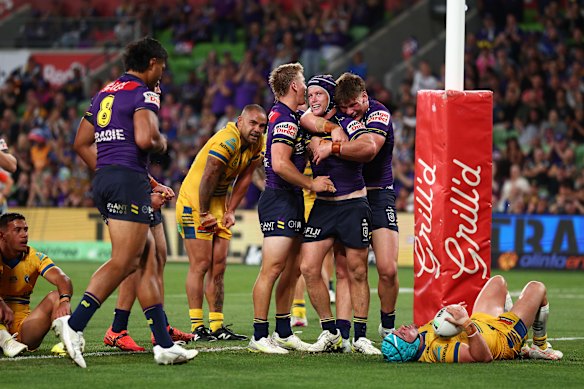
That scenario was only half right following the Storm’s home game against the Eels, the first match of the 2026 NRL season played on Australian soil.
Eels coach Jason Ryles was entitled to be devastated following a pathetic performance by his team in the 52-4 defeat. Melbourne’s Craig Bellamy admitted to being “pretty happy”, admitting he expected a “closer result”, following a pre-season competition won by the Eels and in which the Storm conceded 15 tries. He then proceeded to catalogue the mistakes of his players.
Ryles was a former player and assistant coach under Bellamy but the usual post-match fraternisation when the apprentice comes up against the master was non-existent. It would seem the Zac Lomax affair, which consumed so much of the oxygen leading up to the match, had more casualties than Lomax himself, now banished from the NRL for two years.
Highs and lows: Harry Grant scores another try in Melbourne’s big win over Parramatta.Credit: Getty Images
Despite his histrionics in the coaching box, Bellamy was relatively subdued, a surprise to many considering he started the match with a new look back row, centre and fullback, plus rookies on the bench and his record of winning every opening game since 2003 looked in jeopardy.
But the lifer coaches, like Souths’ Wayne Bennett and Bellamy, ignore the sting of words such as old, finished and selfish on social media. It is precisely these veterans who are best equipped to confront the myriad challenges to success.
After all, a football season is a test of whether the forces that bond a club together can withstand the forces seeking to pull it apart. Coaching is the easy part. It’s the off-field issues that are a challenge – although injuries, suspensions and the random nature of six-agains also have an impact.
But so, too, does an unfair NRL draw with five-day turnarounds and long travel. There are also the more subterranean issues, such as avaricious agents seeking to move players on to secure an additional commission, unfair media, petty jealousies in the locker room, sniping club directors, quarrelling partners and the “grass is greener” mentality of players returning from State of Origin or national duty having heard stories of the superior facilities, days off, richer contracts and relaxed training from teammates at other clubs.
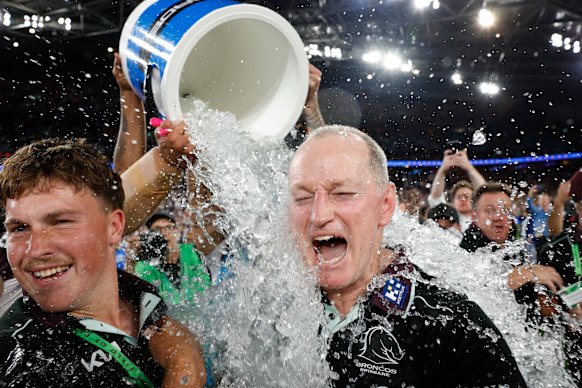
Very few coaches get to celebrate premiership success. Michael Maguire has done it with two clubs.Credit: Getty Images
It takes a special coach to deal with all that.
The lifers, including Penrith’s Ivan Cleary, the Roosters’ Trent Robinson, Canberra’s Ricky Stuart and reigning premiership coach Michael Maguire, as well as Bennett and Bellamy, have the experience to protect their distinctive club cultures against the negative forces. Their total number of top-grade games as coaches exceeds 3000 across well over 100 seasons.
All coach at clubs with boards not easily panicked, although Brisbane’s Old Boys have at times acted as another insurgency, in the same way ex-players from the Bulldogs and Eels have been destabilising forces in the past.
So why do coaches do it? Money is an obvious reason. NRL coaches are paid between $500,000 and $1.5 million. That builds a lot of Gold Coast apartments, farms on the Darling Downs, or a cellar of rare red wine. Most can live off their investments when they retire.
Work ethic is another factor. Bellamy took advice from some of his mates at Portland who retired early and he freely wonders, “What would I do if I didn’t coach?”
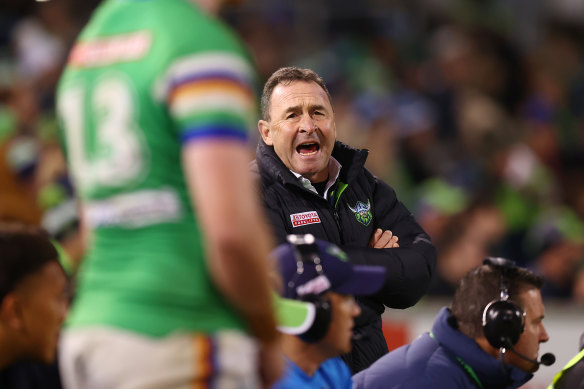
Ricky Stuart wears his heart on his sleeve more than most coaches.Credit: Getty
Financial freedom means they don’t need to find another job. Unlike the part-time coaches of 40 years ago, they don’t have to juggle a job as a school teacher, policeman or selling poker machines while also supervising training three nights a week and studying videos the remaining evenings.
Even today’s head coaches sacked early in their careers, such as Adam O’Brien, return as assistants after they have taken the long walk off the short plank. Others, such as Justin Holbrook, the man who replaced O’Brien at Newcastle, spent time as a Roosters assistant after being sacked as the Titans head coach.
The money that has flowed into the game means head coaches have an army of assistants, including dieticians and psychologists, and access to cutting-edge technology, which saves hours of sifting through video, and superior training facilities.
The lifers are akin to soldiers signing up for another tour of duty. It’s the routine, the early morning rises for a personal workout in the gym, followed by training and a myriad of meetings that drives them, rather than drains them. It’s Robert Duvall, the actor who recently died at age 95, playing the role of Lieutenant Colonel William Kilgore in the movie Apocalypse Now saying: “I love the smell of napalm in the morning. It smells like victory.”
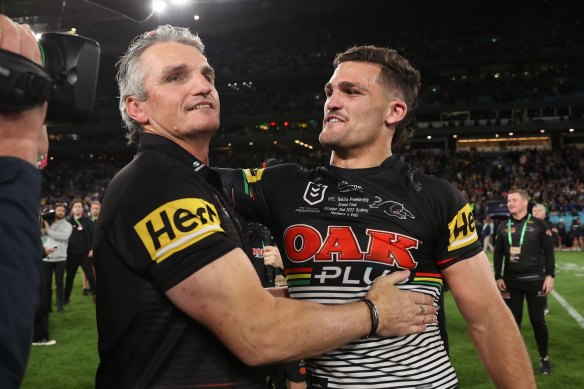
Ivan Cleary always manages to keep his cool, even when celebrating a premiership with son Nathan.Credit: Getty
Maguire probably best fits the Lt Col Kilgore image, and despite his relentless pursuit of victory and short term stays at clubs, he is guaranteed a permanent place on the coaching merry-go-round, given his rare status as a premiership winner at two clubs.
Madge and Stuart probably suffer emotional oscillations more than the Bennetts and Clearys, who appear increasingly accommodating about losses as the years roll by.
To them, victory isn’t the sole motivation, although Bennett would love to be the first coach to win premierships at three clubs. Making players better is a strong motivator. To Bellamy, the games during a 23-season career all blur into each other, but the incremental improvement of each player in his charge does not.
Talking to him in September immediately after his team had qualified for his 11th grand final, I mentioned that a victory would give him a record above 50 per cent, given he had won five (although two were subsequently stripped by the NRL). But he immediately rejected the idea, pointing out improvement of players is his main concern. He also expressed frustration at the prevailing view a premiership means 16 teams are failures.
Australians, like Americans, won’t accept that second place is still a bloody good place. Given that a coach learns more from a loss than a win, the greybeard coaches who focus on player improvement can probably level the emotional swings of cruel defeats and lucky wins.
Yet, for some coaches the highs don’t last long enough and the lows are too low. I recall a one-point loss to the Eels in the 1984 preliminary final following an Eric Grothe try in the final minute. For days, I could not cool down, despite the early September winter. My skin prickled, as if smothered in a heat rash. I eventually visited my GP. He was alarmed at my blood pressure but gambled on sending me home, rather than hospital, with orders to rest and return after two days. He measured my blood pressure on the return visit and, finding it normal, said: “That tells me a lot about your profession.”
Most Viewed in Sport
Disclaimer : This story is auto aggregated by a computer programme and has not been created or edited by DOWNTHENEWS. Publisher: www.smh.com.au