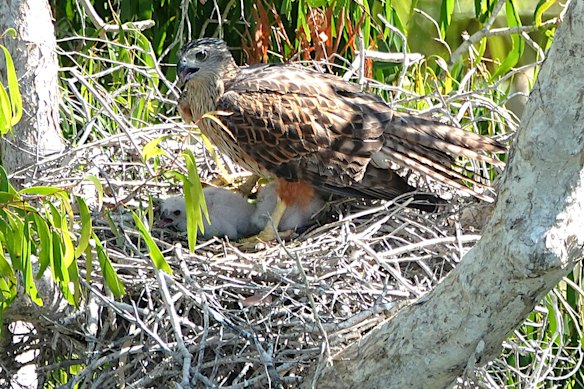
A red goshawk female with chicks in its nest on Dambimangari Country in WA’s north.Credit: Chris MacColl
The hunt for Australia’s rarest bird of prey, the red goshawk, has delivered an early Christmas gift.
Just when it was feared that these superbly patterned raptors were disappearing from Australian landscapes, they’ve been spotted thriving in the remotest parts of the Kimberley, in WA’s north-west.
Finding the red goshawks nest has been a feat in itself. A few weeks ago, bird ecologists and Kimberley Indigenous rangers took turns to peer down from a tiny hovering helicopter, necks craned as they scanned the treetops below.
Suddenly, they spotted a large stick nest, a plump mother bird and her white fluffy chicks. And then another, and another, until the jubilant crew had spotted five red goshawk nests in just two days.
“I think I went into a bit of shock,” says ecologist and survey co-leader Jessica Rooke.
“It was like looking for a needle in a haystack, but after we spotted the first nest, we just kept finding them. It was phenomenal. I still can’t believe it.”
The multiple finds are astonishing in light of the fact only 15 to 20 active red goshawk nests have been previously recorded across the entirety of mainland Australia.
“Five years ago, we did a Kimberley survey and didn’t find a single nest,” says species expert Chris MacColl, who co-led the latest survey.
“We believe that time we were too far inland, where the landscape is drier and with less suitable habitat.”
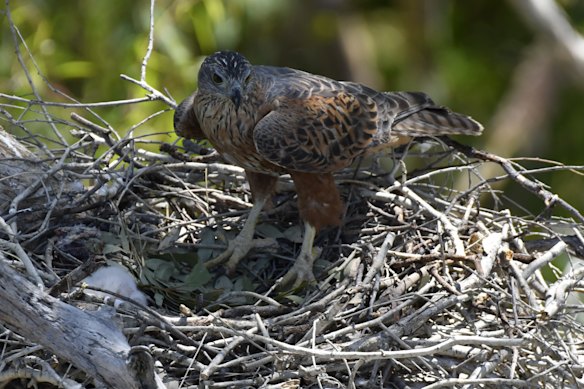
A red goshawk female on a nest with a chick.Credit: Jessica Rooke
The excitement of finding this rare bird in the act of nesting was a thrill for the survey team – Rooke’s organisation Birdlife Australia, the Australian Wildlife Conservancy and Indigenous rangers who live and work in rugged country extending out from the spectacular Mitchell Plateau.
Kane Nanowatt, a Wilinggin Wunggurr ranger said his sightings from the helicopter of both birds and nests was a first. “Only seen them in books before – made me happy to see them there,” he said.
Joyce Malay, a Dambimangari ranger, said she learned “so much about how to identify red goshawks from other birds of prey and about their nesting habitat”.
Rooke says the R44 helicopter had been flying for only three hours on the first day, along creek lines and over stands of tall paperbark trees before pilot Ryan made the first sighting.
“We’d seen other nests already – lots of whistling kite nests – so everyone in the chopper was getting their eye in on what to look for. Then Ryan piped up ‘I think that looks different. It’s bigger, it’s positioned on a horizontal branch.’
“I raised my binoculars and, sure enough, not only is the nest the right shape, but there’s a beautiful red goshawk female calmly looking up at us with her big golden yellow eyes.”
Her colleague MacColl said they checked all the nests by landing the helicopter at a distance and using binoculars.
“Three of the nests had one or two beautiful, fluffy, white chicks – about two weeks old at most – and two contained a pair of eggs. We were pinching ourselves; it was like a dream.”
The red goshawk sightings are a welcome sign for those devoted to saving it. They fill a major knowledge gap about a bird species once known along the eastern seaboard but now found only on Cape York Peninsula, around the Top End and in the Kimberley.
The red goshawk is one of 110 priority species listed under the nation’s Threatened Species Action Plan. “Yet it was one of the first birds of prey encountered by Europeans, because someone nailed a specimen to a settler’s hut in Botany Bay,” says Rooke, Birdlife’s Threatened Species coordinator.
“Since then, a dramatic contraction of range means they are presumed extinct in NSW, southeast and central Queensland. Now it’s not until you get to northern Australia where they’re persisting.”
The recently observed chicks have a good chance of growing to adulthood in a remote wilderness with few feral cats and other introduced threats.
Their chances are helped by Aboriginal ranger programs to manage wildfire risk, tackle weeds and cull feral animals.
“This discovery is a major step forward for one of Australia’s most elusive birds of prey,” says Threatened Species Commissioner Dr Fiona Fraser.
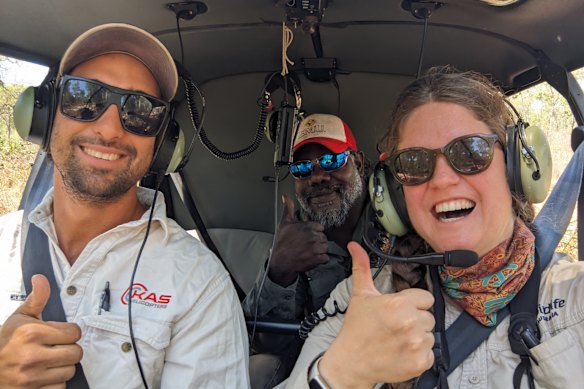
Ryan Jason, ranger Jason Wungundin from Wilinggin Aboriginal Corporation and Jessica Rooke in the helicopter used to search for the red goshawks’ nests.Credit: Jessica Rooke/Australian Wildlife
“It’s a powerful example of what can be achieved through collaboration with traditional owners, scientists and conservation partners.”
Rooke, who describes herself as a “classic bird nerd”, says the red goshawk is a favourite species and a formidable bird with a wingspan of up to 1.3 metres. The female is twice as heavy as her male partner “and she has really huge yellow feet!”
Unlike other raptors, red goshawks are “perch predators” that sit motionless in a tree until a bird flies past. “Then they put on this incredible burst of speed and take down a bird in mid-flight – kookaburras, black cockatoos, waterbirds. We’ve collected remnants of their prey from beneath tree nests.”
Rooke says the recent discovery is a morale boost for conservation at a time when many species continue to face challenges.
“As we kept finding nests, I couldn’t keep the smile from my face, so much so that my muscles hurt.”
Start the day with a summary of the day’s most important and interesting stories, analysis and insights. Sign up for our Morning Edition newsletter.
Most Viewed in National
Disclaimer : This story is auto aggregated by a computer programme and has not been created or edited by DOWNTHENEWS. Publisher: www.smh.com.au