
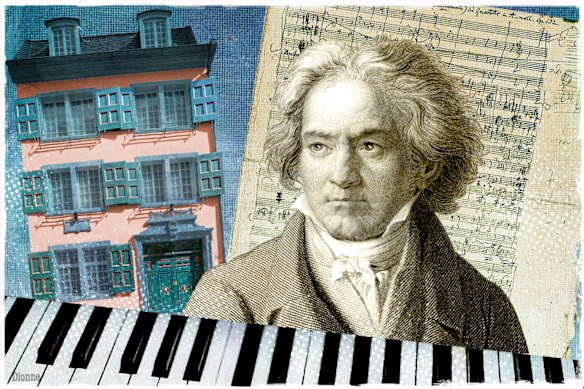
An exhibition in Bonn offers an opportunity to connect with a long-dead relative through his love for the German composer.
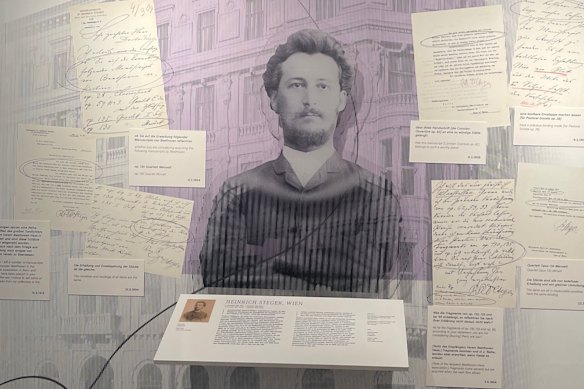
We are not exactly the ageing Blues Brothers but my brother Adrian and I are on some sort of mission. Not from God, though; more likely from our Viennese great-grandfather, Heinrich.
Of course, I never met him. Heinrich was quite a character by all accounts – a defence lawyer, a musicologist who was dotty about Ludwig van Beethoven, and some sort of man about town. Apparently my grandfather, Gustav, once told one of his sisters that he had recently encountered a half-brother he hadn’t known about.
That Austrian side of my family is now sparse. World War II wreaked havoc, and Gustav and my grandmother, Margarete, were murdered by the Nazis at Auschwitz. Their children, my father and uncle, got out, survived, lived full lives in England and Austria respectively, but are now dead.
New information about the family is rare, so when I got a call from Adrian in London about Heinrich I was intrigued. Apparently he owned 10 “autographs” by Beethoven. As an enthusiastic autograph collector in my teenage years – Marlene Dietrich, Noel Coward, Lulu and Lauren Bacall among them – my ears pricked up. But I was way off the mark: when it comes to music, autographs are the first complete version of a score written in the composer’s hand.
They are prized, and very valuable. The autograph manuscript for Beethoven’s Grosse Fuge (originally the final movement in his string quartet opus 130), for example, which had been missing for 115 years, sold at auction 20 years ago for more than $2 million.
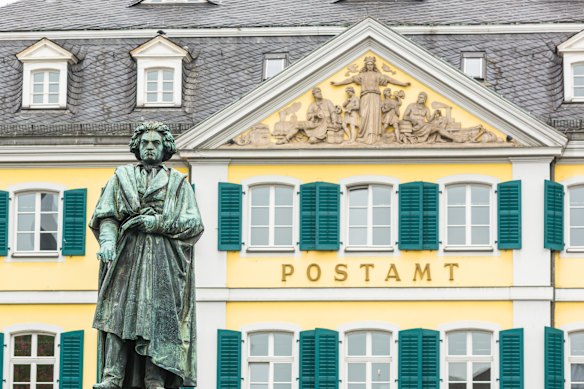
There is to be an exhibition of Heinrich’s collection at the Beethoven-Haus in Bonn. This is where Beethoven was born 256 years ago and it is now a museum, a gallery, a library and a performance space. It also has a huge collection of Beethoven manuscripts, tucked away below ground in a secure, climate-controlled room where the curator, Julia Ronge, shows us correspondence with Heinrich and the large collection of autographs, including the composer’s Pastoral Symphony.
Adrian has sent her some photographs and information about Heinrich and has arranged to meet her for a guided tour and a behind-the-scenes look at the collection. Why, he asks, don’t you come over and we’ll drive down to Bonn? I’d be mad to miss this link across time with Heinrich.
We’re taking something with us, however – chairs. But these aren’t any old chairs. Word is they came from the office of Artaria, the Viennese music publishing firm that was set up in 1770. And if that’s the case, then they were probably sat on by Beethoven and Mozart, both of whom Artaria published.
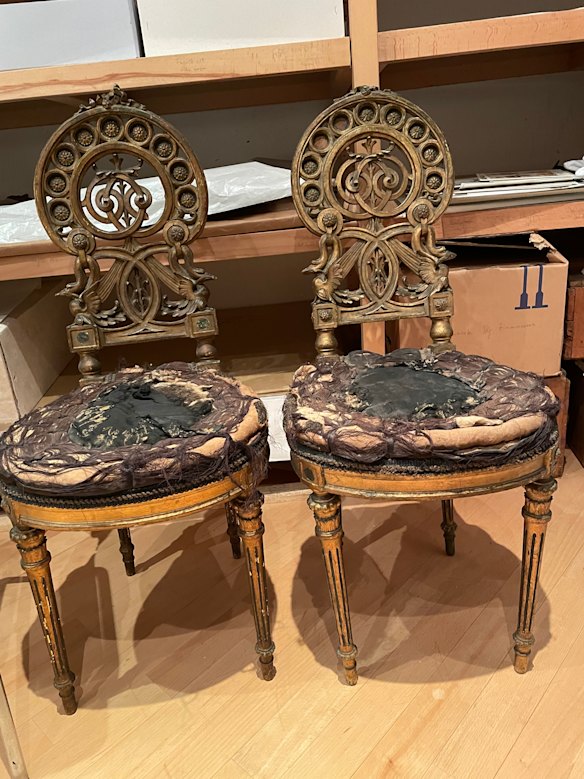
For years these two moth-eaten but elegant gilt chairs were tucked away in a cupboard at the top of our family home. I think my father got them from my great-aunt Hedda, Heinrich’s daughter, after her death in the early 1960s; she had managed to get out of Austria before the Nazi onslaught.
I have sat on them. Does that count as one degree of separation from those great composers? Could DNA still be lurking in that horse-hair upholstery?
So here we are, emerging from the Channel Tunnel and making a beeline across Northern Europe at the fag end of what has clearly been a glorious autumn. Calais and its many migrants desperate to get across to the promised land of the United Kingdom are quickly left behind as we hurry across the flat lands of Belgium and the Netherlands and into Germany.
Bonn is a beautiful city, one of the country’s oldest and one that John le Carré dubbed A Small Town in Germany in his 1968 novel. It’s clear that two men dominate the town’s public image: Beethoven, whose name adorns even a sausage stand in the market square, and the first chancellor of West Germany, Konrad Adenauer, whose pictures with visiting politicians such as John F. Kennedy and Nikita Khrushchev hang in restaurants and bars alike.
Bonn straddles the brown and murky Rhine. The local pleasure craft are all shut up for the winter when we visit – we hoped to find one still willing to take passengers but have to make do with chilly strolls along the promenade – and a few bedraggled deck chairs lie stranded on the shore.
The exhibition is predicated on the Beethoven-Haus having at last got hold of all 10 of Heinrich’s autographs. He had bought most of them in the 1890s from a variety of sources. Among them were the Coriolan Overture, the Alla Danza Tedesca and the beautiful Pastoral Sonata, No 15 op 28, for piano. As Ronge says, his autographs were all of major works: “Heinrich was not satisfied with small and occasional works.” The exhibition is called The Long Journey of the Danza Tedesca from Beethoven’s String Quartet, op 130.
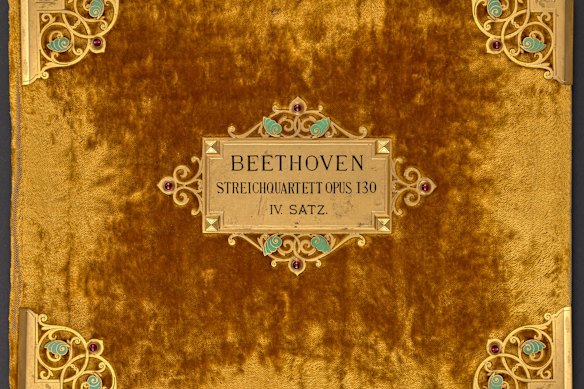
My great-grandfather wasn’t one of those collectors who squirrelled their treasures away from the public eye. In April 1893 he placed an announcement in Vienna’s Neue Freie Presse newspaper: “You may be interested to know that within the space of a year I have succeeded in purchasing a collection of very important manuscripts by Beethoven, some of which were already abroad and some of which were to be sold abroad … Although this collection is in my private possession, I am of course willing to allow any true art lover to view these manuscripts.”
He was proud of them and had special velvet covers made for each one so they could be shown to interested Viennese.
Ronge says Beethoven’s autographs could be scrupulously neat, as his early ones were,or distinctly messy – with scratchings-out, notes and ink blots and even holes in later years.
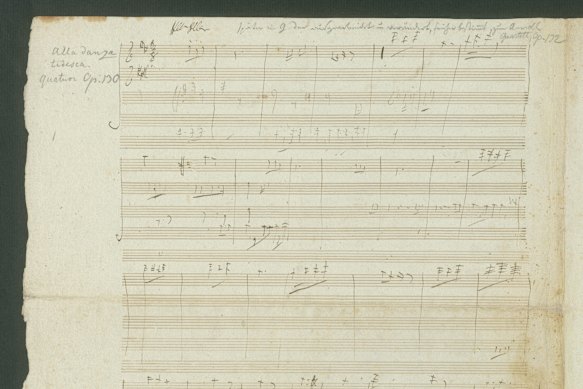
This was particularly true of the autograph of his Cello Sonata Opus 69, which my great-grandfather owned. According to Ronge, “the first page is very clear and neat, but as he wrote, Beethoven made so many changes that he was eventually forced to rewrite the work because this autograph was no longer usable”.
In 1904 Heinrich approached the Beethoven-Haus, wanting to sell his autographs for 35,000 marks. It’s something of a mystery why he decided to do so. A deal was eventually reached for the sale of only three autographs for 12,000 marks after a disagreement at board level about the use of funds. Two years later it bought the Coriolan Overture.
Subsequently, Heinrich started selling the rest. Two were sold to the Wittgenstein family in Vienna, which included the one-handed concert pianist Paul and his younger philosopher brother, Ludwig. Over the years the Beethoven-Haus got hold of nine of them. The 10th, the Alla Danza Tedesca, proved more tricky.
Heinrich sold or gave it to the Petschek family, who were based in the Bohemian city of Aussig (now Usti nad Labem in the Czech Republic). Like Heinrich, the Petscheks were Jewish and, as Ronge puts it, “a high-profile target” for the Nazis. They left Czechoslovakia in 1938 for the United States, with the Beethoven autograph to follow with the rest of their possessions. But their property was stopped at the border, confiscated, and the score sent to the Moravian Museum in Brno. It remained there after the war, and then the communist government refused to return it to the family.
That was the case until a new law allowed “restitution of Jewish property looted by the Nazis, even without current Czech citizenship”. At the end of 2024, Beethoven-Haus finally reunited the missing autograph with the other nine from my great-grandfather’s collection.
Heinrich died in December 1929. I have his picture propped up on my desk – one of those old-fashioned studio photographs printed on a card; he’s looking appropriately prosperous and content with life. History has made his life seem so distant and his world very different but now at least there is a new connection.
The Booklist is a weekly newsletter for book lovers from Jason Steger. Get it delivered every Friday.
Disclaimer : This story is auto aggregated by a computer programme and has not been created or edited by DOWNTHENEWS. Publisher: www.smh.com.au


