The days after Nowruz, the Persian New Year, are usually a bustling time in Tehran, with spring arriving, trees blossoming, businesses reopening after the holidays, and people returning to work and school.
This year, however, Iranians are trying to maintain a semblance of ordinary life against the constant backdrop of explosions, airstrikes – and a conflict many fear may drag on for weeks or months.
“More and more, people are starting to normalise this war,” said Farhad, a photography editor in Tehran. “It’s difficult, but we’re adapting and trying to return to our daily lives as much as possible. There’s no alternative. We’re tired. We just want peace.”
Explosions lit up the city’s skyline overnight on Wednesday as Israel launched fresh airstrikes, but by the morning, joggers were exercising again in the sprawling Pardisan Park. Schools and universities remain closed since the start of the war, but shops, restaurants and cafes are slowly reopening.
Aylar, a 39-year-old human rights worker who spent the first weeks of the war sheltering in her apartment with her cats, said that she had paid for an expensive VPN to try to circumvent the internet blackout imposed by Iranian authorities so she can talk to relatives abroad. “On the same day, I also went for coffee and chocolate cake with friends on what felt like a sunny spring day. These conflicting realities are bizarre,” she said.
Iran’s official death toll has frozen at around 1,500 for days, but the real figure may be more than 3,000, with many more injured, according to the Iranian Human Rights Activists News Agency, which has been tracking attacks and casualties across the country.
And while many Iranians have managed to stay in their homes away from attacks, others have found themselves dangerously close to the violence.
Azadeh, a 46-year-old researcher and cinematographer who returned to Iran after finishing her PhD in Turkey, said she was outside with her pregnant sister when a strike hit.
“It was just 200 metres from us. I held her tightly in my arms to protect her from shrapnel and in that moment, I felt so helpless,” she said from her home in Tehran. “Every time I hear the sound of an explosion, I feel fear. But I also feel such a responsibility towards my family, my sister and my elderly grandmother. I want to protect them from this war. Since the attack, I’ve lived in constant fear.”
With schools and universities still closed, many international students have chosen to leave Iran for the time being. “There’s been a huge exodus,” said Hasina, a 26-year-old Afghan medical student, who undertook a train and bus journey from Tehran back to Afghanistan to wait out the war.
“It was sad and scary to leave, and it was difficult to return to Taliban-controlled Afghanistan. At the border, many of us women got into trouble with the Taliban because we arrived without a male guardian. I hope to be back in Iran soon,” she said from Afghanistan’s western city of Herat, near the Iranian border, adding that being with her family there was for now still better than “hiding from bombs in Tehran.”
For many Iranians the future is uncertain. Some voiced concerns that without significant political change, the conflict could become a recurring reality. “We went through the 12-day war with Israel last year, and now we’re under attack again,” said Abbas, a 41-year-old man in Tehran. “I worry this could become a pattern.”
That uncertainty is further compounded by deep divisions within society, and Tehran remains polarised.
Most Iranians, regardless of their political affiliation, oppose the war, but some have welcomed it, seeing the violence as the best chance for the fall of the Islamic Republic.
In the hours after the death of Ayatollah Ali Khamenei was announced, some Tehranis climbed onto their roofs in spontaneous scenes of celebration, shouting “azadi” (freedom) into the night, while elsewhere, government supporters gathered in the streets to mourn, holding vigils and reciting prayers.
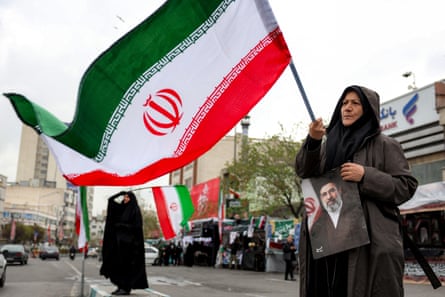
But as attacks across the country have intensified, pro-government supporters have gathered on streets and in public squares every evening, chanting “God is great, Khamenei is the leader” and “death to America, death to Israel”.
“Our society is divided. Some believe this war could lead to a free, democratic government backed by the US, while others dismiss this, pointing to the failures of the US across the region,” said Farhad. “At the same time, many are suffering and being killed. Why aren’t there anti-war protests in the US? It seems that nobody cares.”
Disclaimer : This story is auto aggregated by a computer programme and has not been created or edited by DOWNTHENEWS. Publisher: theguardian.com