

In her first interview since taking the reins, Netflix ANZ’s new content chief offers a few clues about what she’s looking for.
She hasn’t been in the job long – “three months and one week”, to be precise – but Amanda Duthie, the head of content at Netflix Australia and New Zealand, has been busy.
“We have literally been in hundreds of meetings with producers,” she says. “We wanted to open the doors and windows and say, ‘Come and talk to us about your projects, come and get to know us’, because people might know us together or separately, but they’ve never seen that whole team at Netflix, it’s a brand new thing. It’s a curiosity. And it’s been so pleasing that the opportunity to come and pitch to Netflix has been really, really welcomed by the sector.”
The “we” encompasses her second, content director Katherine Slattery, who was formerly at Matchbox Pictures, the production company that this week announced it was folding after 18 years and a string of hit shows (The Slap, Glitch, Hungry Ghosts, Safe Harbour and the recently released Dog Park among them).
Duthie doesn’t say it, but her invitation to the nation’s filmmakers to come and pitch their wares stands in stark contrast to the way the streamer was perceived under her predecessor, Que Minh Luu, who departed suddenly last April. Industry sources told this masthead last year that relations between the streamer and the production sector had become so strained that many filmmakers had simply decided there was no point in approaching Netflix Australia with their pitches.
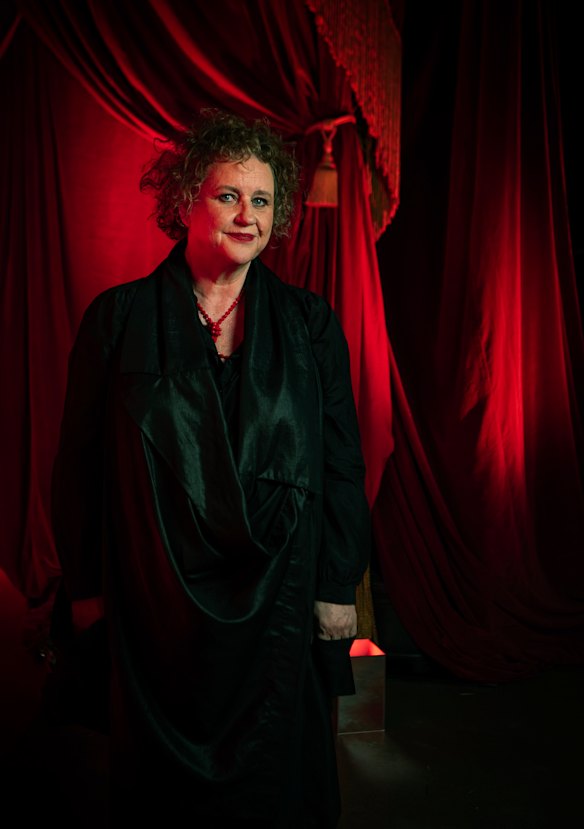
But at a slick showcase in Sydney on Tuesday before a few hundred key industry players, Duthie made her first public foray since leaving rival streamer Stan last August.
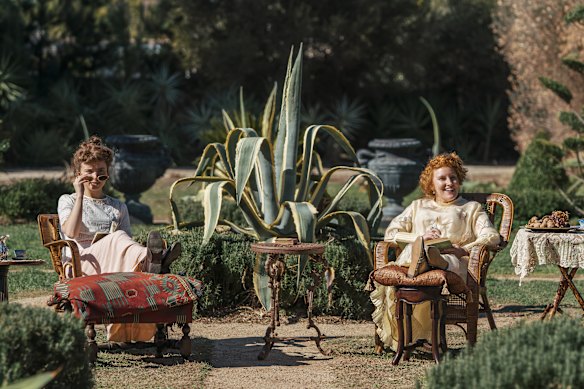
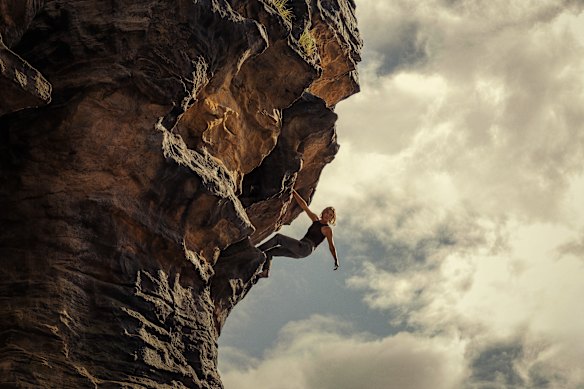
She presented a slate of Australian shows, along with some international productions made here, that will soon drop on the service. Among them: the third and final season of Heartbreak High (“At least until the sequel,” she joked, veering off script, much to the consternation of her minders); the series adaptation of My Brilliant Career; the high-octane action movies War Machine and Apex and surf drama Breakers; the animated Stranger Things spin-off Tales From ’85; the reality competition Wonka (set inside a Gold Coast set modelled on the famous fictional chocolate factory); and Allen, a live-action movie from Ludo, the Brisbane studio behind the world’s most streamed show last year, Bluey.
Duthie readily admits she can take no direct credit for this line-up, as it was all under way long before she arrived (though insiders say she has been very involved in the latter stages of at least some of it).
“We’re custodians of those new Netflix original shows, and they’re all exceptional,” she says. “It has been a privilege to take the baton and run with it.”
It’s clear, though, that she is itching to stamp her identity on Netflix’s local slate. As a former executive at the ABC and SBS, and head of Originals at Stan for five years, she’s used to calling the shots rather than riding shotgun.
She doesn’t know precisely when “we’ll come back out and announce what we’re cooking up for ’27”, she says, but she’s hoping it will be “at some point this year”.
Duthie comes to the job at an interesting juncture. Netflix has made an offer to buy Warner Bros, a massive deal that says much about the maturity of the streaming business (growth through acquisition of rivals rather than customers is now the strategy, it seems). And locally, quotas are now in place for the first time.
Under the Australian content obligation, all streaming services with more than 1 million subscribers will have to fund, produce and screen Australian content (free-to-air and cable broadcasters have long been bound by similar laws, but before January 1, streamers were exempt). The production sector had long argued for such obligations – similar to those in place in Canada and much of Europe – in the belief it would protect against boom-and-bust cycles, and in the hope it would provide a significant uptick in investment.
The jury is out on the latter, though. And with the ACMA having quietly extended the deadline for streamers – from March to the end of the year– to choose between a 10 per cent levy on revenue or a 7.5 per cent levy on expenditure (because the latter is so difficult to calculate), exactly how much money will be in the pot is still unclear.
As far as Duthie is concerned, though, “it’s business as usual” for Netflix. Whichever model the streamer ultimately chooses, insiders are convinced the company is already meeting its obligation, and then some.
And that means for the hundreds of producers who have already met with the new Netflix team, and all those still waiting for their turn, disappointment is very likely just around the corner. But for the lucky few, it could be the deal of a lifetime … literally.
“I have been aware of some projects for 20 years, and maybe only now they’ll come to light,” Duthie says. “That is not a dog whistle to something I’m about to announce, but what I’m saying is, you can track projects – whether it’s that book, or that play, or that conversation you had at a party 15 years ago. You recall those conversations, and you go, ‘Whatever happened to…?’”
Do you call those people?
“Sometimes, yeah.”
So, don’t give up hope yet, all you producers?
“Exactly, exactly. It’s a long game. Yeah.”
As for the sort of content she’s after, well, who knows.
“Every meeting is like unpacking a new present,” she says. “You don’t know what you’re going to find. Are you going to find an Apple Cider Vinegar, a Boy Swallows Universe, another Heartbreak High, another My Brilliant Career? You walk in with open hearts and minds, keen to hear what is that new thing that you’ve never even imagined. Someone tells you and you go, ‘Oh, yeah. Oh my god, that is it. That is amazing. Come on, let’s talk about it. That’s something’.”
Duthie won’t get to commission anywhere near as many shows at Netflix as she did at Stan. But because Netflix buys shows outright rather than looking for international co-financiers (as Stan, the ABC and most other broadcasters do), she’s convinced she’s in a position to make the most purely Australian shows of her career.
“When you’re looking at that international financing model, you [have to ask] do you need an English uncle [in the show, to make it palatable to an English broadcaster], do you need a French cousin, what are those things that might be required, on screen and off, to facilitate a locked-in international finance plan?
“The privilege, the honour, the complete and utter joy of working at Netflix is you don’t have to worry about that. It’s liberating because we don’t have to wait for validation from the international market. [We can say] ‘This is what Australians have always wanted’.”
But surely Netflix is looking for shows that will travel internationally?
“Our brief is pretty clear,” she says. “It’s drenched in that desire and that need to find stories that are local, that are going to resonate for local audiences.
“If the global glow comes, that is great,” she says. “But it’s local audiences first.”
Find out the next TV, streaming series and movies to add to your must-sees. Get The Watchlist delivered every Thursday.
Disclaimer : This story is auto aggregated by a computer programme and has not been created or edited by DOWNTHENEWS. Publisher: www.smh.com.au




