
The UAE has had to defend against a barrage of attacks from Iran, and not only on Dubai. Why? And what are the United Arab Emirates anyway?
Peppered with luxury resorts, glitzy malls and manicured beaches kissed by waves the temperature of bathwater, Dubai has spent decades building its reputation as the ultimate fantastical east-west stopover. Whisked in air-conditioned taxis to their air-conditioned hotels, visitors might vaguely have a sense that the region is sandy, blisteringly hot and on the global map somewhere between here and there in the exotic liminal zone known as the Middle East, but they won’t otherwise gather much else.
“Every time I travel to the region, I’m amazed how artificial everything looks,” says Shahram Akbarzadeh, a professor of Middle East and Central Asian politics at Deakin University. “It’s like a spaceship has landed in the middle of a desert. Everything is in sharp contrast to the landscape. It’s a transplant of a different civilisation and different lifestyle into a hostile environment.”
Indeed, many visitors, until now, are unlikely to have given much thought to Dubai’s actual location, insofar as it is a little over 200 kilometres, as the crow flies, from the shores of its northern neighbour, Iran.
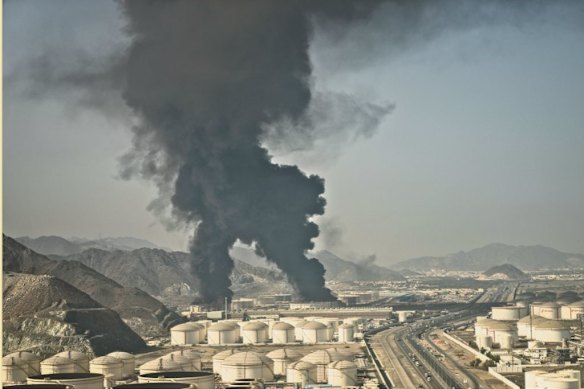
Since February 28, though, Dubai – along with Abu Dhabi and other places in the United Arab Emirates, or UAE – has been the target of repeated Iranian missile and drone attacks. Tourism has stalled, children are home-schooled, office workers are working from home on Zoom. One minor positive for locals is that Dubai’s notoriously clogged Sheikh Zayed Road is running like a dream … if you dare to chance the drive.
Most of the attacks have been blocked by anti-missile systems. Still, it’s been enough for Iran to have killed eight people in the UAE, set fire to hotels, rained debris on civilians, slowed business at the port of Fujairah on the Gulf of Oman, paused air travel, halted sea traffic through the Strait of Hormuz and stranded tens of thousands of transiting tourists (albeit many in five-star hotels paid for by the UAE government).
During the three-week-old conflict, the other Gulf states (and nations further afield) have also been in Iran’s sights: Kuwait, Bahrain, Qatar, Saudi Arabia, even Oman. “This is one of the major strategic errors that Iran has made,” Akbarzadeh says. “It has united all the Gulf states against itself.”
What long-term damage is likely if the war drags on any longer? And where does the UAE, which has attracted the largest number of salvos from Iran, fit into the scheme of things?
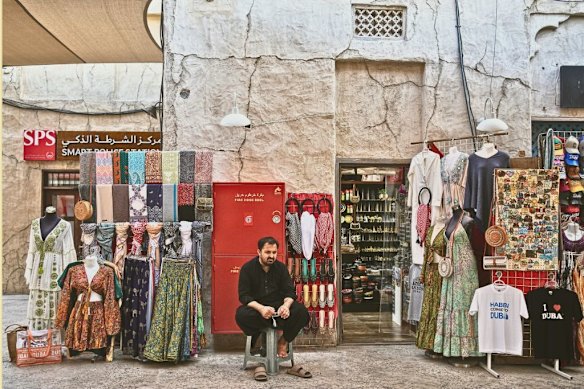
First, what makes up the UAE?
Many Australians are familiar with Dubai from first-hand experience (the water park! The braying camels!) or from its extensive marketing campaigns, especially those of its airline Emirates, based out of the sprawling Dubai International Airport, now one of the world’s most important logistics hubs. Nearby Abu Dhabi, home to luxe-rival Etihad airlines, might be less glitzy and less well-touristed, but it has carved an identity by attracting outposts of international cultural destinations, including branches of the Louvre and the Guggenheim museums, alongside a spot on the Formula 1 grand prix calendar and a Ferrari-branded theme park.
‘The Trucial States realised they needed a collective security arrangement because their small size meant they would be vulnerable to annexation.’
The five other emirates that make up the nation are still playing catch-up or forging their own paths. Sharjah, a short drive from Dubai city, feels like stepping back in time, with its souks, strings of dhows (traditional fishing and trading vessels) and ubiquitous rug shops (once lured inside with the offer of tea, it’s impossible to leave empty-handed). Alcohol is strictly prohibited here, which has proved something of a tourism roadblock.
Even sleepier is Ajman, the smallest of the emirates, slow-paced Umm Al Quwain and Fujairah, where there’s a tanker-refuelling hub and the end of an oil pipeline bypassing the Hormuz Strait which have been on Iran’s radar. Then there’s Ras Al Khaimah, a mountainous outpost that offers tourists a couple of plush hotels and is building a casino, aided by recent amendments to the civil code regarding gambling: a mini-Dubai in the making, perhaps.
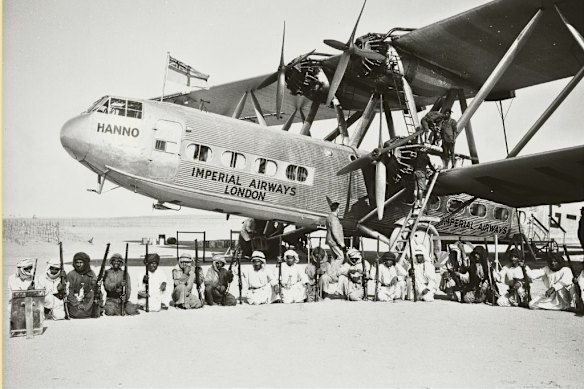
All seven emirates were once governed as tribal fiefdoms, their geographical boundaries blurry. In the early 1800s, they agreed to a treaty with Britain to combat piracy in the region; subsequent agreements, or truces, led this group of sheikdoms to be known as the Trucial States. For a while, they were loosely British “protectorates”, part of the western end of the “Raj”. When a skint Britain decided to vacate its Gulf interests, in the late 1960s, they agreed to stick together.
James Onley, the Ahmed Seddiqi Chair in Gulf Studies at the American University of Sharjah, says: “When, in 1968, Britain announced that it would be withdrawing its military forces east of Suez by 1971, the Trucial States realised they needed a collective security arrangement because their small size meant they would be vulnerable to annexation by their more powerful neighbours, especially Saudi Arabia and Iran.” (By now, the House of Saud, through various conquests and annexations, was entrenched as the ruler of Saudi Arabia.)
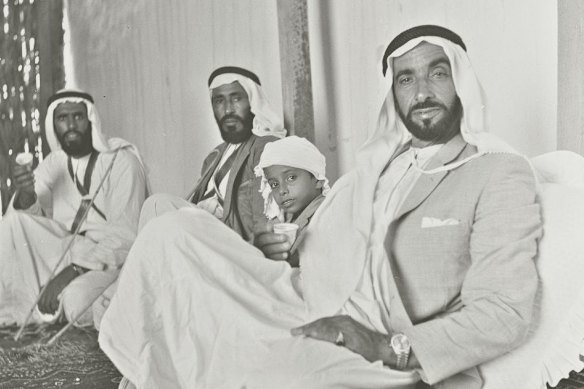
The ruler of Abu Dhabi, Sheikh Zayed bin Sultan Al Nahyan, met Sheikh Rashid bin Saeed Al Maktoum of Dubai in a tent strategically placed between their two sheikdoms to plan their alliances. In 1971, six sheikdoms signed up to form a modern federation and in 1972 Ras Al Khaimah joined the party. (Bahrain and Qatar to the north, also once British protectorates, were initially in the picture but decided to go it alone.)
The union, with the leader of Abu Dhabi as president (currently Sheikh Mohammed bin Zayed, or “MBZ”) and the leader of Dubai as his deputy, offered “collective security, international recognition and economic integration at a critical moment of uncertainty,” says Onley, “while allowing each ruling family to retain sovereignty over its territory, resources and internal governance. Smaller emirates, in particular, benefited from the protection and financial support of Abu Dhabi while the larger emirates of Abu Dhabi, Dubai and Sharjah gained stability and a framework for co-operation.”
The horse-trading from that time is evident: a jigsaw with 10 enclaves and exclaves, left over, says Kristian Ulrichsen, a much-published author on Middle Eastern affairs and a Fellow at Rice University’s Baker Institute for Public Policy, from the “mapping exercises undertaken by British officials who surveyed local landmarks and tribal leaders and sought to ascertain who owed loyalty to whom and drew the maps accordingly”.
Sharjah is the oddest, made up of several disconnected territories including, bizarrely, the village Nahwa that sits within a part of Oman called Madha, which itself is surrounded by Fujairah and Sharjah: an exclave within an exclave known as the Donut Ring, a tourist attraction in its own right (it boasts a hamburger restaurant and a waterfall).
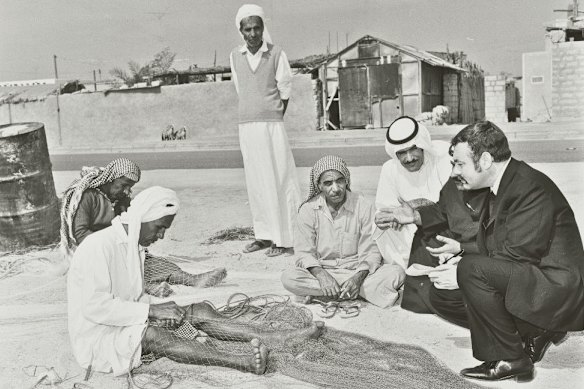
Abu Dhabi did not pave its first road until 1961, but the exploitation of its oil reserves, which were discovered in 1958, has made the UAE one of the world’s richest nations per capita. Abu Dhabi has several sovereign wealth funds with fingers in many pies, including ultimate ownership of Manchester City Football Club.
It has also propped up the other emirates, including Dubai, which is why the world’s tallest building, the Burj Khalifa, is named for MBZ’s older brother and predecessor, a switch from the original “Burj Dubai”, after Abu Dhabi bailed out its overstretched neighbour during the global financial crisis.
“In the 1990s and 2000s, Dubai did its own thing much of the time,” says Ulrichsen. “The impact of the financial crisis in 2008, and the subsequent package of financial assistance from Abu Dhabi to Dubai, curtailed Dubai’s autonomy.” As well as being a finance and maritime centre, Dubai offers investors near-tax-free opportunities in its many free trade zones.
Why has the UAE come under attack?
On February 28, attacked by the US and Israel, Iran struck back. Ostensibly, it was targeting US bases in Gulf states but it also damaged civilian buildings. Debris caused a fire at Dubai International Airport and there were fires at two luxury hotels. Iran has since said the US had launched strikes from “ports, docks and hideouts” in the UAE.
It appears most Iranian munitions were intercepted by anti-missile systems. In the first 10 days of the conflict, the UAE’s Ministry of Defence reported, just two of 238 missiles had reached their targets and 1342 of 1422 drones had been intercepted (80 slipped through). By March 19, it was reporting just its intercepts: a total of 1714 drones, 334 ballistic missiles and 15 cruise missiles.
The UAE is within relatively easy reach of Iran, with less than 100 kilometres of water separating their mainlands, and its global status makes it a symbolic trophy. But as with its neighbours, today’s troubles also seem to stem from its friendship with the United States, which has several military bases in the UAE, and some 3500 personnel stationed there, including on airfields that were used to strike Iran last year.
‘Dubai has been a lot more tolerant of Iran, especially because it has benefited the economy in Dubai.’
In June, after the US bombed its nuclear enrichment sites, Iran signalled a retaliatory attack on Qatar’s Al Udeid Airbase near Doha, which was promptly evacuated. “The June response was symbolic,” says Akbarzadeh, and the Gulf states “would have expected the current war to be a repeat of that kind of scenario where Iran calibrated its response against the US, despite its rhetoric of dragging everyone in. So they would have been surprised [this time]. But at the same time, this was on the cards. Iran has already said they would do this. The fact that it hadn’t in the past, I guess, was no guarantee that it wouldn’t drag everyone into the conflict.” He adds that Tehran, faced with US and Israeli talk of regime change, “felt that this was it, that this is the final battle, and if they lose this one, the whole regime could collapse”.
The UAE’s relationship with Iran has historically been “complex, ambivalent and often contradictory”, says Onley. Ownership of islands has raised tensions, for example: Iran seized the Greater and Lesser Tunbs from Ras Al Khaimah, and Abu Musa from Sharjah, in 1971. “This has remained a central territorial dispute between the two sides ever since,” he says.
There are basic cultural differences – Iran is Persian, not Arab, and it follows the Shiite branch of Islam while most believers in the UAE observe the Sunni form of the faith – but there has also been some $2.5 billion worth of trade per year between Iran and Dubai and an estimated 800,000 Iranians call the UAE home. “There is a large Iranian community that lives in Dubai,” says Akbarzadeh. “Dubai has been a lot more tolerant of Iran, especially because it has benefited the economy in Dubai.” Onley notes: “Long before the formation of the UAE in 1971, the emirates – especially Dubai and Sharjah – maintained close commercial, cultural and migratory ties with the Iranian coast, reflecting centuries of interaction across the Gulf.”
The current onslaught is not confined to the UAE. Qatar’s Ras Laffan LNG production facility was badly damaged this week when Iran stepped up its attacks after Israel struck its South Pars gas field. Also not spared in recent weeks: Qatars’ Al Udeid Airbase (again); homes and infrastructure in Bahrain, which hosts the US Navy’s Fifth Fleet; Kuwait refineries and the Ali Al Salem Airbase; refineries and other sites in Saudi Arabia. In Oman, two foreign nationals died after a drone was downed in an industrial area. Water supplies have not been off limits, either, in a region that relies heavily on desalination plants.
Meanwhile, the UAE is having to defend itself while reassuring the outside world that business as usual – hugely reliant on expat workers, transient Asian labourers, sun-seeking tourists and those itinerant influencers – can somehow endure.
What’s next?
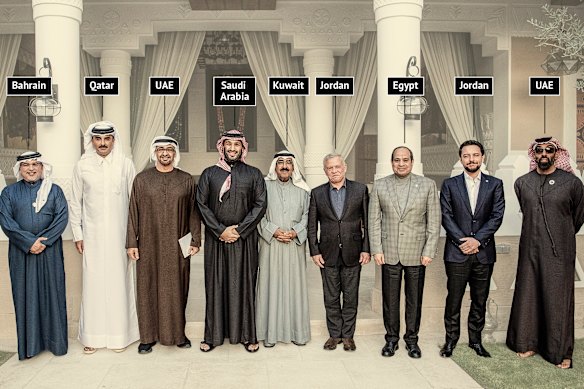
As with Qatar, which has long played regional peacemaker (offering asylum to supporters of the Muslim Brotherhood, Syrian rebels and the Taliban), the UAE has sought to massage neighbourly relationships, religious and historical grievances notwithstanding. “Over time, the relationship [with Iran] has oscillated between periods of tension and cautious engagement,” says Onley. “Abu Dhabi has often taken a more security-focused and wary stance toward Iran, while Dubai has prioritised trade and connectivity, producing a dual-track policy within the federation. Since the 2010s, the UAE has increasingly pursued de-escalation and pragmatic diplomacy, seeking to balance its security concerns with the need to avoid confrontation and maintain economic ties. Overall, the relationship has been characterised less by stable alignment or outright hostility than by a persistent effort to manage coexistence across a narrow but strategically vital maritime divide.”
‘There are questions being asked about the extent to which the [Gulf] relies on the US for its defence, whether there needs to be more investment in national defence mechanisms and institutions.’
Iran’s attacks have consequently seemed “almost unhinged”, said UAE minister for International Co-operation Reem Al Hashimy earlier this month. “We’ve borne the brunt of most of the missiles and drone attacks, and it’s really quite surprising for us that Iran has taken such an irrational path to fight the Gulf states and act in this quite unlawful, quite unacceptable manner,” she said.
Behind the scenes, says Akbarzadeh, “Everyone in the GCC [Gulf Co-operation Council] is very annoyed with how this has turned out. They had already warned Trump that this was the wrong thing to do and it’s dangerous, and Trump did not listen.” The US President this week said he was “shocked” that Iran had gone after other countries in the region, later reiterating, “Nobody, nobody, no, no, no. The greatest experts, nobody thought they were going to hit.” (Reuters, citing a US official and two sources familiar with US intelligence, reported that Trump was briefed this was a potential outcome.) Meanwhile, Trump has said he is considering winding down military efforts as the US gets “very close” to meetings its objectives, although he is also seeking $284 billion from Congress to fund the war and is sending in more troops and warships.
Longer term, what changes might the UAE and its neighbours make? Even though the US bases in their territories have made them targets, Akbarzadeh says the Gulf states are not about to “kick the US assets out”. “But there are questions being asked about the extent to which the GCC relies on the US for its defence, whether there needs to be more investment in national defence mechanisms and institutions … In other words, you’re talking about greater militarisation of the region.” (For its part, the Saudis have signalled that their patience may be running out. “We will not shy away from protecting our country and our economic resources,” Prince Faisal bin Farhan said on Thursday. “Do they have a day, two, a week? I’m not going to telegraph that.“)
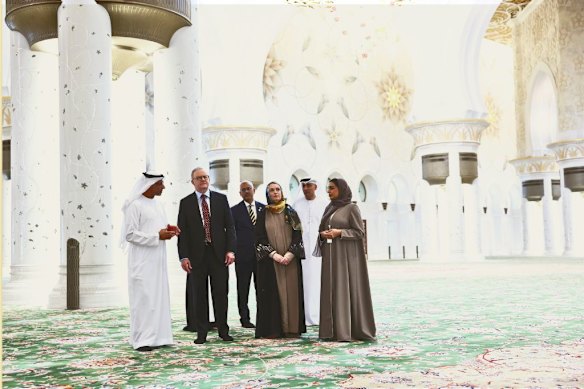
Australia, meanwhile, has now contributed a surveillance plane, 85 personnel and medium-range air-to-air missiles to bolster the UAE’s defences. “Helping Australians means also helping the UAE and other Gulf nations to defend themselves,” Prime Minister Anthony Albanese said in a joint statement. There are usually more than 20,000 Australians based in the UAE, which Albanese visited last September to finalise a trade deal and to mark 50 years of diplomatic relations between the two nations.
For now, the danger level for those within the UAE remains uncertain. Local social media “influencers” have said how safe they feel (the UAE offers “content creators” special visas and low tax rates, but with fine print about what they can and cannot post; certainly, nothing negative about Dubai is permitted). While people in Dubai celebrated the end of Ramadan, explosions were reported as air defences intercepted incoming fire.
MBZ made a rare public appearance at the Dubai Mall on March 2, alongside Defence Minister Hamdan bin Mohammed Al Maktoum, to shore up sentiment. “The UAE places its security and the protection of all citizens, residents and visitors at the very top of its priorities,” he said. “With God’s grace, the UAE is fully prepared to confront these threats.” Hardly Winston Churchill during the Blitz, but you get the idea.
The bottom line, says Kristian Ulrichsen, is that “the longer the war goes on the more damage it may do to the UAE’s international image, which has been predicated so heavily on its aspirational and lifestyle appeal and the notion that the UAE is a safe place to live, work and do business – being in the Middle East but not connected to stereotyped visions of the region as a hotbed of violence and instability.”
Get fascinating insights and explanations on the world’s most perplexing topics. Sign up for our weekly Explainer newsletter.
Disclaimer : This story is auto aggregated by a computer programme and has not been created or edited by DOWNTHENEWS. Publisher: www.smh.com.au




