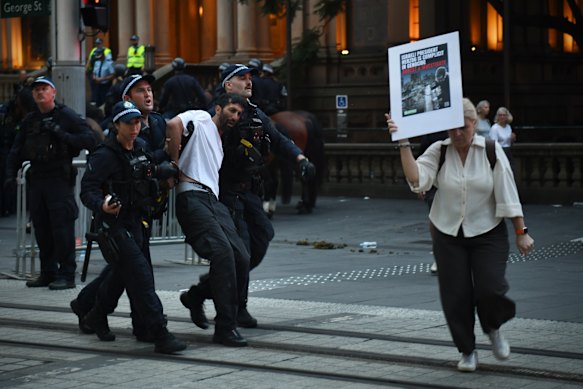
When my daughter returned home this week, shaken and distressed from the protest against the visit of Israel’s President Isaac Herzog, she described a kind of fear she had never experienced as someone born and raised in Australia.
She spoke of police advancing in lines, people trying to move away or standing still, then being pushed to the ground. She described individuals already pinned beneath several officers being struck. People peacefully praying were thrown to the ground. She described panic, confusion and disbelief.
What troubled her most was the certainty that the public narrative would suggest police “had no choice”. They did.
I say this with respect for policing and with decades of experience working alongside police in community engagement. I previously served on the NSW police commissioner’s advisory committee on diversity policing. I have seen the care many officers take to build trust with communities, and the commitment within the force to public safety and social cohesion.
The shocking outcome of Monday night’s protests should not be viewed as a straightforward story about rogue police. It is a far more complicated story about the dangerous political direction we seem to be turning towards.
Since the conflict in Gaza escalated, police and protesters have largely worked co-operatively. Protests have been frequent, organised and overwhelmingly peaceful. That pattern changed with the decision to restrict this protest – a decision that some groups have argued was a misuse of legislation.
Instead of allowing people to remain in place and disperse naturally over time – a long-established approach in protest policing – officers were instructed to move crowds on. The result was predictable and avoidable: confrontation, distress and footage that looks more like US-style crowd suppression than Australian policing by the consent of the people, which is foundational to a healthy democracy.
The NSW government has argued these restrictions were necessary for public safety, particularly given heightened tensions following the terrorist attack at Bondi Beach. Safety matters. But safety cannot be defined so narrowly that it overrides fundamental democratic rights, nor so selectively that it applies only to some forms of speech and not others.
Restricting peaceful protest does not reduce risk; it often increases it. When people feel unheard or corralled, tensions rise. When police are tasked with enforcing blunt political mandates, the likelihood of confrontation grows. That is not a failure of policing – it is a failure of policy.
The events of that night did not make people like my daughter safer. They traumatised them. People were arrested not for violence but for not moving quickly enough. Others were rushed while standing still. Witnesses were traumatised not only by what happened to them, but by what they saw happen to others. Greens MP Abigail Boyd ended the night in a neck brace.
This is not incidental damage. It goes to the heart of democratic practice.
Peaceful protest is not a discretionary privilege. It is a democratic right. Curtailing it because it is politically uncomfortable, or because it is conflated with something it is not, sets a dangerous precedent.
Opposition to the actions of the Israeli government is not, in itself, antisemitism. Treating it as such not only undermines legitimate protest, it weakens the fight against genuine antisemitism. There are strong, evidence-based grounds for this protest, including findings and warnings from international legal and humanitarian bodies regarding war crimes and genocide. Disagreement with those findings does not negate the right to protest about them.
From my time working with police, I know how many mechanisms exist for engagement, liaison and de-escalation. Police understand these tools well. But when political decisions override negotiated policing, officers are placed in an impossible position. They will enforce the order – but the social cost is high.
My daughter asked me why this was allowed to happen. I did not have a simple answer. What I do know is that social cohesion does not fracture because people protest. It fractures when people feel punished for participating in democratic life.
Moments of heightened tension should prompt us to reaffirm democratic values, not retreat from them. A terrorist attack should strengthen our commitment to civil liberties and collective responsibility, not justify their suppression.
Violet Roumeliotis is chief executive of Settlement Services International, a community-based organisation that works to overcome inequality. She has previously served on the NSW police commissioner’s advisory committee on diversity policing.
Get a weekly wrap of views that will challenge, champion and inform your own. Sign up for our Opinion newsletter.
From our partners
Disclaimer : This story is auto aggregated by a computer programme and has not been created or edited by DOWNTHENEWS. Publisher: www.smh.com.au