TOKYO, Feb 07 (News On Japan) –
A prolonged spell of dry weather has led to water shortages and even a “red river” in parts of Japan, with farmers and public facilities sounding alarms as reservoirs shrink and temperatures climb in the Kanto region.
[embedded content]
In Tokyo, a dry weather advisory has been issued for 17 consecutive days as the unusually rainless conditions—described as a once-in-30-years level of low rainfall—continue to spread their impact across multiple regions.
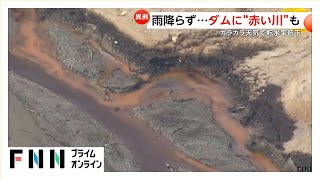
Footage taken from the air on the 5th showed Takihata Dam in Kawachinagano, Osaka, with its storage rate at around 20%, exposing bare rock surfaces and widespread cracking. Nearby waters appeared reddish and muddy.
According to the dam’s management office, the discoloration is caused by iron bacteria that thrive in hot spring or groundwater environments, with the effects becoming more visible due to the drought. While there are currently no water restrictions affecting daily life in the area, the situation underscores the strain on reservoirs.
In Aichi Prefecture, however, agriculture and daily life are already being affected. At Uren Dam, the storage rate stood at just 5.5% as of the 4th, highlighting the severity of the shortage. Farmers in Toyokawa said onions have struggled to take root due to the lack of water, making them easy to pull from the soil and raising concerns they may not grow properly.
Onoda Yasuhiro, head of Momopapa’s Vegetable Farm, said: “Even when we water the crops, we’re being told to conserve, so it’s very difficult. We’d like to see rain at least once a week.”
In Gamagori City, where water-saving measures have been strengthened, a public bath facility has been temporarily closed since late January. Bathwater has been drained and filtration equipment switched off. Hosokawa Mizuki, manager of Yutorina Gamagori, said: “For many customers, taking a bath is part of daily life, so we’ve heard a lot of comments like, ‘This is troubling’ and ‘What should we do?’”
A welfare center for the elderly in the city is also set to suspend use of its bathing facilities starting next week, with no clear timeline for resolving the water shortage as the impact spreads.
Meanwhile, the Kanto region saw springlike warmth, with temperatures in central Tokyo rising to a daytime high of 13.8 degrees. In Yokohama, long lines formed at the Red Brick Warehouse, where visitors wearing strawberry-themed berets gathered for an event celebrating peak strawberry season. On the first day, the first 300 visitors received free strawberries, while others enjoyed strawberry-laden parfaits and crepes. With temperatures reaching 12 degrees, the strawberry festival drew large crowds.
In Matsuda Town in western Kanagawa, early-blooming Kawazu cherry blossoms have begun to color local parks, prompting organizers to move the annual cherry blossom festival forward by a week due to the warm weather.
However, the warmer conditions have also created problems. At Fukuroda Falls in Ibaraki, ice formations that had been about 80% frozen just two to three days earlier began melting due to the recent warmth.
Although many areas are experiencing early springlike conditions, the weather is expected to shift sharply over the weekend as a powerful cold air mass moves in, bringing a return to midwinter cold across the country. Heavy snowfall is forecast over a wide area along the Sea of Japan coast, with a risk of rapidly increasing snow accumulation.
Snow is also possible in Tokyo over the weekend, with up to 5 centimeters forecast for some southern Kanto plains. With voting and ballot counting for the Lower House election set for the 8th, authorities are urging caution over icy roads and potential disruptions to transportation.
Source: FNN
[embedded content]
Disclaimer : This story is auto aggregated by a computer programme and has not been created or edited by DOWNTHENEWS. Publisher: newsonjapan.com