“Amadeus,” Peter Shaffer’s 1979 runaway hit drama, has one foot in the Vienna of Mozart and another foot in whatever period the production is taking place in. The play, a sumptuous historical pastiche, is both an invitation and a daunting challenge to theater makers.
Darko Tresnjak, the Tony winning-director (“A Gentleman’s Guide to Love and Murder”) with a glittering opera resume (including “The Ghosts of Versailles” at LA Opera), is unusually well-equipped to take on the assignment. And Jefferson Mays, the Tony-winning actor (“I Am My Own Wife”) and a prized collaborator of Tresnjak’s, was born to take on the role of Antonio Salieri, the music bureaucrat whose overweening ambition to join the pantheon of great composers leads to some diabolical machinations.
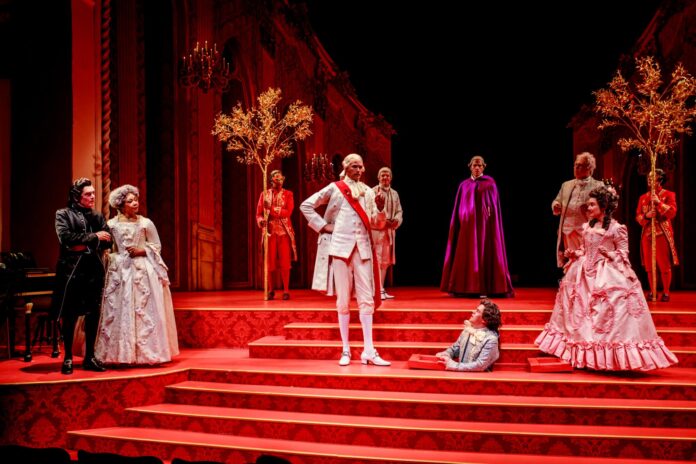
No surprise, then, that the revival of “Amadeus” that opened Sunday at Pasadena Playhouse is a marvel to behold. Contained within Alexander Dodge’s lush red set, Tresnjak’s production moves between the rococo grandeur of Emperor Joseph II’s court and a kind of interior hellscape, where Salieri, the play’s guide and scheming rival of Wolfgang Amadeus Mozart, can recall the mischief he wrought against the young upstart perversely blessed with a divine spark of genius.
“Amadeus” offers a twist on the Faust legend. As a young man, Salieri prayed to an image of God in his Northern Italian town, pledging that, if he were to become a composer of sufficient fame, he would repay this gift not only through his music but through living a life of virtue. This wish is granted, but Salieri reneges on his end of the deal after losing faith in the Almighty.
AMADEUS at Pasadena Playhouse – Ensemble
(Jeff Lorch)
Worldly success, he comes to see, is no sign of genuine distinction. As court composer and music gatekeeper, Salieri has power and position. But he knows that he’ll never have that natural brilliance that radiates from Mozart’s compositions like a heavenly light. He is a mediocrity while the jejune young man running riot in the palace is a miraculous, world-changing prodigy.
Shaffer, whose plays include “Equus,” “The Royal Hunt of the Sun” and “Black Comedy,” is drawn to existential reckonings, and in “Amadeus” he’s written his cris de coeur on the immorality of the universe. The hard fact is that genius isn’t reserved for the worthy any more than misfortune is reserved for the wicked.
After ruining Mozart’s prospects at court, Salieri is stunned to learn that he’s been promoted to kapellmeister. He can’t shake his Catholic upbringing, but what’s the point of being a martyr when Machiavels are rewarded?
For all the play’s prolific acclaim, “Amadeus” has had a conspicuous second act problem. Shaffer kept revising the play, even after the avalanche of accolades for the London and New York premieres. Miloš Forman’s 1984 film version was lavished with Oscars, further cementing the work’s place in public consciousness. But like Salieri, Shaffer was all too aware that popularity isn’t the same thing as greatness.
He kept reworking the confrontation scene between Salieri and Mozart, the play’s climactic moment in which irony once again gets the better of tragic recognition. As an impoverished and ailing Mozart struggles to complete his “Requiem” before his death at the age of 35, Salieri is torn between his fidelity to music and his loyalty to his own career. He is one of the few people of his age equipped to recognize the scale of Mozart’s achievement, but the fragility of his ego and his obsession with music immortality stand in his way.

AMADEUS at Pasadena Playhouse – Sam Clemmett and Lauren Worsham
(Jeff Lorch)
In the preface to the updated Samuel French edition of the play, Peter Hall, who directed the work’s original London and New York productions, recalls his 1998-99 revival and the important role Los Angeles played in the script’s evolution. “We opened at the Old Vic in London in 1998,” he writes. “We then came to the Ahmanson Theatre in October 1999 to begin our pre-Broadway tour. There should be a plaque on the wall of that theatre — ‘Amadeus was finished here October 1999 after twenty years of work ’ — because the text-work continued there and was (I think) finally concluded.”
The general thrust of the changes were to de-melodramatize Salieri’s action and to focus more attention on his guilt and metaphysical torment. Shaffer succeeds in this regard, but the wordy play grows cumbersome in its final explanatory stages. And Salieri seems more of hybrid creature, as though a villain out of Christopher Marlowe had suddenly been endowed with Shakespearean self-awareness.
Mays’ portrayal — I can’t imagine anyone topping his interpretation of the character — is fiendishly complex. There’s not a layer that has gone unexcavated in a performance of extraordinary verbal facility and color. “Amadeus” relies heavy on monologues, and Mays is not only a crack ensemble player but also a master soloist. (His tour de force in “A Christmas Carol,” where he played dozens of characters, matched his virtuosity in Doug Wright’s “I Am My Own Wife.”)
The play begins at Salieri’s end, the scene of a dying man fanning suspicions over his role in Mozart’s death. Mays’ Salieri — bald, munching Italian cookies and foaming at the mouth when in the grip of seething resentment — has a story to tell, a detective tale in which the crime being investigated may not be the murder he’s touting but a spiritual offense that is even more agonizing to confess. An inveterate self-promoter, Salieri is determined to control how he’ll be remembered. And if he can’t beat Mozart at music, then he’ll happily accept a place in history as his assassin.

AMADEUS at Pasadena Playhouse – Jefferson Mays
(Jeff Lorch)
The play rewinds to the moment when Mozart (Sam Clemmett) enters the scene, whooping like a court jester and making scatological remarks like the “obscene child” that Salieri (now wearing a wig) compares him to. While the weary court composer is buried in the bureaucracy of state music, teaching scores of pupils, serving on endless committees and composing anthems and choral pieces, Mozart is dashing off works of startling originality while acting like a complete goofball.
Mays and Clemmett are well matched as antagonists, balancing the flamboyant flaws and stubborn humanity of their characters. Clemmett’s Mozart is a baby-faced libertine, an overgrown boy trying to climb up skirts. Mays’ Salieri is at once aghast at such loutish behavior and bitterly envious that Mozart is exceptional enough to get away with it.
Mozart, however, isn’t merely a puerile rascal, as his relationship with Lauren Worsham’s Constanze reveals. As their romance turns to marriage, reality sets in for them both. Their poverty, the fruit of Salieri’s malicious ploys, tests the limits of their endurance. Mozart’s genius isn’t so much unrecognized as unremunerated. When Constanze reaches her breaking point, Mozart’s imbecility is exposed as fragility. He’s lost without her nurturing sensuality.
Tresnjak treats the play as though it were a tragedy wearing the mask of comedy. He doesn’t resist the melodrama that’s inherent in the material, but he refuses to overindulge it. This production hasn’t convinced me that “Amadeus” is a world classic. (The story slogs at points and the second act is overwritten.) But I doubt I’ll have the opportunity to see a better revival in my lifetime.

AMADEUS at Pasadena Playhouse – Sam Clemmett and Jefferson Mays
(Jeff Lorch)
The ensemble’s playful insouciance maintains the production’s buoyancy. Matthew Patrick Davis accentuates with a wink the callowness of Joseph II, an emperor who perhaps sees in Mozart a reflection of his own stunted nature. John Lavelle exudes a perfumed whiff of modern camp in his portrayal of Orsini-Rosenberg, the fussy, backstabbing director of the Imperial Opera.
The Venticelli, the chorus-like “purveyors of fact, rumor and gossip throughout the play,” according to Shaffer, are played by Jennifer Chang and Hilary Ward with timeless vibrancy. Sopranos Michelle Allie Drever and Alaysha Fox give us a sample of Mozart’s operatic preeminence. (The highlight is “Soave sia il vento,” a gorgeous trio from “Così fan tutte” that’s performed here with Jared Andrew Bybee.)
But it’s on a visual level that the production is at its most entrancing. Linda Cho’s costumes, built from scratch by L.A. Opera’s costume shop, summon the spectacular opulence of this music-obsessed Viennese world. Will Vicari’s wig and makeup design complete the extravagantly artificial fashion of the period. Pablo Santiago’s lighting and Aaron Rhyne’s projections lend the production a dreamlike fluidity, ideal for a play that emanates as much from Salieri’s memory as from his unconscious.
All would be lost, however, without Mays’ quicksilver brilliance — the way he can shift from savage irony to vindictive rage to godless despair in the space of a line. Salieri may be a mediocrity, destined to be a footnote in the short yet indelible life of Mozart. But in the coterie world of theater connoisseurs, Mays has earned a place among acting immortals.
‘Amadeus’
Where: Pasadena Playhouse, 39 S. El Molino Ave., Pasadena
When: 8 p.m. Tuesdays, Wednesdays, Fridays. 7 p.m. Thursdays, 2 and 8 p.m. Saturdays, 2 and 7:30 p.m. Sundays. Ends March 15
Tickets: Start at $53
Contact: (626) 356-7529 or pasadenaplayhouse.org
Running time: 2 hours, 40 minutes (including one 15-minute intermission)
More to Read
Disclaimer : This story is auto aggregated by a computer programme and has not been created or edited by DOWNTHENEWS. Publisher: latimes.com